

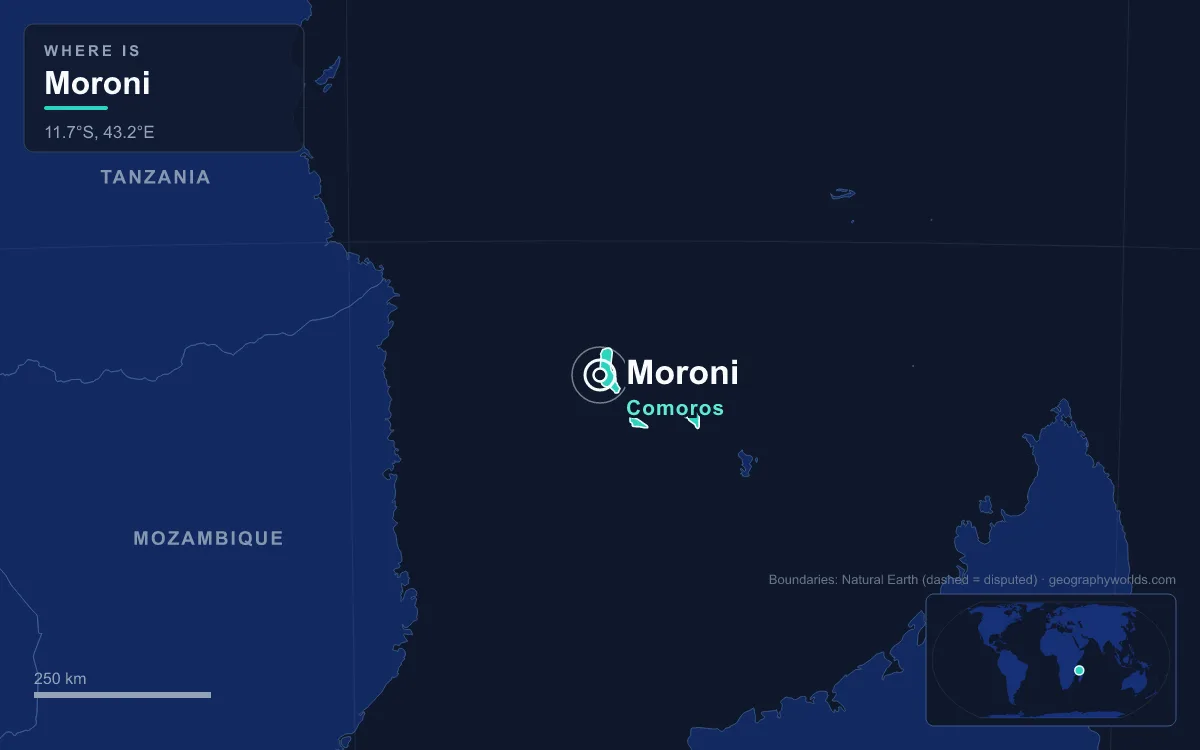
The capital of the Comoros is Moroni, a port on the west coast of Ngazidja (Grande Comore), the largest island of the archipelago that lies at the northern end of the Mozambique Channel between Mozambique and Madagascar. It is the country's largest city and seat of government, though a small one: about 54,000 people lived in the city in 2011, and wider estimates that take in its suburbs run past 100,000. Its name means "at the river" in Shingazidja. What sets it apart is its setting, an old Swahili stone town squeezed onto black volcanic rock at the foot of Mount Karthala, a very active volcano that has erupted more than 20 times since the nineteenth century. The best way to understand it is on foot, starting at the water.
The Old Harbour and the Friday Mosque of 1427
Every walk through Moroni begins at the little harbour, where small wooden and fibreglass boats tie up inside a stone sea wall. The coastline here is rocky and volcanic, with almost no beaches, and the white building that dominates the waterfront is the Badjanani Mosque, also called the Ancienne Mosquée du Vendredi, the old Friday mosque. It was built in 1427, and its tall minaret was added in 1921. It is the oldest mosque in the medina, and it is proof that Moroni was already a wealthy trading town by the fifteenth century, when Swahili ports along the East African coast were at their height.
The harbour explains why the city never grew into a major port. Its quay is only about 80 metres long with a draught of 3.5 metres, and coral reefs make it unsafe for large ships to come alongside, so bigger vessels anchor offshore and cargo is ferried in. Boats still run from here to Anjouan, Mohéli, Madagascar and the African mainland. A container terminal in the harbour's small industrial zone was run by Gulfcom Port Management from 2006 until 2012, when Bolloré Africa Logistics won the concession. Vanilla, essential oils and processed pozzolana cement leave through this same modest quay.
Inside the Medina's Narrow Stone Alleys
Step back from the mosque and you are in the medina, a maze of narrow alleys and old stone buildings. It resembles the old town of Lamu on the Kenyan coast, on a smaller scale. For decades it was poorly maintained, but in 2026 UNESCO inscribed it as a World Heritage Site as part of the Medinas of the Historical Sultanates of the Comoros, together with the old towns of Ntsoudjini, Itsandra and Ikoni on the same island and Mutsamudu and Domoni on Anjouan.

The alleys carry the town's early history. Ceramic finds from the seventh to tenth centuries show the islands were part of the emerging Swahili world, settled by Bantu-speaking farmers, Austronesian seafarers and Arab traders, but nobody knows when Moroni itself was founded. By the middle of the second millennium it was one of two centres of power in the sultanate of Bambao, sharing that role with the royal town of Ikoni to the south. Grande Comore was then divided among several rival sultanates, and Moroni was only one large town among many. Religious life remains central: about 98% of residents are Sunni Muslims, and the medina alone holds many mosques besides Badjanani.
The Government Quarter: How Dzaoudzi Lost the Capital in 1958
Walk inland from the medina and the lanes widen into the administrative town that made Moroni a capital. The turning point was 1886, when Sultan Said Ali of Bambao signed a protectorate treaty with France in exchange for French backing of his claim to rule all of Grande Comore. His town became the seat of colonial administration on the island. That did not make it the capital of the archipelago: the territorial government sat at Dzaoudzi on Mayotte, which France had held since 1841, and in 1958 Moroni still had only 6,545 inhabitants. That same year the decision was taken to move the capital from Dzaoudzi to Moroni, and the town slowly became the largest in the islands.
Independence came on 6 July 1975, when the Comorian parliament declared it unilaterally and Ahmed Abdallah became the first president. Mayotte had voted to stay with France in the December 1974 referendum and remains a French department, a status the Comoros still disputes: the Comoros claims the island, with backing from the African Union and a series of UN General Assembly resolutions, while France administers it and Mayotte's voters have repeatedly chosen to remain French. The years that followed made Moroni a byword for coups. The mercenary Bob Denard returned in 1978 to restore Abdallah, Abdallah was killed in 1989, and in April 1999 Colonel Azali Assoumani seized power in what was counted as the country's 18th coup or attempted coup since independence. In December 2003 the island presidents signed the Moroni Agreement on transitional arrangements for the new Union of the Comoros. Today the quarter holds the ministries, the Banque Centrale des Comores and the offices of the two national dailies, the state-owned Al-Watwan and the private La Gazette des Comores. For evenings there is the 500-seat Palais du Peuple, the 700-seat Al-Kamar and the 300-seat theatre of the Alliance Franco-Comorienne.
North to Volo Volo Market
Head north through the city and the old market gives way to the larger market at Volo Volo in the north of the city. The goods produced around Moroni are a short list: vanilla, soft drinks, distilled essential oils such as ylang-ylang for the perfume trade, metal and wood products, and pozzolana cement. Tourism has never taken off, and the city has only a handful of hotels and nightclubs, so Volo Volo remains a market for residents rather than visitors. The city is home to many of the country's recent Chinese immigrants and to members of its small, mostly Ismaili Indian minority.
Along Route Nationale 1 to Itsandra and Hahaya
Moroni lies along Route Nationale 1, and following it north leads through a string of older towns that are now almost suburbs: Itsandra, Ntsoudjini, Ouellah, Bahani, Batsa, Vanambouani and Vanadjou. Itsandra was once one of the two major sultanates of the island, until it was absorbed in 1886 into a united sultanate of Ngazidja. Its medina, like Ntsoudjini's, is part of the 2026 UNESCO listing.
About 15 kilometres north of the city, beside the village of Hahaya, is Prince Said Ibrahim International Airport, with a single 2,900-metre runway. There are no direct flights to Europe; Ethiopian Airlines, Kenya Airways, Air Tanzania and Air Austral provide the long-haul links, while local carriers fly to Anjouan and Mohéli. The approach has a sad history. On 30 June 2009 Yemenia Flight 626 crashed into the sea on its final approach, killing 152 of the 153 people on board.
South to Ikoni, the Royal Rival
South of the centre the coastal road reaches Ikoni, and beyond it Mvouni, Daoueni and Séléa. Ikoni was the royal capital and port of Bambao, the other of the kingdom's two centres of power, yet it was Moroni that the Sultan of Bambao's 1886 treaty turned into the colonial seat. Ikoni's medina is also on the 2026 World Heritage list. The walk from Moroni to Ikoni follows the same black lava shoreline, a reminder that the whole island is geologically young: Ngazidja is the newest island of the archipelago, with thin, rocky soil and few good harbours.

Up the Slopes of Mount Karthala
The last leg of the walk goes uphill. Moroni sits about 10 kilometres northwest of the crater of Mount Karthala, a shield volcano that rises to 2,361 metres, the highest point in the Comoros. Eruptions have shaped a summit caldera about 3 by 4 kilometres across. The eruption that began on 17 April 2005 forced evacuations and destroyed the crater lake that had formed after the 1991 eruption; in May 2006 residents of Moroni could see lava at the summit. Karthala National Park, designated in 2010, protects 262 square kilometres of the mountain, where moist evergreen forest grows between about 1,200 and 1,800 metres. Four bird species live only on its slopes, among them the Karthala scops owl and the Karthala white-eye.
The mountain and the ocean together make Moroni very wet. The city has a tropical rainforest climate with about 2,700 millimetres of rain a year, and every month is wet: only October averages below 100 millimetres. The monsoon season is usually given as November to April, although the WMO averages show January as the wettest month and May to July still receiving around 250 millimetres each; cyclones are a recurring risk.
Temperatures barely move through the year, with daytime highs of roughly 28 to 31°C, so the less rainy months from August to November are the most comfortable for a climb, provided the volcano is quiet; our guide to the best time to visit the Comoros sets out the seasons in more detail. From the upper slopes the whole of the walk is visible at once: the medina and its mosque, the harbour wall, the villages strung along Route Nationale 1, and beyond them the open Indian Ocean. For the wider story of the three islands and the disputed fourth, see our Comoros country guide, or settle the common question of whether the Comoros belongs to Africa or Asia.
Quick Facts About Moroni
- Country: Comoros
- Continent: Africa (East Africa)
- Country population: approximately 899 thousand
- Capital city status: Moroni is the capital of Comoros, the seat of national government, and the location of foreign embassies, parliament, and the head of state's official residence.
Frequently Asked Questions
What is the capital of Comoros?
The capital of Comoros is Moroni. Moroni is the seat of national government, hosts most foreign embassies and consulates, and is typically where the head of state and parliament are located.
What continent is Moroni in?
Moroni, the capital of Comoros, is located in Africa, in the East Africa region. As Comoros's capital, Moroni serves as the country's primary connection to the broader African political, economic, and cultural sphere.
Why is Moroni the capital of Comoros?
Moroni was chosen as the capital of Comoros for reasons that typically combine geography, history, and politics. Capital city selections often reflect a desire for centrality (being accessible from across the country), historical importance (being a longstanding seat of government or culture), or neutrality (being acceptable to multiple regions or ethnic groups within the country). The specific reasons for Moroni's designation are detailed in the city's history above.
What is Moroni known for?
As the capital of Comoros, Moroni is best known for housing the country's central government institutions — parliament, presidential or royal residences, supreme court, and key ministries. It is also typically a major cultural and economic center within Comoros, hosting national museums, embassies, and signature monuments. The introduction and history sections above provide detailed coverage of the city's specific notable institutions and landmarks.
Related Pages
- Comoros Country Guide — full geography, climate, economy, and culture overview
- Flag of Comoros — meaning, history, and design of Comoros's national flag