
Perched on the easternmost tip of Africa, Somalia juts into the Indian Ocean like a giant fishhook, giving it the longest coastline on the entire continental mainland. It is a land of camel-herding poets, ancient frankincense groves, and a turbulent modern story that often overshadows its remarkable cultural depth. These ten facts go far beyond the headlines to reveal a country shaped by trade winds, oral artistry, and an unusually unified national identity.
1. It Has Africa's Longest Mainland Coastline
Somalia stretches roughly 3,300 kilometres along both the Gulf of Aden and the Indian Ocean, giving it the longest coastline of any country on the African mainland. This dramatic seaboard wraps around the "Horn of Africa," the pointed peninsula that gives the region its name. For thousands of years this coast made Somalia a natural crossroads, with traders sailing on the monsoon winds between Arabia, Persia, India and the East African shore. Ancient port towns such as Zeila and Mogadishu grew rich on this maritime traffic. Today the coast supports rich but underexploited fisheries, and you can read more about the nation's geography in our country guide.
2. The Land of Punt and Frankincense
Long before the modern era, the Somali coast was likely part of the legendary "Land of Punt," a trading partner the ancient Egyptians prized for gold, ebony, myrrh and frankincense. Northern Somalia, especially the rugged highlands of the self-declared region of Puntland (named after that very legend), still produces some of the world's finest frankincense and myrrh. These aromatic resins are tapped from gnarled Boswellia and Commiphora trees that cling to limestone cliffs. The trade is ancient, dangerous and largely done by hand, with harvesters scaling near-vertical rock faces to score the bark and collect the hardened "tears" of resin.
3. Mogadishu, the "White Pearl of the Indian Ocean"
The capital, Mogadishu, is one of the oldest continuously inhabited cities in the region, with a history stretching back well over a thousand years. Medieval Arab geographers described it as a thriving commercial hub, and its old quarter once dazzled visitors with coral-stone mosques and Italian colonial architecture, earning it the nickname the "White Pearl of the Indian Ocean." The 13th-century Fakr ad-Din Mosque is among its oldest surviving buildings. After decades of conflict, Mogadishu has seen a striking revival, with rebuilt streets, beachfront cafes along Lido Beach, and a returning diaspora investing in hotels and businesses.
4. A Nation of Poets
Somalia is often called a "nation of poets," and oral poetry is the beating heart of its culture. Before widespread literacy, poems carried news, settled disputes, courted lovers and rallied clans, and a gifted poet could wield enormous political influence. The most prestigious form, the gabay, follows strict rules of alliteration and meter that take years to master. The early 20th-century leader Sayyid Mohammed Abdullah Hassan was as feared for his verses as for his rifles. Even today, poetry contests draw huge audiences, and a memorable line can spread across the country faster than any newspaper headline.
5. Around 20 Million People, Most Speaking One Language
Somalia is home to roughly 20 million people, and unlike most African nations it is remarkably homogeneous. The overwhelming majority share the Somali language, Sunni Islam, and a sense of common ancestry, organised through a complex system of clans and sub-clans. The Somali language belongs to the Cushitic branch of the Afroasiatic family. Remarkably, Somali was only given an official standardised written script in 1972, when the government adopted a Latin-based alphabet, after long debates over whether to use Arabic, Latin or a uniquely Somali script. Arabic is also widely used, especially in religious contexts.
6. The Camel Is King
No animal is more central to Somali life than the camel. Somalia is believed to have one of the largest camel populations on Earth, and camels are far more than transport, they are wealth, status, dowry and a constant subject of poetry. Pastoralist families measure their fortune in herds, and camel milk is a daily staple, prized for being nourishing in the harsh, arid climate. Camels also feature heavily in traditional law, where compensation for disputes was historically counted in heads of livestock. The bond runs so deep that classical Somali poetry overflows with loving, detailed descriptions of prized camels.
7. A Cuisine Born of Many Worlds
Somali food is a delicious record of the country's trading history. Centuries of contact with Arab, Persian, Indian and Italian visitors left their mark on the kitchen. A signature dish is bariis iskukaris, fragrant rice spiced with cardamom, cumin and cloves, often served with goat or camel meat. From Italy came a surprising love of pasta, and baasto (spaghetti) is a common lunch. Almost every meal ends with a banana eaten alongside the savoury food, and is washed down with shaah, sweet spiced tea. Sweet fried xalwo (halva) is the centrepiece of celebrations and hospitality.
8. Two Stars and the Self-Declared Somaliland
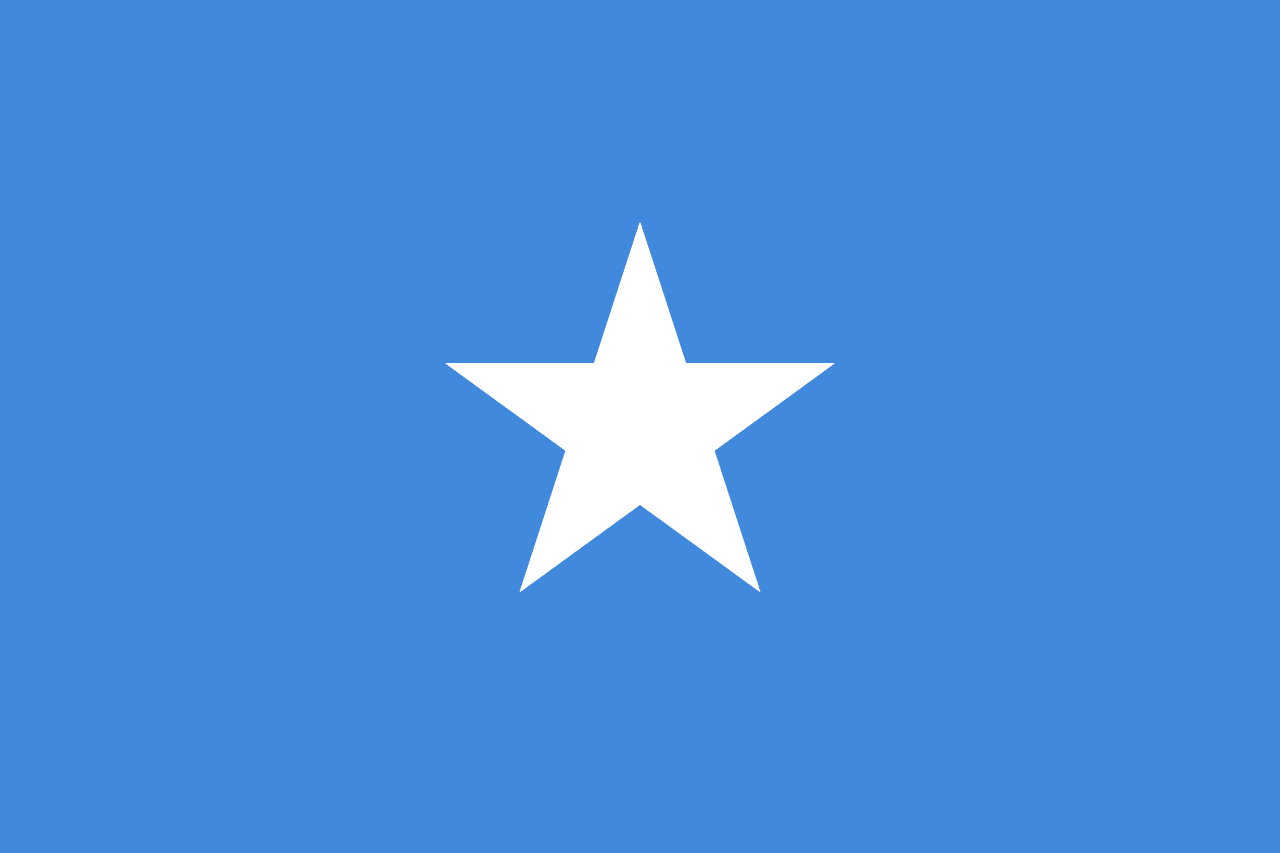
Somalia's history of unification is written into its flag, a light blue field with a single white five-pointed star. The five points were meant to represent the five regions where Somali people traditionally lived, a dream of a "Greater Somalia." That ideal remains unfulfilled. In 1991, the northwestern region declared independence as the Republic of Somaliland, complete with its own government, currency and passports. Though Somaliland has functioned with relative stability for over three decades, no country officially recognises it, making it one of the world's most enduring unrecognised states.
9. Landscapes from Cool Highlands to Hot Plains
Despite a reputation as a dry, dusty land, Somalia's terrain is more varied than many expect. The north is dominated by the rugged Cal Madow and Golis mountain ranges, where the highest peak, Shimbiris, rises above 2,400 metres and supports rare juniper forests and cooler air. Between the two main rivers, the Jubba and the Shabelle, lies the country's most fertile farmland, the only places where year-round flowing rivers exist. Elsewhere, vast semi-arid plains called the Haud and the Ogo plateau stretch toward the horizon, grazed by the camels and goats of nomadic herders.
10. Unique Wildlife on the Horn
The Horn of Africa is a global biodiversity hotspot, and Somalia hosts species found almost nowhere else. The most famous is the beira antelope, a tiny, big-eared gazelle adapted to stony hills, and the Somali wild ass, a critically endangered ancestor of the domestic donkey with striking zebra-like stripes on its legs. The Speke's gazelle, with its odd inflatable nose sac, is another Somali endemic. The coral reefs off the coast and the isolated cliffs of the north shelter rare birds and plants, including the famous frankincense trees, making this corner of Africa a quiet treasure for naturalists.
Frequently Asked Questions
What is the capital of Somalia?
The capital of Somalia is Mogadishu, a historic port city on the Indian Ocean coast. It is the country's largest city, its centre of government and commerce, and one of the oldest continuously inhabited urban settlements in East Africa.
What is Somalia famous for?
Somalia is famous for having Africa's longest mainland coastline, its rich tradition of oral poetry, its enormous camel population, and its production of frankincense and myrrh. It is also the cultural homeland of a large, globe-spanning Somali diaspora.
Why does the Somali flag have a single star?
The five points of the white star on Somalia's blue flag symbolise the five regions historically inhabited by Somali people, reflecting the unfulfilled dream of uniting them all into one "Greater Somalia." The blue field was originally inspired by the United Nations flag.
Conclusion
Somalia is a country whose ancient seafaring trade, poetic soul and resilient people deserve to be known for far more than recent turmoil. From frankincense cliffs to spiced rice dinners and beloved camels, it offers a story as rich as any on the continent. These ten facts are only an invitation to keep exploring this fascinating corner of the Horn of Africa.