

China produces the most renewable energy of any country, generating about 3,913 terawatt-hours (TWh) of renewable electricity in 2025, far ahead of the United States at about 1,159 TWh and Brazil at about 650 TWh, according to the energy think tank Ember’s yearly electricity data. Measured by share rather than volume, the leaders are much smaller countries: Iceland, Paraguay, Costa Rica, Bhutan, Ethiopia and the Democratic Republic of the Congo all generate essentially all of their electricity from renewable sources. This guide reads the ranking continent by continent.
The figures count electricity only, from hydropower, wind, solar, bioenergy and geothermal plants. They leave out renewable heat and transport fuels, which is why a country such as Iceland, which heats most of its homes with geothermal water, looks no better here than a country that burns gas for heat. Worldwide, renewables generated 10,715 TWh in 2025, or 33.8% of all electricity; hydropower supplied 4,433 TWh of that, solar 2,778 TWh and wind 2,711 TWh, with solar now slightly ahead of wind.
| Rank | Country | Renewable electricity, 2025 (TWh) | Share of the country’s electricity | Largest source |
|---|---|---|---|---|
| 1 | China | 3,912.7 | 37.0% | Hydro |
| 2 | United States | 1,158.8 | 25.6% | Wind |
| 3 | Brazil | 650.0 | 86.6% | Hydro |
| 4 | India | 501.0 | 24.0% | Solar |
| 5 | Canada | 416.8 | 63.9% | Hydro |
| 6 | Germany | 295.7 | 59.1% | Wind |
| 7 | Japan | 242.7 | 23.5% | Solar |
| 8 | Russia | 207.0 | 17.3% | Hydro |
| 9 | Spain | 160.8 | 55.8% | Solar |
| 10 | Norway | 159.2 | 98.9% | Hydro |
Asia: China’s 3,913 TWh and India’s solar surge
China alone produced more than a third of the world’s renewable electricity in 2025, and it now has the largest installed capacity of hydro, solar and wind power of any country. Its generation is split almost evenly between the three: about 1,396 TWh from hydro, 1,175 TWh from solar and 1,135 TWh from wind. The largest single plant is the Three Gorges Dam on the Yangtze in Hubei, the world’s largest power station by installed capacity at 22,500 MW, which generates around 95 TWh in an average year. China’s demand is so large, though, that renewables still supplied only 37% of its electricity, and fossil fuels, chiefly coal, still supply the majority.
India is fourth, with 501 TWh, and solar is already its biggest renewable source, at about 196 TWh against 178 TWh from hydro. Japan, seventh with 243 TWh, also gets more renewable power from solar (101 TWh) than from its mountain dams (74 TWh). Vietnam, 14th in the world at 141 TWh, gets 45% of its power from renewables, nearly three-quarters of it from hydropower. The region’s highest shares belong to Himalayan states: Bhutan and Nepal generate all of their electricity from renewables, almost entirely hydropower, and Bhutan trades its summer surplus with India, though in dry winters it becomes a small net importer. The mountain states of Central Asia follow the same pattern: Tajikistan generated 94.1% of its electricity from hydropower in 2025 and Kyrgyzstan 85.2%, while Laos, relying almost entirely on hydropower, reached 76.8% in 2024.
North America: Texas wind and Quebec’s rivers
The United States generated 1,159 TWh of renewable electricity in 2025, a quarter of its total. Wind overtook hydropower as the country’s largest renewable source in 2019 and produced about 464 TWh in 2025, much of it on the Great Plains: as of 2019, five states, Texas, Iowa, Oklahoma, Kansas and California, produced more than half of all American wind power. Solar added another 389 TWh.
Canada, fifth, is a hydropower country. Rivers supplied about 345 TWh of its 417 TWh of renewable output, and 63.9% of all Canadian electricity was renewable in 2025. The biggest operator is Hydro-Québec, whose 63 hydroelectric stations, including the James Bay project, have a combined capacity of 37,370 MW. Mexico trails with 82 TWh and a 23% share. Further south, Costa Rica generated all of its electricity from renewables in 2025, three-quarters of it from hydropower and most of the rest from wind and geothermal plants on its volcanic spine.
South America: Itaipu, Paraguay and Uruguay’s wind
South America’s great rivers give it some of the cleanest grids in the world. Brazil, third in the world, generated 650 TWh of renewable electricity, 86.6% of its total, with hydro supplying about 389 TWh and wind and solar adding a rapidly growing share. The anchor is the Itaipu Dam on the Paraná River, completed in 1984 and run jointly by Brazil and Paraguay; of its twenty generating units, ten run at 50 Hz for Paraguay and ten at 60 Hz for Brazil, because the two countries use different grid frequencies.

Paraguay’s share of Itaipu and its other dams gives it about 45 TWh of hydropower, essentially 100% of its generation. Uruguay took a different route: in 2014 it installed more wind capacity per person than any other country, and in 2025 wind supplied 40.6% of its electricity within a renewable share of 97.8%. Colombia (77.1%) and Venezuela (91.1% in 2024) also rely heavily on hydro. The full story of the continent’s biggest dam is in our guide to the Itaipu Dam.
Europe: Norway’s dams, Germany’s turbines and Iceland’s steam
Counting Russia as European, Europe has four countries in the global top ten, more than any other continent. Germany leads the continent by volume with 296 TWh, 59.1% of its electricity, and wind is its main source at 136 TWh. Spain, ninth, generated 161 TWh, with solar (63 TWh) now slightly ahead of wind. Norway is tenth by volume but almost entirely renewable, at 98.9%, with 90% of its power from hydroelectric plants fed by rain and snowmelt in its mountains. Russia’s 207 TWh comes almost wholly from hydropower, about 200 TWh, but that is only 17.3% of its electricity.
The United Kingdom generated 152 TWh, more than half its electricity, and 86 TWh of that came from wind. Much of it is offshore: Hornsea Project 1, 120 km off the east coast of England in the North Sea, was the largest offshore wind farm in the world when it was completed, at 1,218 MW. Denmark, at 91.3%, gets 57.7% of its electricity from wind, the highest wind share of any country in the Ember data. Other European share leaders include Austria (83.6%), Portugal (80.9%) and Sweden (71.2%), which pairs hydropower (40% of its electricity) with wind (22.8%).
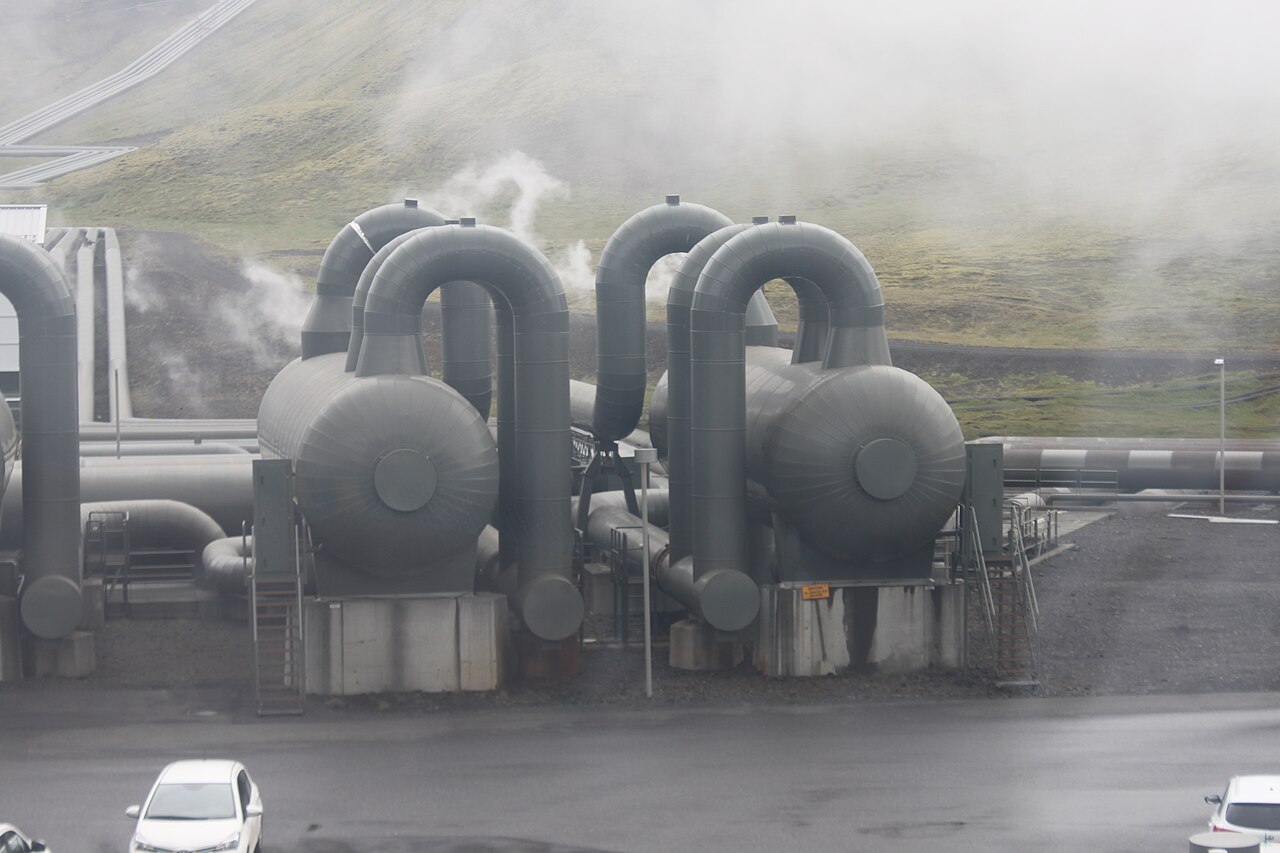
Iceland is the continent’s share leader at 100% in 2024: 70.7% from hydropower and 29.2% from geothermal plants tapping the volcanic heat beneath the island. Hellisheiði, the country’s largest, has a capacity of 303 MW of electricity and supplies hot water to Reykjavík’s district heating network, and about 90% of Icelandic homes are heated geothermally. The volcanic landscape behind that supply is explained in our guide to Iceland’s geography.
Africa: Ethiopia’s dam and Kenya’s geothermal rift
Africa’s totals are small, because many of its countries generate little electricity at all, but its shares are among the highest in the world. Ethiopia leads the continent in renewable output with 33.4 TWh, virtually all of it renewable and 96.5% from hydropower. Its flagship is the Grand Ethiopian Renaissance Dam on the Blue Nile, formally inaugurated on 9 September 2025; with 5.15 GW installed, it is the largest hydroelectric plant in Africa. The Democratic Republic of the Congo is also at 100%, and the Inga Falls on the lower Congo River, where the river drops about 96 m, have a theoretical potential of around 39.6 GW.
Kenya stands out on the continent. In 2025, 89.9% of its electricity was renewable, and 45.9% came from geothermal plants in the Great Rift Valley, chiefly at Olkaria inside Hell’s Gate National Park, a field with an estimated potential of 2,000 MW. Across East and Southern Africa, hydropower keeps shares high elsewhere too: in 2024 Uganda reached 97.1%, Zambia 87.5% and Mozambique 83.5%.

North and southern Africa look different. South Africa generated 33.1 TWh from renewables, but that was only 13.7% of its coal-dominated supply, and Egypt’s 32.0 TWh was 13.0%. Morocco reached 23.3%, mostly from wind, and hosts the Ouarzazate solar complex, whose 510 MW concentrated solar plant is the largest of its kind in the world.
Oceania and the Gulf: rooftops in Australia, oil in Arabia
Australia generated 111 TWh of renewable electricity in 2025, 38.7% of its total, and solar was the largest source at 19.6% of all generation. Much of it sits on houses: by December 2025 the country had more than 4.29 million solar PV installations with a combined capacity of 45.1 GW, most of them rooftop systems on homes and businesses. New Zealand is far greener in share terms, at 88.5%, combining hydro in the Southern Alps with geothermal stations on the North Island’s volcanic plateau, which supplied 21.8% of its electricity.
The Arabian Peninsula is the counterpoint. Saudi Arabia generated only 2.1% of its electricity from renewables in 2024 and the United Arab Emirates 8.8%, almost all of it solar, despite some of the strongest sunshine on Earth. Their grids still run on the oil and gas they export. Sunshine is the resource with the most room to grow in both regions, and our ranking of countries with the most solar power shows who is building it fastest.