
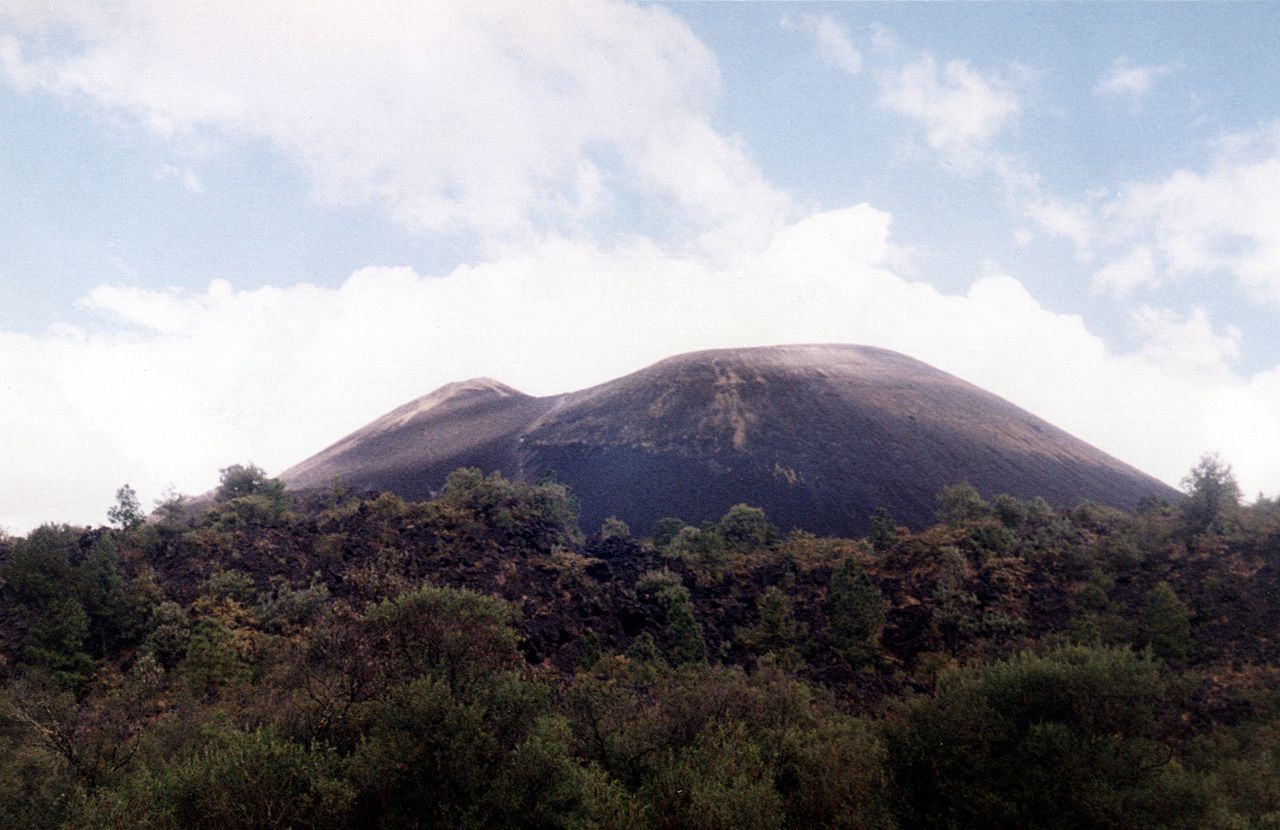
On the slopes of large volcanoes like Mount Etna or the volcanoes of the Cascade Range, and scattered across volcanic regions like northern Arizona, central Mexico, and the rift valleys of East Africa, you can find them — small, conical hills, often a few hundred metres tall, with steep slopes and craters at their summits. They look like miniature versions of the great stratovolcanoes, but they are not. They are cinder cones — the most common type of volcano on Earth, and a distinctly different kind of volcanic feature from the towering stratovolcanoes and broad shields they are sometimes associated with. Cinder cones are built up over months or years by the eruption of pyroclastic fragments — cinders, ash, and bombs — from a central vent. They are typically active for only a short period, sometimes within a single human lifetime, and once their activity ceases they remain as small, often-symmetrical cones, slowly eroding into the surrounding landscape over thousands of years.
What They Are
Cinder cones, also called scoria cones or volcanic cones, are simple, single-vent volcanoes built up by the accumulation of pyroclastic fragments around a central eruption point. The fragments are typically scoria — basaltic to andesitic volcanic material that has been ejected with substantial dissolved gas content, producing the foamy, bubble-filled texture that gives scoria its distinctive low density and rough surface. The fragments range from fine ash (millimetre-sized) to lapilli (a few centimetres) to bombs (large blobs of partially-cooled molten lava ejected from the vent). The fragments fall in a roughly conical pattern around the vent, with larger fragments closer to the vent and finer material spread further out. Over time, this accumulating cone of fragments builds up the characteristic cinder-cone form.
The Size and Shape
Most cinder cones are small — typically 50-450 metres tall and 600 metres to 2 kilometres in basal diameter. The slopes are steep — typically 30-40 degrees, near the natural angle of repose for loose volcanic fragments. The crater at the summit is usually quite prominent — typically 100-300 metres in diameter, with steep walls descending into a flat or gently sloping floor. The crater may be filled with later-erupted material or may remain as a bowl-shaped depression. The cone may have flank vents on its sides where subsidiary eruptions have occurred. The overall geometry — a steep, symmetric, small cone with a summit crater — is one of the most distinctive volcanic forms.
The Eruption Cycle
Most cinder cones are built up by a single eruptive episode lasting weeks to months. The eruption typically begins with magma rising to the surface through a fracture or fissure, releasing dissolved gases that fragment the magma into pyroclasts as it reaches the surface. These pyroclasts are ejected by the gas pressure and form a fountain of glowing fragments, falling back to the surface around the vent. The largest fragments (bombs) often retain heat and have characteristic streamlined or curving shapes from their flight through the air. The smallest fragments (ash) can be carried by wind and deposited as much as tens of kilometres away from the vent. As the cone builds up, subsidiary lava flows often emerge from the base or flanks of the cone — the cinder cone is built up by the fragmentary material while the underlying magma flow continues. Once the gas content of the magma is exhausted (or the magma supply runs out), the eruption ends. The cone is essentially complete from that point forward, gradually eroding over the subsequent millennia.
The Paricutin Example
The most famous cinder cone, in terms of human observation, is Paricutin in Michoacán, Mexico. On 20 February 1943, a fissure opened in the cornfield of a farmer named Dionisio Pulido. By the end of the first day, a cone of cinders 6 metres tall had built up around the fissure. Within a week the cone was 50 metres tall. Within a year it was 336 metres tall and the activity was substantially complete. The eruption continued for another eight years at progressively lower intensity, ultimately ceasing in 1952. The final cone is about 424 metres tall and 1.6 km across. The neighbouring villages of Paricutin and San Juan Parangaricutiro were largely destroyed by ashfall and lava flows; the church of San Juan Parangaricutiro, partially buried but still standing, is now a famous landmark — its tower rising out of the lava field that surrounds it. Paricutin is the type case for understanding the formation and behaviour of cinder cones because the entire process was documented in detail from the first day onwards.
Sunset Crater and the Southwestern US
The Southwestern US has hundreds of cinder cones scattered across its volcanic regions. The San Francisco volcanic field in northern Arizona contains over 600 cinder cones, the most prominent being Sunset Crater Volcano — which formed around 1085 AD. Sunset Crater is approximately 340 metres tall and 1.6 km in diameter. Its formation substantially altered the lives of the indigenous Sinagua people of the region. The cone's red and orange color (which gave it its name) results from oxidation of iron in the volcanic fragments. Sunset Crater Volcano National Monument was established in 1930 to protect the volcano and the surrounding landscape. The nearby Bonito lava flow and various other features make this region one of the most accessible volcanic landscapes in the US. Similarly, the Lassen Volcanic National Park region of California, the Black Rock Desert of Utah, the Craters of the Moon region of Idaho, and various other regions of the Southwest have substantial cinder cone fields.
Distribution
Cinder cones are the most numerous type of volcano on Earth. There are estimated to be several million cinder cones globally, with new ones being added at a rate of perhaps 1-2 per year (averaged over geological time). They occur in essentially every volcanic region — at subduction zones, hotspots, divergent plate boundaries, and various other tectonic settings. Some volcanic landscapes are dominated by cinder cone fields rather than larger central volcanoes: the Tarawera volcano in New Zealand, the Newer Volcanic Province of southeastern Australia, the volcanic fields of northern Mexico, the East African Rift volcanic centres, and many others. Major cinder cone fields can contain hundreds of individual cones spread over hundreds of square kilometres. The Snake River Plain of Idaho, the volcanic fields of Iceland, and various other regions all have similar distributions.
Geological Significance
Cinder cones, despite their individual small size, have substantial geological significance. They mark sites of small-volume magma eruptions and provide samples of the magma compositions and styles of activity in their host regions. The timing of cinder cone formation can be determined by various dating methods (radiocarbon dating of organic material in lava-buried soils, paleomagnetic dating of cooled basalt, and others). The pattern and ages of cinder cones in a region can be used to map the underlying magmatic system and understand its evolution. Many cinder cones contain xenoliths — pieces of country rock or deeper crust that were ripped from the walls of the magma conduit as the magma rose. These xenoliths can be the only samples of certain crustal or mantle materials that ever reach the surface, providing important constraints on the deep geology of the region.
Hazards
Despite their generally short-lived activity, cinder cones can be hazardous to communities in their immediate vicinity. The eruption of a new cinder cone can be sudden and unpredictable — the first sign of activity is typically just hours or days before the actual eruption begins. People living near the eruption site can be killed by ashfall, by toxic gases (particularly carbon dioxide and sulfur dioxide), by lava flows from the cone or adjacent fissures, or by various other effects. The 1943 Paricutin eruption killed a small number of villagers directly and many more were displaced by the destruction of their villages and the disruption of their agricultural systems. The 1973 Eldfell eruption on Heimaey in Iceland (a cinder-cone-type eruption) buried much of a town, killed one person, and forced the evacuation of the entire population. The risk of a sudden cinder cone eruption in a populated area is one of the more challenging aspects of volcanic risk management.
Lava Flows from Cinder Cones
Many cinder cones are accompanied by substantial lava flows from the base of the cone or from associated fissures. These flows can extend kilometres from the cone and can be tens of metres thick. The Sunset Crater eruption produced the Bonito lava flow that extends over a square kilometre. The Paricutin eruption produced lava flows that destroyed villages and roads. Many cinder cone eruptions produce more lava than fragmental material — the fragmental cone is the more visible feature, but the underlying lava flows may dominate the overall eruption volume. The interactions between the fragmental cone and the lava flow are complex and produce some of the more intriguing volcanic geology — flow-fed cones, breached cones (where the flow has broken through the cone wall), and various other configurations.
The Bigger Picture
Cinder cones are part of the larger family of volcanic landforms that include stratovolcanoes, shield volcanoes, calderas, lava plateaus, and various other features. They are typically the smallest and most ephemeral of these features, but they are also the most numerous and the most widely distributed. They mark sites of small-volume magma eruptions in essentially every volcanic region of the world. Their study provides insights into magmatic processes that complement what can be learned from the larger volcanic features. And they sometimes pose risks to nearby populations that, while smaller in absolute terms than the risks from major stratovolcanoes, are nonetheless real and require attention. The continued formation of new cinder cones — at the rate of one or two per year on average — is one of the persistent expressions of Earth's ongoing volcanic activity, a reminder that the planet is still geologically alive.