
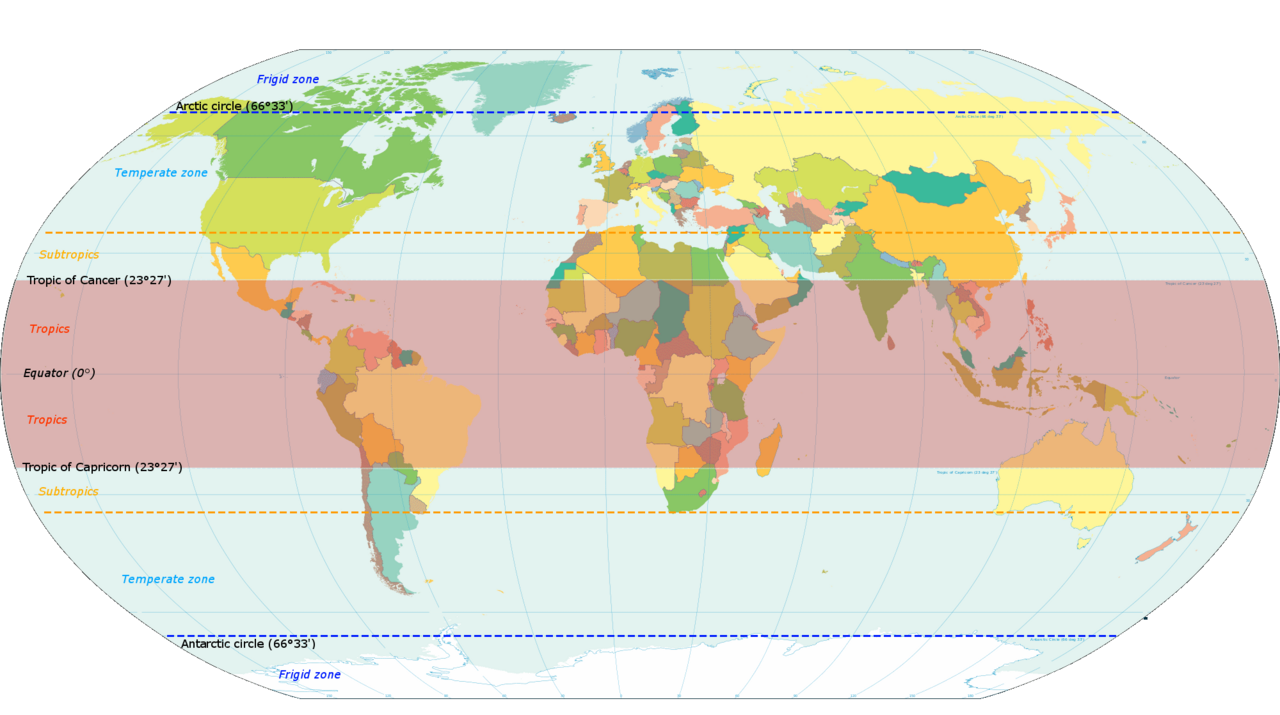
The tropics encompass some of Earth's most extraordinary places — the Amazon rainforest, African savannas, Great Barrier Reef, Indonesian volcanoes, and Caribbean beaches. This warm region around the equator contains most of the planet's biodiversity, harbors most of humanity, and faces some of climate change's greatest challenges. Together with the polar regions and temperate zones, the tropics form the third major climate region of Earth.
The Short Answer
The tropics is the region of Earth between the Tropic of Cancer (23.5°N) and the Tropic of Capricorn (23.5°S). Within this region, the Sun appears directly overhead at some point during the year. The tropics are characterized by year-round warm temperatures, minimal seasonal temperature variation, and (in many places) heavy seasonal rainfall. The region contains most of Earth's biodiversity.
Geography of the Tropics
The tropics include:
- About 40% of Earth's surface
- Most of Central America
- Northern South America
- Central and southern Africa
- Southeast Asia and Oceania
- Northern Australia
- Many Pacific, Atlantic, and Indian Ocean islands
- Population: about 3.5 billion people (40% of world)
Why the Tropics Are Warm
The Sun's angle explains it:
- The Sun is directly overhead at some point during the year
- Sunlight hits the surface more directly
- Same energy concentrated over smaller area
- Less seasonal variation in solar input
- Year-round temperatures stay relatively high
- Less heat loss through long winter periods
Tropical Climates
Variations within the tropics:
- Tropical rainforest: Year-round heavy rain (over 2,000 mm). Amazon, Congo, SE Asian rainforests.
- Tropical monsoon: Heavy seasonal rain. South Asia, parts of Africa.
- Tropical savanna: Distinct wet/dry seasons. African plains, Brazilian Cerrado.
- Tropical desert: Some deserts like Sahara are mostly in tropics.
- Tropical alpine: Higher elevations are cooler despite tropic location.
The Tropic of Cancer
The northern boundary:
- At 23.5°N latitude
- Sun directly overhead on June solstice
- Passes through 16 countries
- Includes major deserts (Sahara, Arabian)
- Important agricultural zones
The Tropic of Capricorn
The southern boundary:
- At 23.5°S latitude
- Sun directly overhead on December solstice
- Passes through 10 countries
- Mostly oceans
- Includes parts of Australia, Brazil, South Africa, Chile
Biodiversity
The tropics are biological treasure:
- About 50% of Earth's land species in tropics
- About 80% of marine species near tropics
- Amazon contains 10% of all known species
- One hectare of rainforest can have 750+ tree species
- Highest biodiversity per unit area
- Many species not yet discovered
Why So Much Biodiversity
Reasons for tropical species richness:
- Year-round growing season: No winter dormancy.
- Stable climate: Less evolutionary disruption.
- High productivity: Plants grow vigorously, supporting food webs.
- Older ecosystems: More time for evolution to diversify.
- Spatial complexity: Many microhabitats.
- Climate stability through ice ages: Tropics less affected by glaciations.
Tropical Rainforests
The world's most diverse ecosystems:
- Amazon Rainforest: 5.5 million km², largest rainforest.
- Congo Basin: Second largest.
- Southeast Asia: Including Borneo and Sumatra.
- Madagascar: Smaller but extraordinarily unique.
- Central American forests: From Mexico south.
- Cover only 6% of Earth's surface but house half of all species.
Tropical Agriculture
Important global crops:
- Rice: Asian tropics produce most of the world's rice.
- Coffee, cocoa: Equatorial regions.
- Bananas, pineapples: Tropical fruits.
- Sugarcane: Major export crop.
- Palm oil: Massive Indonesian/Malaysian production.
- Tropical hardwoods: Mahogany, teak, etc.
- Spices: Many native to tropics.
Coral Reefs
Underwater biodiversity:
- Located in tropical waters
- "Rainforests of the sea"
- Great Barrier Reef largest
- About 25% of marine species use them
- Critically threatened by warming
- Many already bleached and dying
Population
The tropics support massive populations:
- 3.5 billion people in tropics
- India alone has 1.4 billion
- Indonesia: 270 million
- Nigeria: 220 million
- Brazil: 215 million
- Increasingly urbanized populations
Tropical Cities
Major urban centers:
- Jakarta, Indonesia: 11 million.
- Mumbai, India: 20 million.
- Lagos, Nigeria: 21+ million.
- Sao Paulo, Brazil: 22 million.
- Manila, Philippines: 13 million.
- Mexico City: 22 million.
- Many among world's largest cities.
Climate Change in the Tropics
Vulnerability is severe:
- Already-hot regions warming dangerously
- Sea-level rise threatens many tropical countries
- Coral reefs dying
- Rainfall patterns changing
- Hurricanes and tropical storms intensifying
- Food production at risk
- Climate refugees increasing
Diseases
Tropical diseases concern:
- Malaria (1 million deaths annually in past, declining)
- Dengue fever
- Yellow fever
- Sleeping sickness
- Leishmaniasis
- Schistosomiasis
- Many parasitic infections
- Climate change expanding mosquito ranges
Monsoons
Critical climate phenomenon:
- Indian, Southeast Asian, West African monsoons
- Seasonal reversal of winds
- Brings essential rainfall
- Affects 60% of world population
- Failed monsoons cause famines
- Climate change disrupting patterns
Tropical Storms
Hurricanes, typhoons, cyclones:
- Form in warm tropical waters
- Most powerful storms on Earth
- Atlantic hurricanes, Pacific typhoons, Indian cyclones
- Increasing in intensity with climate change
- Massive damage potential
- Storm surge especially deadly
Indigenous Peoples
Cultures of the tropics:
- Many indigenous peoples have lived in tropics for millennia
- Amazon's indigenous tribes
- Pacific Islander cultures
- African forest peoples
- Southeast Asian indigenous communities
- Often face displacement and cultural change
- Increasingly recognized for sustainable practices
Tropical Astronomy
Unique observations:
- Both Northern and Southern Hemisphere stars visible
- Celestial equator passes through tropics
- Time markers across many cultures
- Polar regions only visible from one hemisphere
- Great for stargazing in clear nights
Tourism
Major economic factor:
- Beach tourism (Caribbean, Pacific islands)
- Adventure tourism (Amazon, African safaris)
- Cultural tourism (Bali, Thailand, etc.)
- Diving (coral reefs)
- Ecotourism growing rapidly
- Major source of income for many tropical nations
The Tropics in History
Civilization's roots:
- Many ancient civilizations developed in tropics
- Mesopotamia, Egypt, Indus Valley
- Maya, Aztec, Inca empires
- Vast tropical civilizations
- Spice trade dominated by tropics
- Colonial extraction of resources
Conservation
Protecting tropical biodiversity:
- Major focus of global conservation
- Protected areas in many tropical countries
- Deforestation remains huge problem
- International cooperation needed
- Indigenous land rights critical
- Climate change adds urgency
Key Facts
- The tropics are between 23.5°N and 23.5°S.
- About 40% of Earth's surface is tropical.
- Tropics contain about 50% of land species and 80% of marine species.
- 3.5 billion people live in the tropics.
- Rainforests in tropics are Earth's most biodiverse ecosystems.
Fun Facts
- Tropical rainforests cover only 6% of Earth but house half of all species.
- Some Amazon trees have never been studied scientifically.
- Many tropical fruits familiar today (bananas, mangoes) come from tropics.
- The Sun appears directly overhead in the tropics twice a year (except at edges).
- Tropics receive about 40% of total Earth solar input despite being only 40% of surface area.
Tropical Sea Life
Tropical oceans host extraordinary biodiversity. Coral reefs, often called "rainforests of the sea," support a quarter of all marine species. The Great Barrier Reef is the largest living structure on Earth. Tropical fish display extraordinary colors and patterns. Sharks, rays, dolphins, and whales inhabit tropical waters. Sea turtles return to tropical beaches to lay eggs. Tropical waters support some of the world's largest fisheries. The diversity of tropical sea life provides both ecological value and economic opportunity. Yet tropical marine ecosystems face severe threats from warming, acidification, pollution, and overfishing. Conservation efforts are intensive in tropical seas.
Tropical Wildlife
The tropics contain Earth's most diverse wildlife. Tigers, jaguars, leopards, and lions inhabit different tropical regions. Tropical rainforests host more species per hectare than any other ecosystems. Tropical reefs support a quarter of all marine species. Tropical insects display extraordinary diversity. Birds of paradise, hummingbirds, and toucans are tropical specialties. Many monkey species evolved in tropical forests. Reptiles flourish in warm tropical climates. Tropical wildlife faces threats from habitat loss, climate change, poaching, and pollution. Tropical biodiversity hotspots receive intensive conservation focus, though many species remain undiscovered or insufficiently studied.
Tropical Cuisine
Tropical cuisines reflect the region's abundance and diversity. Spice trade originated in tropics — pepper, cloves, nutmeg, cinnamon. Tropical fruits like mango, banana, pineapple, papaya, coconut are now globally beloved. Many staple grains like rice originated in tropics. Cuisines like Thai, Caribbean, Indian, Brazilian developed sophisticated flavors using tropical ingredients. Coffee, cocoa, and tea — all of tropical origin — are global beverages. Modern fusion cuisine incorporates tropical influences. Tropical food culture continues evolving as ingredients spread globally and new diaspora communities establish themselves in non-tropical regions.
The Tropics in Cinema and Literature
Tropical settings have inspired countless creative works. Joseph Conrad's "Heart of Darkness" featured tropical Africa. "Lost in the Jungle" tropes appear in countless adventures. Caribbean settings of Hemingway and others. Brazilian cinema novo. Indian cinema. African literature flourishing. Tropical Asian films. "Slumdog Millionaire," "Life of Pi," and many others. Travel writing about tropics has its own canon. The tropics represent both exotic adventure and harsh reality in storytelling. As global media expands, tropical voices and perspectives increasingly shape global culture.
The Bottom Line
The tropics are the region between 23.5°N and 23.5°S, where the Sun reaches directly overhead during the year. With year-round warmth, abundant rainfall in many areas, and minimal seasonal variation, the tropics support more biodiversity than any other region of Earth. They're also home to 40% of humanity, often in vulnerable conditions. The tropics face unique challenges from climate change and continue to be of vital importance to Earth's ecosystems and human civilization.