
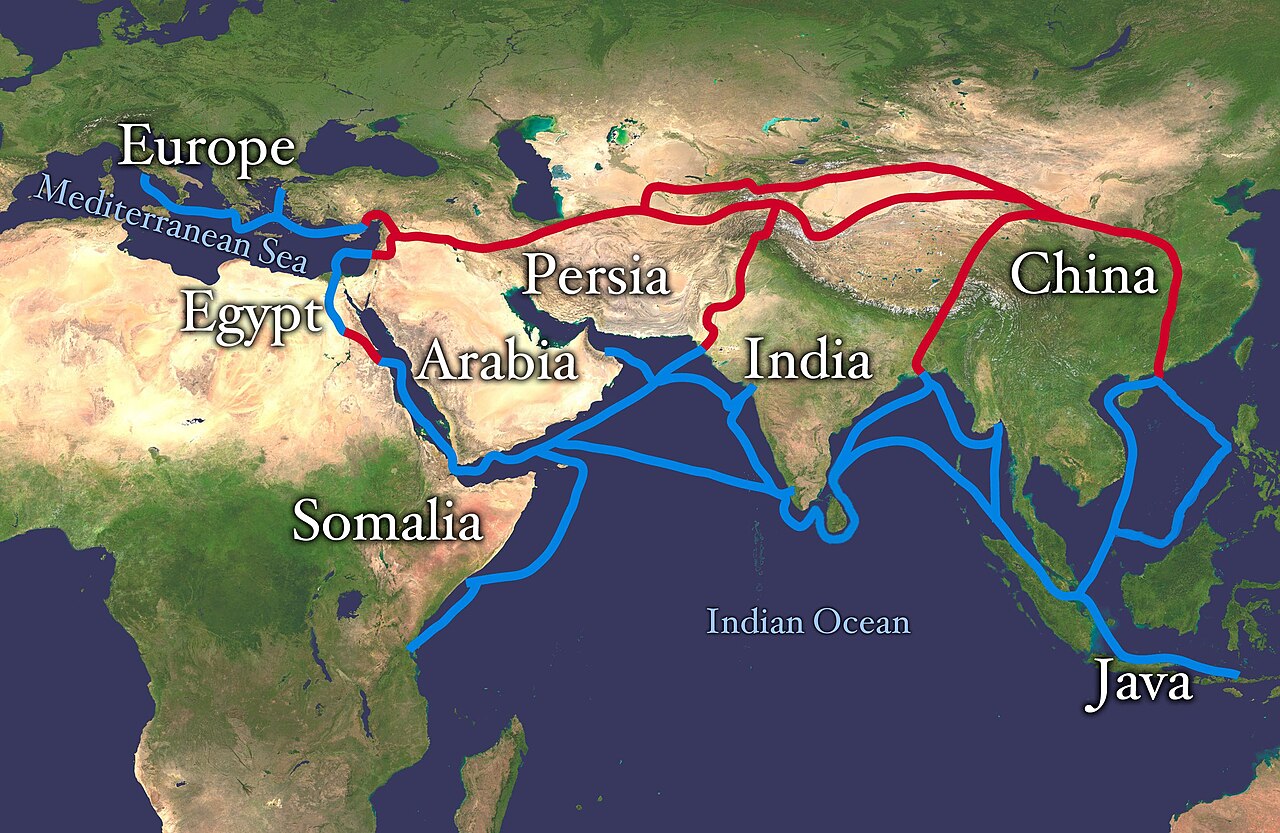
The Spice Route — sometimes called the Maritime Silk Road — was the network of sea-based trade routes that carried Asian spices (pepper, cinnamon, cloves, nutmeg, mace, ginger, cardamom, and many others) from their production zones in South and Southeast Asia to consumers in the Middle East, Europe, and eventually elsewhere. The route operated continuously in some form from at least the 1st millennium BCE through to the modern era, with substantial shifts in its political and economic structure over the centuries. The maritime spice trade is one of the foundational stories in pre-modern globalisation; in the early modern period it became one of the principal drivers of European overseas expansion, the founding of the joint-stock trading companies (the Portuguese Estado da Índia, the Dutch and English East India Companies), and the establishment of the colonial systems whose legacies still shape the modern world. The economic value of spices — particularly cloves, nutmeg, and mace, which until the 18th century could only be obtained from a small number of islands in the Maluku archipelago — was, at the route's height, large enough to motivate trans-oceanic exploration and outright warfare.
The Earliest Trade
The maritime spice trade has roots in the second millennium BCE, with Egyptian and Mesopotamian sources documenting the import of cinnamon and other spices from southern and eastern sources well before the more famous classical-era trade. The "incense road" overland from southern Arabia to the Mediterranean carried frankincense, myrrh, and various imported Asian spices that had reached southern Arabia by sea. The Roman period saw substantial intensification of the spice trade; Roman authors complained about the drain of gold to pay for Indian pepper. Indian and Arab navigators developed substantial knowledge of monsoon patterns that allowed reliable seasonal sailing between southern Asia and East Africa or Arabia. The Periplus of the Erythraean Sea (a 1st-century CE Greek-language merchant's handbook) describes the routes from Egyptian Red Sea ports to East Africa, southern Arabia, and the west coast of India in detail and is one of the major sources for the ancient maritime trade.
The Indian Ocean System
The medieval Indian Ocean was perhaps the most extensively developed long-distance maritime trade system in the pre-modern world. By the 9th-10th centuries CE, integrated trade networks connected the southern Chinese ports (Guangzhou, Quanzhou), the Southeast Asian ports (Sumatra, the Malay peninsula), the Indian coastal ports (Calicut, Cochin, Kollam on the Malabar Coast; Cambay on the Gujarat coast), the Persian Gulf ports (Siraf, Hormuz, Basra), the Red Sea ports (Aden, Mocha, Jeddah), and the East African ports (Mombasa, Kilwa, Zanzibar, Mogadishu, Sofala). Arab, Persian, Indian, Malay, and Chinese merchants all participated in the trade, with substantial inter-cultural and inter-religious exchange producing the cosmopolitan trade cities of the Indian Ocean. The trade was conducted under monsoon-driven sailing schedules — the southwest monsoon (April-September) carried ships eastward from Africa and Arabia to India; the northeast monsoon (October-March) carried them back. The seasonal pattern produced a rhythm of trade and waiting that shaped the political and cultural life of the port cities.
The Specific Spices
The spice trade involved many spices but the highest-value were a small set with restricted production zones. Pepper, the most important by volume, was produced primarily in southern India (the Malabar Coast) and later in Sumatra and Borneo as cultivation spread. Cinnamon, in the high-value form (Cinnamomum verum), was produced almost exclusively in Sri Lanka; the related but lower-quality cassia (Cinnamomum cassia) was produced in southern China. Cloves were produced only on five small volcanic islands in the northern Maluku archipelago: Ternate, Tidore, Moti, Makian, and Bacan. Nutmeg and mace (the two distinct products of the same tree) were produced only on the Banda Islands in the central Maluku archipelago — about a dozen small islands totalling perhaps 40 square kilometres of nutmeg-producing land. The extreme geographic concentration of clove and nutmeg production made these spices simultaneously enormously valuable and politically vulnerable; whoever controlled these few islands could in principle control the entire global supply.
Why Spices Mattered
The European demand for spices that drove the early modern maritime expansion was based on several factors. Spices were used in cooking — partly to flavour bland food, partly because the wealthy aristocracy of medieval and early modern Europe used spice-heavy dishes as conspicuous consumption that demonstrated wealth and status. Spices were used in medicine — the medical theory of the time attributed substantial therapeutic value to spices, and they were prescribed for a wide range of conditions. Spices were used in religious and cultural rituals — frankincense and myrrh for religious purposes, particular spices for various civic and household uses. Some spices (particularly nutmeg) were also used as preservatives. The combined demand was high enough to support the very long supply chains and high per-unit prices that characterised the spice trade for centuries. The myth that spices were used primarily to preserve or mask spoiled meat is largely a 19th-century invention; medieval and early modern Europeans had refrigeration through cellars and various other preservation methods, and the wealthy who could afford spices could also afford fresh food.
The Portuguese Arrival
The major reconfiguration of the spice trade began with the Portuguese arrival in the Indian Ocean. Vasco da Gama's 1497-99 voyage opened the Cape route from Europe directly to India, bypassing the previous Mediterranean-and-Middle-East intermediary system. The Portuguese established their first Asian outpost at Cochin in 1500, captured Goa in 1510, took Malacca (the major Southeast Asian entrepôt) in 1511, took Hormuz in 1515, and reached Ternate in 1512. The Portuguese strategy was based on naval superiority, the construction of fortified trading posts along the coast, and the establishment of a "cartaz" system requiring all Indian Ocean shipping to purchase Portuguese passes — essentially a protection racket enforced by naval power. The system functioned reasonably well for the 16th century but was substantially undermined by the late 16th century arrival of Dutch and English competitors.
The Dutch Domination
The 17th century saw the Dutch East India Company (VOC), founded in 1602, become the dominant force in the Asian maritime trade. The VOC was a joint-stock company with unprecedented capital backing, naval and military forces, and a single-minded focus on maximising spice trade profits. The Dutch progressively pushed the Portuguese out of most of their Asian positions over the first half of the 17th century. The key episode in Dutch domination of the spice trade was the company's conquest of the Banda Islands in 1621, when VOC governor Jan Pieterszoon Coen led an attack that killed or enslaved the majority of the Bandanese population (approximately 13,000 of an estimated 15,000 population) and established direct Dutch control over the nutmeg production. The VOC subsequently maintained tight monopoly control over nutmeg and (after taking Ternate from the Spanish in the late 17th century) cloves for over a century. The monopoly was enforced by the systematic destruction of clove and nutmeg trees outside the VOC-controlled production zones, and by violent punishment of anyone caught smuggling spice plants.
The Spice Wars
The competition for spice trade dominance produced one of the more remarkable diplomatic exchanges of the 17th century. The Treaty of Breda (1667), which settled the Second Anglo-Dutch War, included an exchange in which the Netherlands ceded New Amsterdam (renamed New York) to England, and England ceded the small island of Run in the Banda group to the Netherlands. The exchange was, at the time, considered favourable to the Netherlands — Run's nutmeg production was more valuable than the colony at the mouth of the Hudson River. The valuation of the Banda Islands' nutmeg over Manhattan was substantially less correct in the long run than it appeared at the time. The exchange is now one of the more memorable retrospective reminders of how the actual relative values of trade goods and territories shift dramatically over centuries.
The End of the Monopolies
The Dutch monopoly on clove and nutmeg production was eventually broken in the late 18th century. Pierre Poivre, a French missionary and botanist, smuggled clove and nutmeg seedlings out of the Dutch-controlled Maluku islands in 1769-70 and established new plantations in French Mauritius and other locations. The British similarly established clove plantations in Zanzibar in the 19th century, eventually making Zanzibar (then under the Sultanate of Oman) the world's largest clove producer. By the early 19th century, the geographic concentration of spice production that had made the original spice islands so important had been substantially broken. The end of the geographic monopoly substantially reduced the per-unit value of the spices and ended the world-historical significance of the original spice islands, though the trade continued at lower margins through the colonial period and into the modern era.
The Legacy
The Spice Route's legacy is visible in multiple dimensions of the modern world. The colonial systems established to control the spice trade — Portuguese in the 16th century, Dutch in the 17th-18th, British in the 18th-19th, French in various places — became the foundation for the broader colonial empires whose legacies continue to shape global politics and economics. The genetic and ecological exchanges that the spice trade enabled spread plants and animals across the world; many of what are now staple foods in various regions arrived via the trade networks the spice trade developed. The cuisines of multiple continents were transformed by the introduction of new spices, with effects still visible today. The financial and corporate structures developed for the spice trade — joint-stock companies, stock markets, insurance markets, complex international financial instruments — became foundational to the development of modern capitalism. The Spice Route is one of the foundational stories of pre-modern globalisation, and its consequences continue to shape the world more than half a millennium after the great changes of the 16th century.