
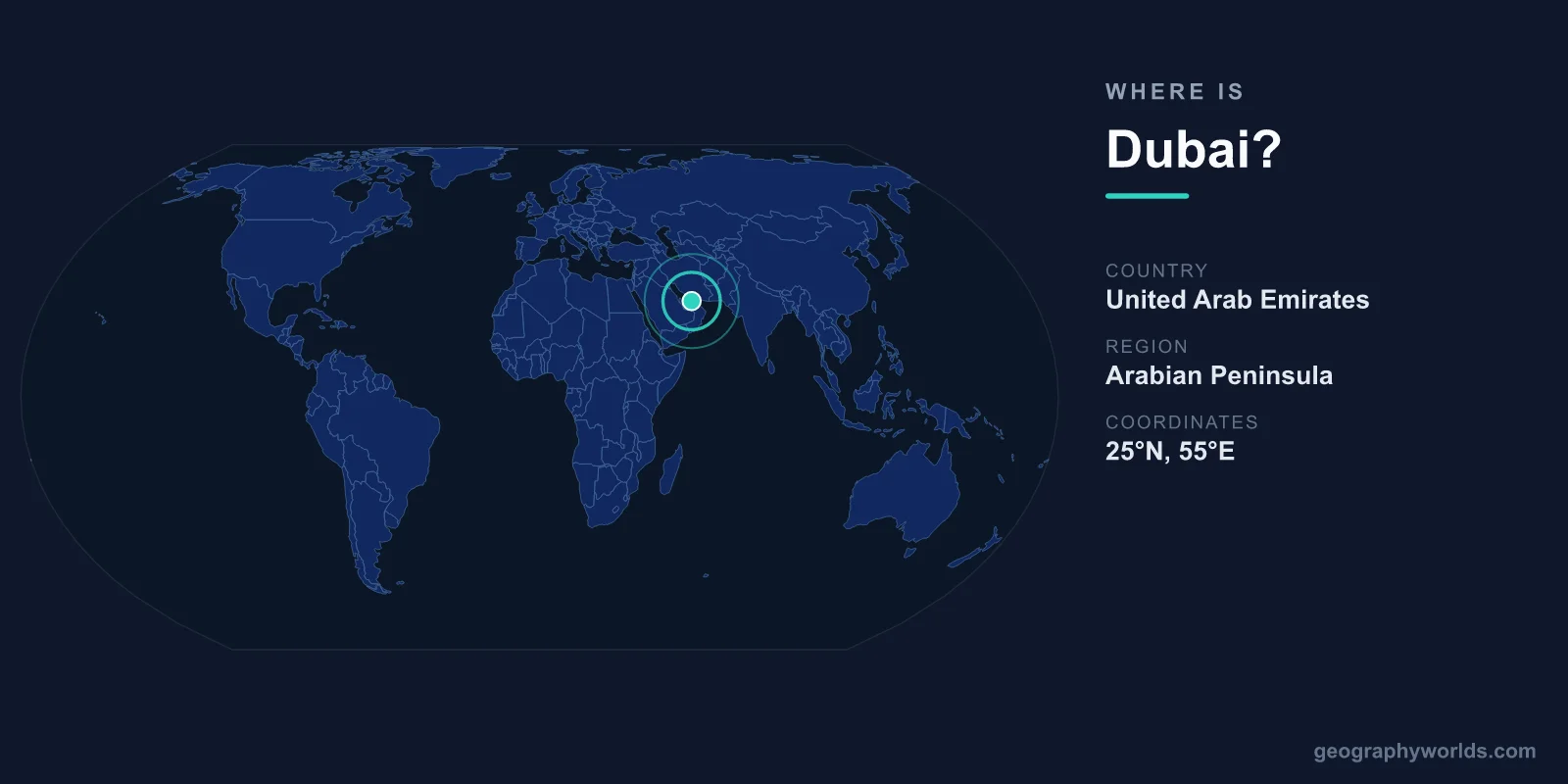
Dubai is located on the southeastern shore of the Persian Gulf in the United Arab Emirates (UAE), at approximately 25.20°N latitude and 55.27°E longitude, on the northeastern edge of the Arabian Peninsula in the Middle East. It is one of the seven emirates that form the UAE and the country's most populous city, with more than 3.5 million people in its metropolitan area. The city sits roughly 150 kilometers southwest of the Strait of Hormuz, the strategic waterway that connects the Gulf to the open Indian Ocean.
Where Exactly Is Dubai on the Map?
Dubai lies in both the Northern and Eastern Hemispheres, in western Asia. Its position on the flat, arid Gulf coastline places it at a natural crossroads between Europe, Asia, and Africa. The city is roughly equidistant by air from London and Singapore, a midpoint geography that has helped it grow into one of the world's busiest aviation and trade hubs. To the south and west sprawls the Arabian Desert, including the vast Rub' al Khali, or Empty Quarter, while to the east the Hajar Mountains mark the boundary with Oman.
The emirate of Dubai covers roughly 4,114 square kilometers, making it the second-largest emirate in the UAE after Abu Dhabi. The urban core hugs the coast and fans inland into the desert, centered on Dubai Creek (Khor Dubai), a natural saltwater inlet that for centuries served as the city's harbor and the lifeline of its pearling and trading economy.
What Surrounds Dubai?
Because Dubai is an emirate within a federation rather than an independent country, its land borders are shared with neighboring emirates:
- South and southwest: Abu Dhabi, the largest emirate and the federal capital.
- North and northeast: Sharjah, which adjoins Dubai so closely that the two cities effectively merge into a single continuous urban area.
- East: The Hajar Mountains rise about 100 kilometers inland, forming the natural frontier between the UAE and Oman.
- West and northwest: The Persian Gulf, where Dubai's celebrated artificial islands extend into the shallow coastal waters.
The nearest international border is with Oman, roughly 130 kilometers to the east. Saudi Arabia lies about 400 kilometers to the southwest across the desert. Dubai also holds a small exclave, Hatta, tucked into the Hajar Mountains far from the coast.
The Landscape: Desert, Coast, and Engineered Geography
Dubai's natural terrain is overwhelmingly flat: sandy desert plains, rolling dunes, salt flats known as sabkha, and sparse scrubland. The coastline is low-lying, averaging only about 5 meters above sea level, with natural sandy beaches running along the Gulf. Dubai Creek reaches roughly 14 kilometers inland and historically split the city into the Deira and Bur Dubai districts.
What sets Dubai apart geographically is how aggressively it has reshaped its own coastline. The Palm Jumeirah, an artificial island visible from space, added dozens of kilometers of new shoreline, and the offshore World Islands form a man-made archipelago shaped like a map of the globe. Towering above it all, the Burj Khalifa rises 828 meters, the tallest structure ever built. Together these projects have turned a modest fishing and trading port into one of the planet's most recognizable skylines.
Dubai's Climate
Dubai has a hot desert climate (BWh in the Köppen system), among the hottest of any major city. Summer, from June through September, brings daytime highs that routinely exceed 40°C (104°F) and can approach 50°C, with coastal humidity making the heat feel even more intense. Winters, by contrast, are mild and pleasant, with December-to-February daytime temperatures of around 20-25°C (68-77°F) that draw visitors from cooler parts of the world.
Rainfall is scarce, averaging only about 94 millimeters a year, almost all of it between December and March. Spring can bring shamal sandstorms that sharply cut visibility. With so little natural freshwater, Dubai relies heavily on seawater desalination to supply its homes, hotels, and gardens.
How to Reach Dubai
Dubai International Airport (DXB) is one of the world's busiest airports for international passengers, serving direct flights to well over 200 destinations and acting as the global hub for Emirates airline. A second airport, Al Maktoum International (DWC) in Dubai South, handles cargo and a growing share of passenger traffic. By land, Dubai is reachable via well-built highways from elsewhere in the UAE and neighboring Gulf states, and by sea its cruise terminals at Port Rashid welcome ships throughout the cooler winter months. If you enjoy testing your knowledge of cities and countries like this one, try our interactive geography games.
Frequently Asked Questions
What country is Dubai in?
Dubai is in the United Arab Emirates (UAE), a federation of seven emirates on the Arabian Peninsula. Dubai is one of those emirates and the country's most populous city, though Abu Dhabi is the federal capital.
Is Dubai in Asia or the Middle East?
Both descriptions are correct. Dubai sits in western Asia on the Arabian Peninsula, a region also commonly called the Middle East. It lies in the Northern and Eastern Hemispheres along the Persian Gulf coast.
What continent is Dubai on?
Dubai is on the continent of Asia, specifically in its southwestern corner on the Arabian Peninsula. Its location near the meeting point of Asia, Europe, and Africa is a major reason it has become a global transit hub.
How far is Dubai from the Strait of Hormuz?
Dubai is roughly 150 kilometers southwest of the Strait of Hormuz, the narrow chokepoint linking the Persian Gulf to the Gulf of Oman and the wider Indian Ocean. This proximity has long shaped the city's role in regional trade and shipping.
