
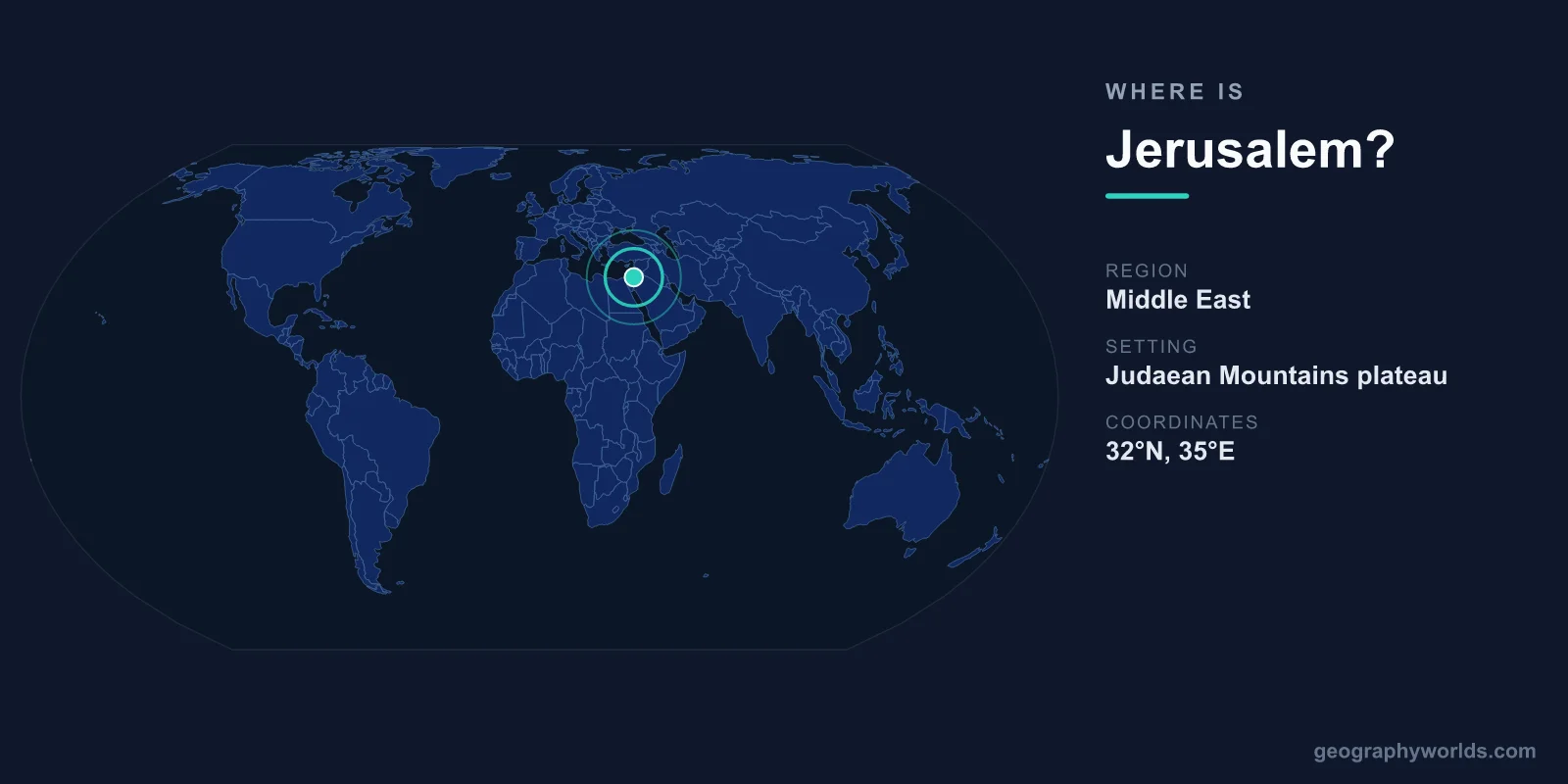
Jerusalem is located in the Middle East, set high in the Judaean Mountains at roughly 31.77°N latitude and 35.21°E longitude, about 60 kilometres east of the Mediterranean Sea and 35 kilometres west of the Dead Sea. Perched near 800 metres above sea level on the central highland ridge of the Levant, it is one of the oldest continuously inhabited cities on Earth, with a recorded history stretching back more than 3,000 years and human settlement reaching back several millennia further. The city sits in western Asia, in the southern part of the region known as the Holy Land, and is sacred to Judaism, Christianity, and Islam.
Where Exactly Is Jerusalem on the Map?
Jerusalem sits in the southern Levant, the eastern arm of the Mediterranean world that links the continents of Africa and Asia. Its coordinates of 31.77°N, 35.21°E place it almost midway between the Mediterranean coast and the Jordan Rift Valley, on the watershed ridge that divides them. Drainage to the west flows toward the sea; drainage to the east plunges into the deep trench of the Jordan Valley and the Dead Sea.
The city occupies a series of hills and the valleys between them, including the Kidron Valley to the east and the Hinnom Valley to the south and west. This rugged terrain, rather than any harbour or great river, is what historically gave Jerusalem its defensive strength and its enduring location on the same hilltops for thousands of years. Unlike most great cities of the ancient world, Jerusalem rose far from any sea, navigable river, or major trade artery. Its importance was never economic or strategic in the usual sense; it grew from religion, faith, and the symbolic weight of its hills.
Elevation and the Land Around It
At around 750 to 830 metres above sea level, Jerusalem is one of the higher cities in the region, noticeably cooler and breezier than the humid coastal plain. It stands on the boundary between two contrasting worlds: the well-watered Mediterranean zone to the west and the stark Judaean Desert to the east.
That contrast is dramatic. Travel just 35 kilometres east and the land drops to the shores of the Dead Sea, the lowest point on the surface of the Earth at roughly 430 metres below sea level. Few places on the planet pack such a steep change in altitude and climate into so short a distance. To the west, the Judaean foothills, known as the Shephelah, step gradually down toward the coastal plain and the city of Tel Aviv, about 60 kilometres away. This position on a sharp ecological divide explains why the eastern slopes of the city quickly turn dry and rocky while the western approaches remain green with pine and olive groves.
Which Country Is Jerusalem In?
Jerusalem's political status is among the most disputed in the world. Israel administers the whole city and regards it as its capital, having proclaimed it so and located its parliament, supreme court, and government ministries there. Palestinians claim East Jerusalem as the capital of a future Palestinian state, and most of the international community does not recognise sovereignty over the eastern part of the city, which Israel captured from Jordanian control during the 1967 Six-Day War.
Because of this, many foreign embassies have traditionally been based in or near Tel Aviv rather than Jerusalem. Geographically, the city lies at the meeting point of Israel and the occupied Palestinian territories of the West Bank, which helps explain why its surroundings include both Israeli and Palestinian communities. The dividing line that ran through the city from 1949 to 1967, often called the Green Line, still shapes everyday geography, separating West Jerusalem from the predominantly Palestinian neighbourhoods of the east.
The Old City and Its Sacred Heart
At the city's core lies the walled Old City, an area of less than one square kilometre divided into the Jewish, Christian, Muslim, and Armenian Quarters. The current walls were built in the 16th century by the Ottoman sultan Suleiman the Magnificent, tracing roughly the lines of much older fortifications. Within these walls stand sites sacred to three faiths, packed into a space smaller than many shopping centres:
- The Western Wall: the last surviving section of the retaining wall of the Second Temple and the holiest site where Jews can pray.
- The Church of the Holy Sepulchre: revered by Christians as the place of Jesus's crucifixion, burial, and resurrection.
- The Temple Mount / Haram al-Sharif: home to the golden Dome of the Rock and Al-Aqsa Mosque, among the most important sites in Islam and also the holiest site in Judaism.
The entire Old City has been a UNESCO World Heritage Site since 1981. Nowhere else on Earth concentrates so much religious significance into such a small space, which is a large part of why the city is so fiercely contested.
What Is Near Jerusalem?
Jerusalem's hilltop position makes it a hub from which several historically significant places lie within easy reach:
- South: Bethlehem sits only about 10 kilometres away, deeper into the Judaean highlands.
- North: Ramallah lies roughly 15 kilometres along the central ridge.
- East: Jericho, one of the world's oldest towns, is about 35 kilometres down toward the Jordan Valley.
- West: Tel Aviv and the Mediterranean coast are around 60 kilometres away.
This compact geography means that within an hour's drive a traveller can move from a high mountain city, through the bare Judaean Desert, down to the salt shores of the Dead Sea, and on to the subtropical Jordan Valley. Few capitals sit at the centre of such varied terrain.
Climate and Getting There
Jerusalem has a Mediterranean climate of hot, dry summers and cool, damp winters. Temperatures average around 9°C (48°F) in January and 24°C (75°F) in August, with almost all of the roughly 550 millimetres of yearly rain falling between October and April. Snow dusts the Old City every few years, a rare and memorable sight. Just a few kilometres east, on the desert side of the ridge, annual rainfall collapses to under 200 millimetres.
Most visitors arrive through Ben Gurion International Airport (TLV) near Tel Aviv, about 50 kilometres to the northwest. From there a high-speed train reaches Jerusalem's Yitzhak Navon Station in roughly 25 minutes, while buses and shared taxis offer alternatives. Overland travellers can also enter from Jordan via the Allenby/King Hussein Bridge crossing to the east. If you enjoy testing your sense of world geography, try locating cities like this one in our map-based geography games.
Key Facts
- Coordinates: 31.77°N, 35.21°E
- Region: Southern Levant, western Asia (Middle East)
- Elevation: roughly 750 to 830 metres above sea level
- Distance to Mediterranean Sea: about 60 kilometres west
- Distance to Dead Sea: about 35 kilometres east
- Climate: Mediterranean, with hot dry summers and cool wet winters
- Status: administered by Israel as its capital; East Jerusalem claimed by Palestinians and internationally disputed
Frequently Asked Questions
Is Jerusalem in Israel or Palestine?
Israel administers the entire city and treats it as its capital, while Palestinians claim East Jerusalem for a future state. The status of the eastern part of the city is internationally disputed and unresolved.
How far is Jerusalem from the Dead Sea?
The Dead Sea lies about 35 kilometres east of Jerusalem, roughly a 35-minute drive that descends from the city's 800-metre elevation to some 430 metres below sea level.
How high above sea level is Jerusalem?
Jerusalem stands at approximately 750 to 830 metres above sea level on the watershed ridge of the Judaean Mountains, making it cooler than the nearby Mediterranean coast.
What continent is Jerusalem on?
Jerusalem is in western Asia, in the region known as the Middle East or the Levant, close to the land bridge that connects Asia with Africa.
