

Mountain railways represent some of the most extreme engineering challenges in transportation, climbing steep gradients that would cause conventional trains to lose traction. The steepest railways in the world use specialized technologies like rack-and-pinion systems, where a toothed rail between the tracks engages with a cog wheel on the locomotive.
Introduction
From the impossibly steep Pilatus Railway in Switzerland to the historic Nilgiri Mountain Railway in India, these lines were built to conquer mountains, connect alpine communities, and provide access to some of the world's most spectacular scenery.
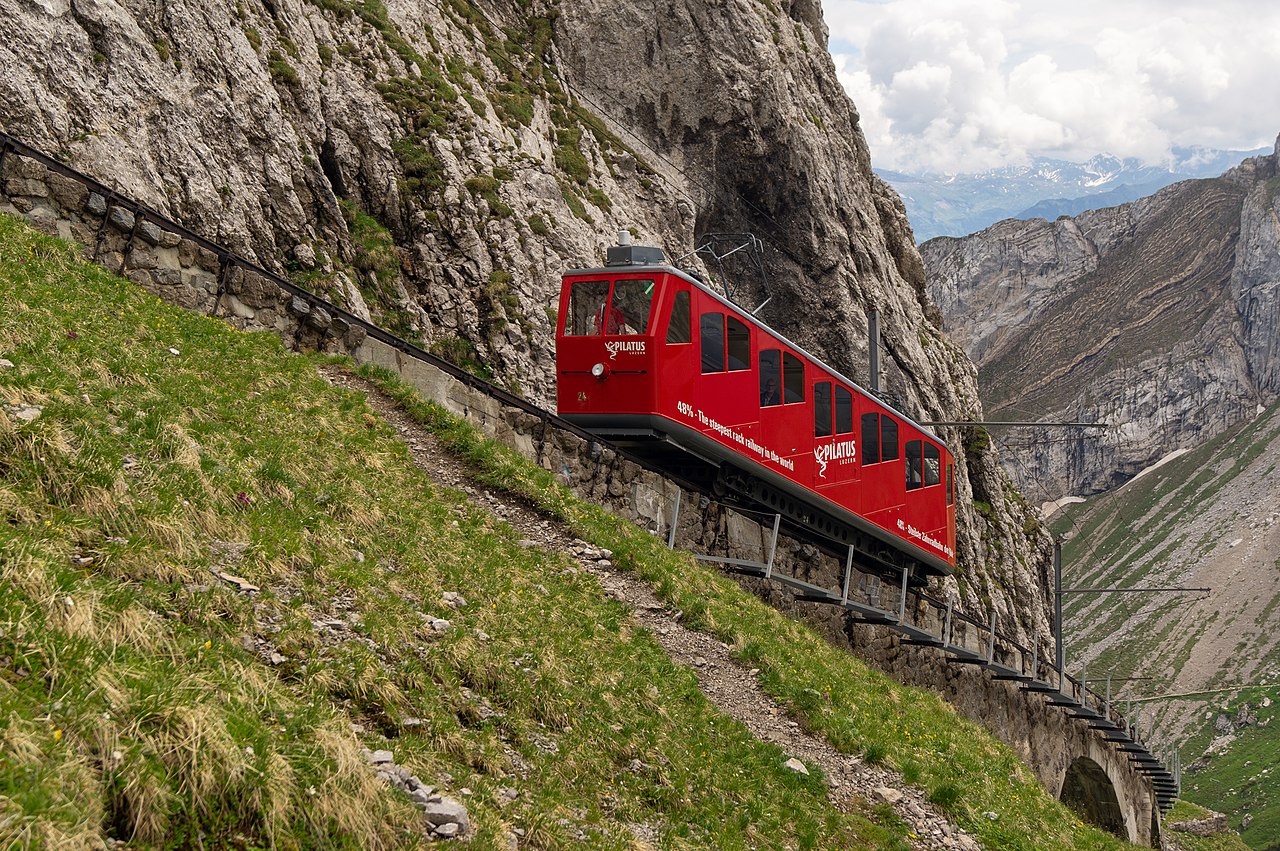
Route & Engineering
- Steepest Rack Railway: Pilatus Railway (Switzerland): 48% gradient
- Steepest Funicular: Stoos Funicular (Switzerland): 110% gradient (47.7 degrees)
- Notable Adhesion: Nilgiri Mountain Railway (India): 8.33% gradient
The Pilatus Railway near Lucerne, Switzerland, is the world's steepest rack railway, climbing a gradient of 48% (an angle of 25.6 degrees). It uses a unique horizontal cogwheel system designed by Colonel Eduard Locher in 1889, which grips a double rack rail from both sides.
Funicular railways achieve even steeper grades. The Stoos Funicular in Switzerland, opened in 2017, has a gradient of 110% (47.7 degrees) and uses innovative cylindrical cabins that rotate to keep passengers level as the incline changes.
Key Stats
- Pilatus Gradient: 48% (25.6 degrees)
- Pilatus Altitude: Rises from 510 m to 2,073 m
- Jungfrau Railway: Highest station in Europe: 3,454 m
The Pilatus Railway rises 1,563 meters in altitude over a track length of 4.6 km, taking approximately 30 minutes. The views of Lake Lucerne and the Swiss Alps from the open carriages are spectacular, and the railway operates from May to November.
The Jungfraujoch Railway in Switzerland climbs through the Eiger and Monch mountains to reach the highest railway station in Europe at 3,454 meters. Most of the line runs through tunnels blasted through the mountain rock, with observation windows cut into the north face of the Eiger.
History
- First Rack Railway: Mount Washington Cog Railway (1869, USA)
- Swiss Pioneers: Multiple Swiss mountain railways built 1870s-1900s
- UNESCO Railways: Rhaetian Railway, Nilgiri Mountain Railway
The Mount Washington Cog Railway in New Hampshire, USA, opened in 1869 as the world's first rack railway. It climbs the highest peak in the northeastern United States with gradients of up to 37.4%, and it still operates today using both steam and biodiesel locomotives.
Switzerland became the global center of mountain railway engineering in the late 19th century. Entrepreneurs and engineers built dozens of rack railways to summit stations across the Alps, creating a network of mountain transport that remains the densest in the world.
Current Status
- Tourism: Mountain railways are major tourist attractions
- Modernization: New cabins and safety systems on historic lines
- New Projects: Steep railways being built in Asia and South America
Mountain railways have evolved from practical transportation into major tourism attractions. The Jungfrau Railway, Pilatus Railway, and Gornergrat Railway in Switzerland collectively carry millions of visitors per year and are among the country's most popular attractions.
India's Nilgiri Mountain Railway, a UNESCO World Heritage Site, uses an unusual rack-and-adhesion system to climb from the plains to the hill station of Ooty. The line's steam locomotives are among the last working meter-gauge rack engines in the world.
Visitor & Travel Info
- Pilatus Ticket: ~CHF 72 roundtrip
- Jungfraujoch: Swiss Travel Pass for discounts
- Best Experience: Sit on the downhill side for views
The classic Swiss mountain railway experience combines several modes of transport. The "Golden Round Trip" to Pilatus takes the cogwheel railway up, a panoramic gondola and aerial cableway down, and a boat across Lake Lucerne, all in one day.
For railway enthusiasts, the Brienz Rothorn Railway is Switzerland's last purely steam-powered rack railway, using original 1890s locomotives. The ride takes about an hour each way and climbs to 2,244 meters with magnificent views of Lake Brienz and the Bernese Alps.
Key Facts
- The Pilatus Railway in Switzerland has a 48% gradient, the steepest rack railway.
- The Stoos Funicular reaches a 110% gradient (47.7 degrees).
- The Mount Washington Cog Railway (1869) was the world's first rack railway.
- The Jungfraujoch is the highest railway station in Europe at 3,454 m.
- India's Nilgiri Mountain Railway is a UNESCO World Heritage Site.
Fun Facts
- The Pilatus Railway's unique horizontal cogwheel system has never been replicated on any other railway.
- Switzerland has more rack railways per square kilometer than any other country.
- The Mount Washington Cog Railway briefly held the record as the steepest rack railway in the world.
- Some mountain railway locomotives carry a water tank that shifts from front to rear as the gradient changes.
Final Thoughts
The world's steepest railways represent the extreme edge of rail engineering, conquering gradients that seem impossible for wheeled vehicles. From Swiss alpine peaks to Indian hill stations, these lines demonstrate the remarkable ingenuity humans bring to the challenge of climbing mountains by rail.
Test Your Knowledge!
Think you know your transportation geography? Try our interactive quiz!
Play Geography Games →