

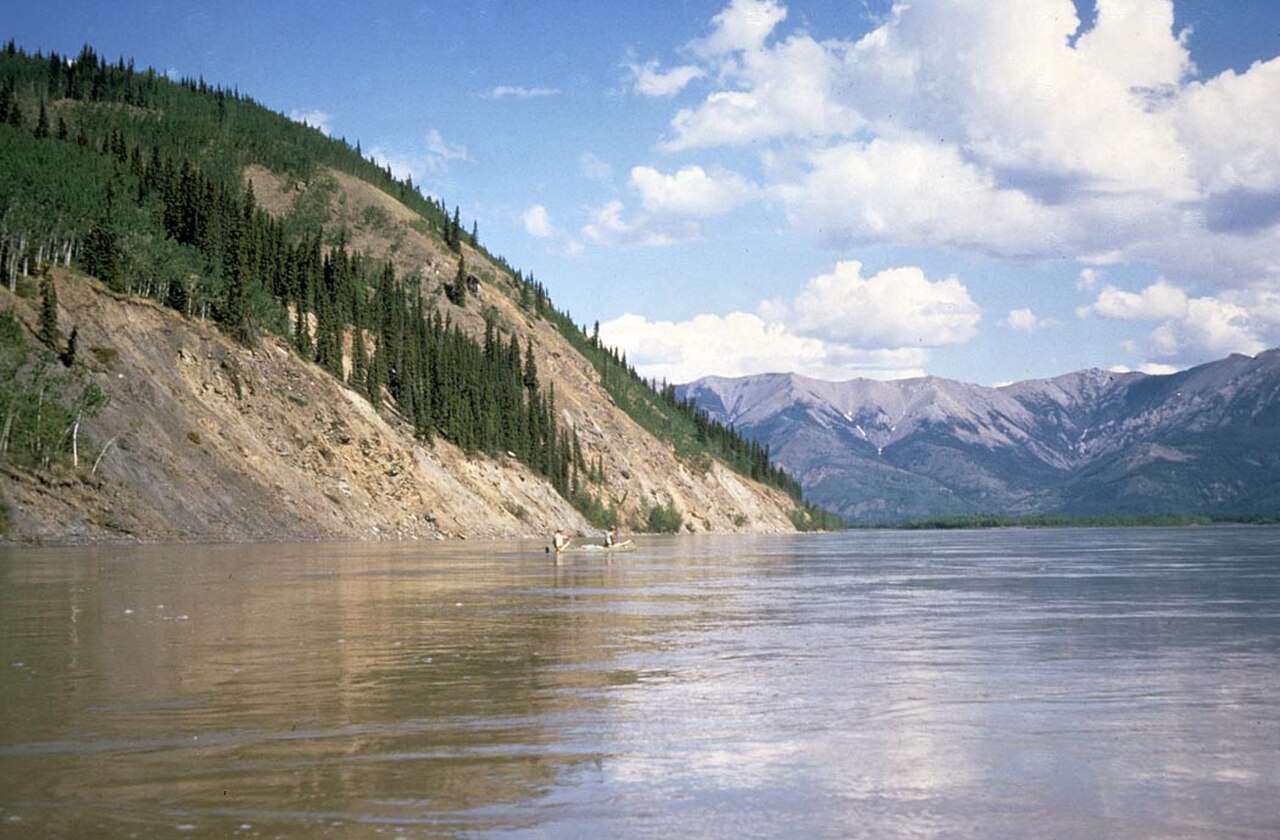
The Yukon River is one of the longest rivers in North America, flowing approximately 3,190 kilometers from its headwaters in British Columbia through the Yukon Territory and across Alaska to the Bering Sea. It drains an area of 854,000 square kilometers across some of the most remote and sparsely populated terrain on the continent.
Introduction
The Yukon is forever linked to the Klondike Gold Rush of 1896-1899, which drew over 100,000 prospectors to the river and transformed the region overnight. Today, the river remains a vital transportation corridor for remote communities, a world-class salmon fishery, and one of the last great wilderness rivers in North America.
Geography & Course
- Length: 3,190 km (1,982 mi)
- Basin Area: 854,000 km²
- Countries: Canada and United States
The Yukon begins at Marsh Lake in British Columbia, fed by streams draining the Coast Mountains. It flows northwest through the Yukon Territory, passing through Whitehorse (the territory's capital) and Dawson City (epicenter of the Gold Rush), before crossing into Alaska near the 141st meridian.
In Alaska, the Yukon flows generally westward through the Interior, past Fairbanks's connected rivers, the town of Galena, and the villages of the Yukon Flats, before turning southwest to reach the Bering Sea through a vast delta. The Yukon Flats, a broad wetland basin in central Alaska, is one of the most important waterfowl breeding areas in North America.
Klondike Gold Rush
- Discovery: August 16, 1896 (Bonanza Creek)
- Stampeders: ~100,000 set out; ~30,000 arrived
- Dawson City Peak: ~40,000 population (1898)
- Gold Extracted: ~$600 million (modern value)
The Klondike Gold Rush began on August 16, 1896, when gold was discovered on Bonanza Creek, a tributary of the Klondike River near its confluence with the Yukon. When news reached the outside world in July 1897, it triggered one of the greatest mass migrations in history, with approximately 100,000 people setting out for the Klondike.
The journey was extraordinarily difficult. Most stampeders traveled by ship to Skagway, Alaska, then climbed the brutal Chilkoot or White Pass trails to reach the headwaters of the Yukon, where they built boats and floated downstream to Dawson City. Of the 100,000 who set out, only about 30,000 reached Dawson, and only about 4,000 found gold. The Gold Rush's legacy includes the creation of the Yukon Territory and the opening of Alaska to broader settlement.
Indigenous Peoples
- Gwich'in: Yukon Flats and upper Yukon
- Han: Dawson City area
- Yup'ik: Lower Yukon and delta
- Salmon Dependence: King salmon is cultural keystone
Indigenous peoples have inhabited the Yukon River corridor for at least 14,000 years. The Gwich'in, Han, Koyukon, Tanana, and Yup'ik peoples developed diverse cultures adapted to the river's resources and the extreme subarctic climate. The Yukon was their highway, food source, and the axis of their world.
King (chinook) salmon from the Yukon is the cultural and nutritional keystone for indigenous communities throughout the basin. Families spend weeks at fish camps each summer, catching, cutting, and drying salmon for winter. In recent years, severely declining king salmon returns have forced fishing closures that have devastated indigenous food security and cultural practices.
Wildlife
- Salmon Species: All 5 Pacific salmon species
- King Salmon Migration: 3,200 km from sea to Canadian headwaters
- Moose: Abundant throughout the basin
- Yukon Flats: One of North America's top waterfowl areas
The Yukon supports all five species of Pacific salmon, but king salmon are the most remarkable. Yukon king salmon make one of the longest freshwater migrations of any salmon in the world, traveling up to 3,200 kilometers from the Bering Sea to spawning grounds in the Canadian headwaters. This epic journey takes about 60 days and the fish do not eat during the entire upstream migration.
The Yukon basin is home to large populations of moose, caribou, grizzly and black bears, wolves, and wolverines. The Yukon Flats National Wildlife Refuge in Alaska is one of the most productive waterfowl nesting areas in North America, with over 2 million ducks, geese, and other birds breeding there annually.
Modern Challenges
- King Salmon Decline: Severe decline since 2000s
- Climate Change: Permafrost thaw, changing ice patterns
- Mining Legacy: Abandoned mines and contamination
Yukon king salmon populations have declined dramatically since the early 2000s, prompting fishing closures that have severely impacted indigenous communities on both sides of the border. The causes include ocean conditions (warming Pacific waters reducing marine survival), habitat degradation, and the cumulative effects of commercial and sport fishing.
Climate change is transforming the Yukon basin rapidly. Permafrost thaw is causing riverbank erosion, landslides, and changes in water temperature and chemistry. Several indigenous villages, including Kivalina and Shishmaref on the Yukon's coast, face relocation due to erosion. The historical mining legacy, including mercury and other contaminants from gold mining operations, continues to affect water quality in some tributaries.
Key Facts
- The Yukon is 3,190 km long, one of the longest rivers in North America.
- The Klondike Gold Rush (1896-1899) drew 100,000 people to the river.
- Yukon king salmon migrate up to 3,200 km from the Bering Sea to spawn.
- The Yukon Flats is one of North America's most important waterfowl areas.
- The river remains a vital transportation route for remote indigenous communities.
Fun Facts
- The Yukon Quest, a 1,600 km dogsled race between Whitehorse and Fairbanks, follows much of the Yukon River's frozen course.
- During the Gold Rush, a floating saloon operated on a barge on the Yukon, moving from town to town.
- The Yukon River freezes thick enough to support truck traffic in winter, with official ice roads crossing the river.
- Jack London's novels "The Call of the Wild" and "White Fang" were inspired by his experiences on the Yukon during the Gold Rush.
Final Thoughts
The Yukon River is a river of legends — of Gold Rush fortunes and failures, of indigenous resilience, and of salmon that swim thousands of kilometers against the current to spawn. Its wild character endures, but declining salmon runs and a rapidly changing climate threaten the ecological and cultural systems that have defined the Yukon for millennia.
Test Your Knowledge!
Think you know your rivers? Try our interactive quiz!
Play Geography Games →