
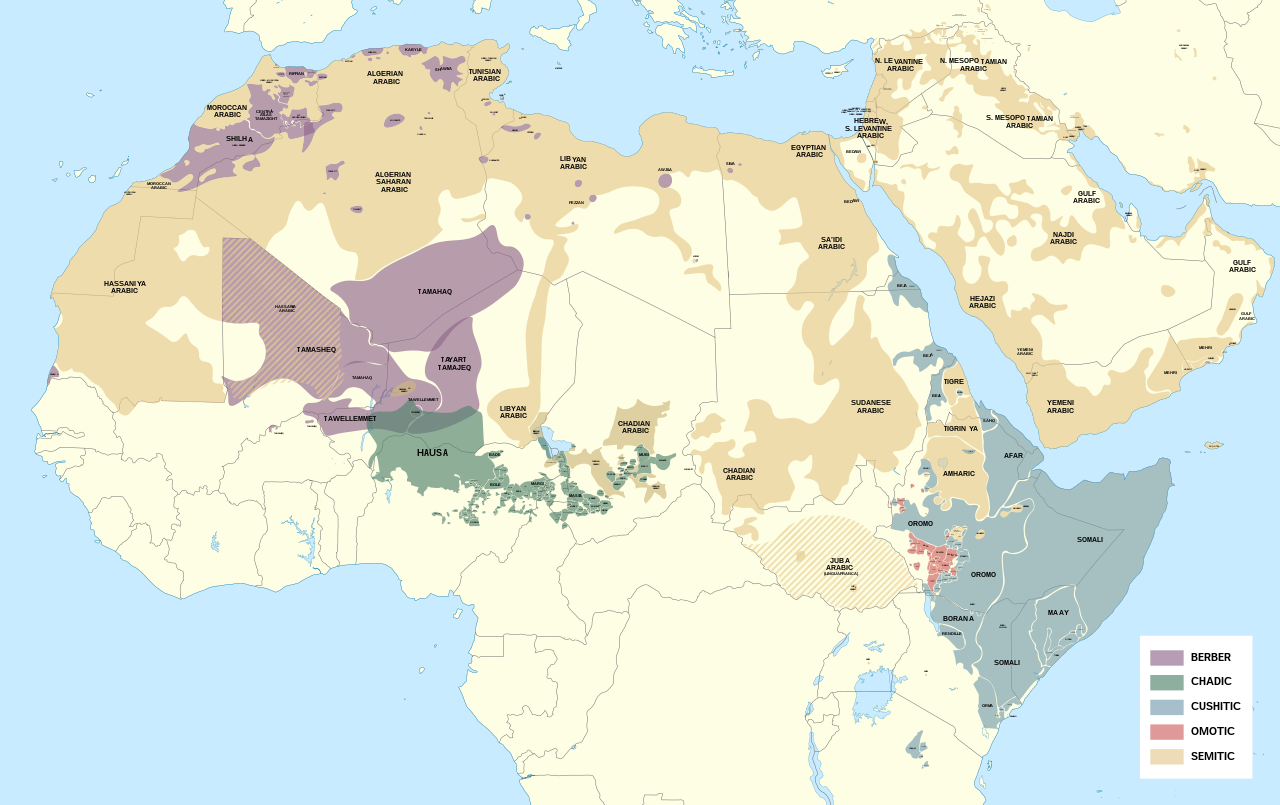
The Afroasiatic language family is one of the world's largest and oldest, encompassing over 400 languages spoken by approximately 500 million people across North Africa, the Horn of Africa, and the Middle East. Its members include some of the most historically important languages in human civilization — Arabic, Hebrew, Amharic, Hausa, and the Berber languages — as well as the oldest recorded language on Earth, ancient Egyptian.
Introduction
The family's name reflects its unique geographic span: "Afro" for its deep African roots (four of its six branches are exclusively African) and "Asiatic" for the Semitic branch that spread into the Middle East. This dual continental presence has fueled centuries of debate about whether the family originated in Africa or Asia, with current evidence slightly favoring an origin in the Horn of Africa or the eastern Sahara.

The Six Branches
- Semitic: Arabic, Hebrew, Amharic, Tigrinya — ~350 million speakers
- Berber: Tamazight, Kabyle, Tuareg — ~40 million speakers
- Chadic: Hausa and ~200 languages — ~80 million speakers
- Cushitic: Somali, Oromo, Afar — ~50 million speakers
- Omotic: ~5 million speakers in Ethiopia
- Egyptian: Ancient Egyptian/Coptic — extinct as a spoken language
The Semitic branch is by far the largest, dominated by Arabic with its approximately 310 million native speakers across 25 countries. Hebrew, revived as a spoken language in the 20th century, has about 9 million speakers. Amharic, the working language of Ethiopia, has roughly 32 million native speakers. The Semitic branch is the only one with members outside Africa, having spread into the Middle East thousands of years ago.
The Chadic branch, centered in Nigeria and the Lake Chad basin, is the most diverse with approximately 200 languages, though the vast majority of speakers use Hausa. Hausa is the most spoken language in West Africa with about 80 million speakers (native and second language) and serves as a trade lingua franca across the Sahel. The Berber languages, spoken by the indigenous peoples of North Africa from Morocco to Egypt, have experienced a cultural revival in recent decades, with Tamazight gaining official status in Morocco (2011) and Algeria (2016).
Ancient Roots
- Age: Proto-Afroasiatic estimated at 12,000-18,000 years old
- Oldest Written Member: Ancient Egyptian (~3200 BC)
- Proposed Homeland: Horn of Africa or Eastern Sahara (debated)
- Earliest Semitic Records: Akkadian cuneiform (~2400 BC)
Afroasiatic may be one of the oldest demonstrable language families in the world. Estimates for the age of Proto-Afroasiatic range from 12,000 to 18,000 years ago, potentially making it older than Proto-Indo-European by several millennia. The family's earliest written record is ancient Egyptian, with hieroglyphic inscriptions dating to approximately 3200 BC, followed by Akkadian cuneiform around 2400 BC.
The question of where the Afroasiatic family originated remains one of the great debates in historical linguistics. The majority of branches (Chadic, Cushitic, Omotic, Berber, Egyptian) are exclusively African, suggesting an African origin. The most widely supported hypothesis places the homeland in the Horn of Africa or the eastern Sahara during the early Holocene, when the region was wetter and more habitable than today. From there, the Semitic branch crossed into the Arabian Peninsula and spread throughout the Middle East.
Shared Features
- Root System: Triconsonantal roots (k-t-b = writing in Arabic, Hebrew)
- Gender: Two grammatical genders (masculine/feminine)
- Verb Morphology: Extensive internal vowel changes to mark tense and aspect
- Pharyngeal Sounds: Distinctive throat sounds shared across branches
The most famous Afroasiatic feature is the consonantal root system, best known from Arabic and Hebrew. In Arabic, the three consonants k-t-b form a root meaning "writing": kitab (book), kataba (he wrote), maktub (written), maktaba (library), katib (writer). Hebrew uses the same root: sefer (book, from s-f-r), katav (he wrote, from k-t-v). This system of extracting meaning from consonant patterns while vowels change grammatically is found across the family.
Afroasiatic languages share distinctive pharyngeal consonants — sounds produced deep in the throat that are rare in other language families. The Arabic sounds represented by the letters ayn and ha are examples familiar to many, and similar sounds appear in Berber, Cushitic, and Chadic languages. These shared sounds, combined with the root system and two-gender grammar, form a cluster of features that distinguishes Afroasiatic from neighboring language families.
Modern Dynamics
- Arabic: Largest member, expanding through religion and media
- Hebrew: Uniquely revived from liturgical to daily use in 20th century
- Berber Revival: Tamazight gaining official status and school instruction
- Endangered: Many smaller Chadic and Cushitic languages losing speakers
Arabic continues to expand its reach as the liturgical language of 1.8 billion Muslims and through Arabic-language media like Al Jazeera, which broadcasts to hundreds of millions. The Arabic linguistic situation is complex: Modern Standard Arabic serves as the formal written language, but spoken Arabic varies dramatically from Morocco to Iraq, with some dialects mutually unintelligible.
Hebrew's revival is perhaps the most remarkable linguistic achievement of the modern era. Essentially a liturgical language by the early 19th century, Hebrew was revived as a spoken vernacular by Eliezer Ben-Yehuda and Zionist settlers in Palestine, becoming the daily language of Israel's 9 million citizens. No other language has been successfully revived from near-extinction to full national use, making Hebrew the only "dead" language to have come back to life.
Key Facts
- Afroasiatic includes 400+ languages spoken by ~500 million people across Africa and the Middle East
- Arabic (~310 million native speakers) is the largest member; Hausa (~80 million) dominates the Chadic branch
- Proto-Afroasiatic may be 12,000-18,000 years old, making it one of the oldest demonstrable language families
- The triconsonantal root system (e.g., k-t-b for "writing") is the family's most distinctive shared feature
- Hebrew is the only language in history successfully revived from liturgical-only to full daily national use
Fun Facts
- Ancient Egyptian, the language of the pharaohs, is Afroasiatic — making the family's written record 5,200+ years old
- The Arabic word "algorithm" comes from the name of the mathematician al-Khwarizmi — connecting math to Afroasiatic
- Hausa is written in two scripts: Latin (Boko) in Nigeria and Arabic-based (Ajami) in Niger and traditional contexts
- The Berber Tifinagh script, used by the Tuareg, is one of the oldest alphabets in continuous use, descended from ancient Libyan
Final Thoughts
The Afroasiatic language family is a bridge between continents and millennia. From the hieroglyphs of ancient Egypt to the Arabic of modern media, from the revived Hebrew of Israel to the Hausa of West African markets, this family encompasses an extraordinary range of human expression. Its 400+ languages, spoken across the breadth of North Africa and deep into the Middle East, carry forward linguistic traditions that have shaped civilization for over five thousand years of recorded history.
Test Your Knowledge!
Think you know your world languages? Try our interactive quiz!
Play Geography Games →