

Annapurna I, standing at 8,091 meters in north-central Nepal, was the first 8,000-meter peak ever climbed — a historic achievement by Maurice Herzog and Louis Lachenal on June 3, 1950. Despite this pioneering distinction, or perhaps because of the harrowing conditions revealed by that first ascent, Annapurna has maintained the highest fatality rate of any 8,000-meter peak, with approximately one death for every three successful summits.
Introduction
The Annapurna massif stretches 55 kilometers and includes one peak above 8,000 meters, thirteen above 7,000 meters, and sixteen above 6,000 meters. While the summit of Annapurna I remains one of mountaineering's most dangerous objectives, the region is also home to the famous Annapurna Circuit — one of the world's greatest trekking routes, drawing tens of thousands of hikers annually through spectacular Himalayan landscapes.
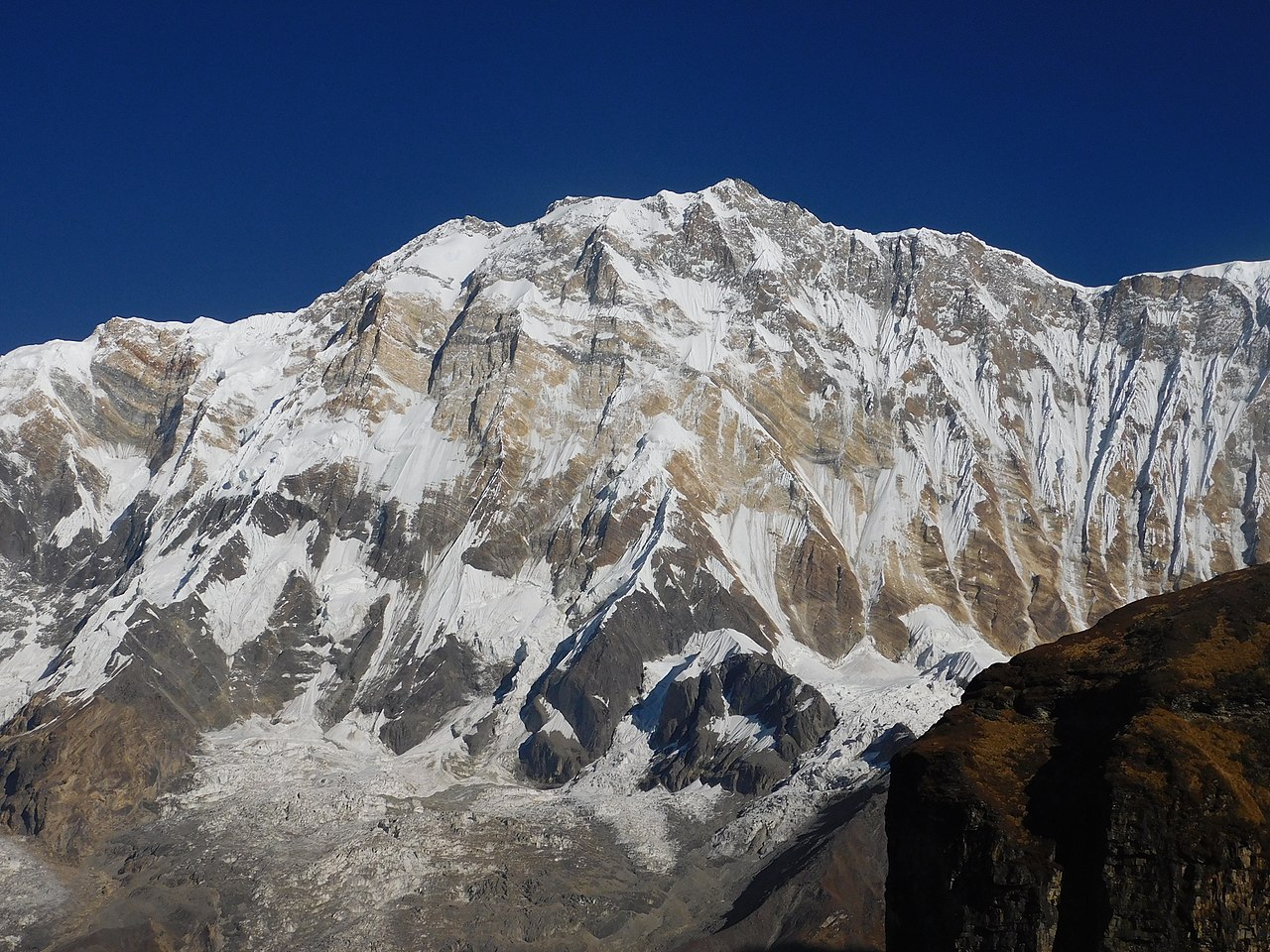
Geography & Dimensions
- Height: 8,091 m (26,545 ft)
- Massif Length: 55 km
- Location: Gandaki Province, Nepal
The Annapurna massif forms a curved barrier in central Nepal, with Annapurna I at its western end. The massif includes several major peaks: Annapurna I (8,091 m), Annapurna II (7,937 m), Annapurna III (7,555 m), Annapurna IV (7,525 m), and Gangapurna (7,455 m). The Kali Gandaki Gorge, one of the deepest gorges in the world, separates the Annapurna and Dhaulagiri massifs.
The south face of Annapurna I rises over 3,000 meters from its base — one of the largest and most imposing mountain faces on Earth. This immense wall of rock, ice, and snow has been the stage for some of mountaineering's greatest achievements and most tragic losses.
Geology & Formation
- Rock Type: Sedimentary and metamorphic
- Notable Feature: Kali Gandaki Gorge (one of world's deepest)
- Tectonic Setting: Main Central Thrust zone
Annapurna lies along the Main Central Thrust, a major geological fault where the Indian plate is being forced beneath the Tibetan plateau. The massif is composed of a complex mix of sedimentary and metamorphic rocks, including limestone, schist, and gneiss. The dramatic vertical relief of the south face exposes these rock layers in a spectacular geological cross-section.
The Kali Gandaki Gorge between Annapurna and Dhaulagiri reaches depths of over 5,500 meters from the surrounding peaks to the river below, making it one of the deepest gorges in the world. Ancient ammonite fossils found at high elevations in the Annapurna region provide evidence that these rocks were once beneath the Tethys Sea.
Climate & Conditions
- South Face Precipitation: Over 5,000 mm annually
- Avalanche Risk: Extremely high on most routes
- Best Climbing Season: April-May
Annapurna's position in the central Himalayas exposes it to heavy monsoon precipitation, particularly on its southern slopes, which receive over 5,000 mm of precipitation annually. This heavy snowfall, combined with the mountain's steep terrain, creates extremely high avalanche risk — the primary cause of death on the peak.
The mountain's weather is notoriously unstable. The south face creates its own weather patterns, with thermal updrafts generating afternoon storms even during the climbing season. The north side, in the rain shadow, receives less precipitation but is exposed to powerful winds descending from the Tibetan plateau.
Climbing History
- First Ascent: June 3, 1950 — Maurice Herzog & Louis Lachenal
- Fatality Rate: ~34% historically (highest of any 8,000er)
- South Face First Ascent: 1970 — Chris Bonington's British expedition
The first ascent of Annapurna by Herzog and Lachenal was an epic of survival. The French expedition struggled to even find a route to the mountain, and the summit push left both climbers severely frostbitten. Herzog lost all his fingers and toes, and Lachenal lost all his toes. Herzog's account, "Annapurna: First Conquest of an 8,000-Meter Peak," became one of the best-selling mountaineering books of all time.
The first ascent of the south face in 1970 by a British team led by Chris Bonington was a landmark achievement in Himalayan climbing. Don Whillans and Dougal Haston reached the summit via the immense wall, opening a new chapter in high-altitude alpinism. Tragically, Ian Clough was killed by a serac collapse during the descent, foreshadowing the face's continuing toll on climbers.
Conservation & Challenges
- Protected Area: Annapurna Conservation Area (7,629 km²)
- Annual Trekkers: Over 150,000
- Key Challenge: Balancing tourism with conservation
The Annapurna Conservation Area, established in 1986, is Nepal's largest protected area at 7,629 square kilometers. It was the first conservation area in Nepal to be managed by a non-governmental organization (the National Trust for Nature Conservation), pioneering a community-based conservation model that has become a template for protected areas throughout the Himalayas.
The Annapurna Circuit, a 160-230 km trekking route that encircles the massif, is one of the world's premier long-distance treks. It draws over 150,000 trekkers annually, generating significant income for local communities but also creating environmental pressures including waste management, deforestation for fuel, and trail erosion. Road construction along parts of the circuit has altered the traditional trekking experience.
Key Facts
- Annapurna was the first 8,000-meter peak ever climbed, in 1950, three years before Everest.
- The mountain has the highest fatality-to-summit ratio of any 8,000-meter peak at approximately 34%.
- The south face rises over 3,000 meters — one of the largest mountain faces on Earth.
- The Annapurna Conservation Area is Nepal's largest protected area at 7,629 km².
- Ancient ammonite fossils found on Annapurna prove these rocks were once beneath an ancient sea.
Fun Facts
- Maurice Herzog's book about the first ascent sold over 11 million copies worldwide, making it the best-selling mountaineering book ever.
- The Annapurna Circuit trek crosses the Thorong La pass at 5,416 m, one of the highest trekking passes in the world.
- The Kali Gandaki Gorge between Annapurna and Dhaulagiri is so deep that you can stand at the river and look up at two 8,000-meter peaks simultaneously.
- Annapurna means "Goddess of the Harvests" in Sanskrit, reflecting the mountain's importance to local agricultural communities.
Final Thoughts
Annapurna occupies a unique place in mountaineering history as both the first 8,000-meter peak to be climbed and the most dangerous to attempt. Its deadly combination of extreme avalanche risk, unstable weather, and technical difficulty has humbled generations of climbers. Yet the Annapurna region also offers some of the finest trekking on Earth, drawing adventurers from around the world to witness the majesty of the Himalayan giants up close.
Test Your Knowledge!
Think you know your mountains? Try our interactive geography quiz!
Play Geographic Features Quiz →