
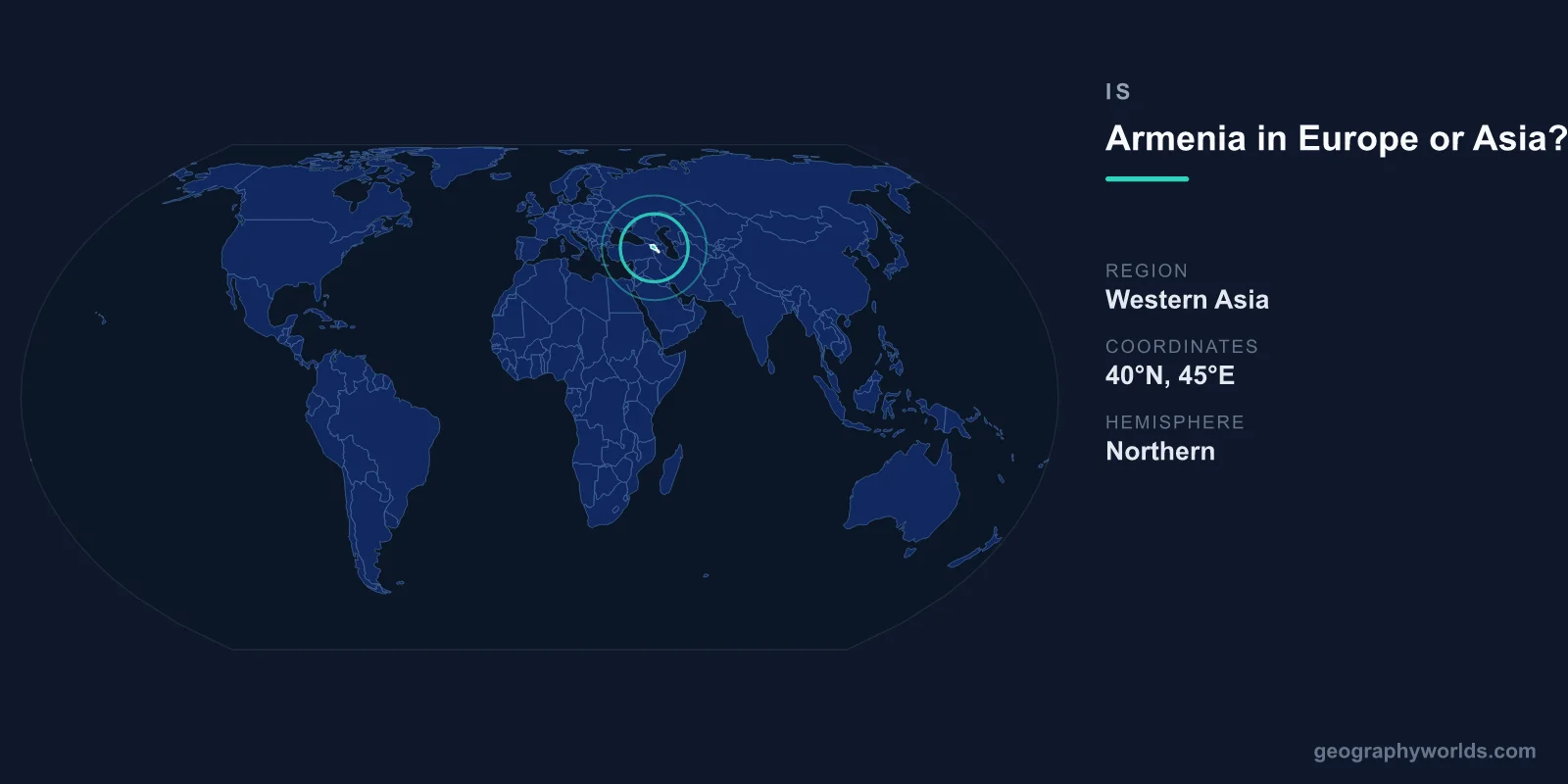
Armenia is most commonly classified as part of Asia, sitting in the South Caucasus just south of the conventional Europe-Asia boundary, but it is frequently treated as transcontinental because of its deep political and cultural ties to Europe. The short answer depends on whether you ask a physical geographer or a cultural and political institution, and Armenia is one of the clearest examples of how those two answers can diverge.
The Short Answer: Asia by Geography, Europe by Affiliation
Physically, Armenia lies entirely south of the watershed of the Greater Caucasus mountains, the line most geographers use to separate the European and Asian landmasses. By that standard, the country falls within Western Asia. The CIA World Factbook places Armenia in "Southwestern Asia," and the United Nations groups it under Western Asia as well. At the same time, Armenia belongs to several pan-European bodies, competes in European sporting and cultural events, and shares centuries of religious and historical connection with Europe. So while the most defensible single answer is Asia, calling Armenia transcontinental or "European in spirit" is not wrong either.
Where Exactly Is Armenia?
Armenia is a small, landlocked, mountainous country in the South Caucasus, a region that bridges the Black Sea and the Caspian Sea. It is bordered by four neighbours: Georgia to the north, Azerbaijan to the east, Iran to the south, and Turkey to the west. With an area of roughly 29,743 square kilometres and a population of around three million, it is one of the smaller countries in the region. Its capital, Yerevan, is one of the oldest continuously inhabited cities in the world, founded in 782 BC, which makes it older than Rome. You can explore more in our armenia country guide.
Why the Boundary Is So Contested Here
The Europe-Asia divide is a human convention rather than a fact of physical geography, and the South Caucasus is precisely where that convention breaks down. Cartographers have used several competing lines over the centuries:
- The Greater Caucasus watershed: This is the most widely accepted modern boundary. It runs along the crest of the mountain range to Armenia's north, placing all three Caucasus nations (Armenia, Georgia, and Azerbaijan) in Asia.
- The Aras (Araxes) River and historic lines: Some older schemes ran the boundary further south, which would have pulled parts of the Caucasus into Europe.
- The Kuma-Manych Depression: An alternative line north of the mountains that, if used, would place the entire Caucasus firmly in Asia.
Because reasonable mapmakers have drawn the line in different places, Armenia ends up sitting in the grey zone no matter which version you choose to emphasise.
Armenia's European Connections
The cultural case for "Europe" is strong and helps explain why so many people instinctively answer that way. Armenia was the first nation in the world to adopt Christianity as its state religion, in 301 AD, tying it to a shared European Christian heritage centuries before many Western European kingdoms converted. In the modern era, Armenia is a full member of the Council of Europe, participates in the Eurovision Song Contest, and its football and other sports teams compete in European federations such as UEFA. The country also has association agreements and trade ties with the European Union. These institutional memberships are reserved for or strongly associated with European states, which reinforces the perception that Armenia "belongs" to Europe even though it sits geographically in Asia.
The Landscape That Defines It
Whichever continent you assign it to, Armenia's terrain is unmistakably highland. The country sits on the Armenian Highlands, with an average elevation of about 1,800 metres, making it one of the most consistently elevated nations on Earth. Mount Ararat, the enduring national symbol depicted on Armenia's coat of arms, is visible from Yerevan but actually lies just across the border in modern Turkey. Lake Sevan, perched at roughly 1,900 metres, is one of the largest high-altitude freshwater lakes in the world and a centrepiece of Armenian life and tourism. This rugged, elevated geography is part of why the Caucasus has historically been seen as a natural frontier between worlds.
Frequently Asked Questions
Is Armenia officially in Europe or Asia?
There is no single official ruling. Most geographic authorities, including the United Nations and the CIA World Factbook, place Armenia in Western (Southwestern) Asia. However, it is a member of European political and cultural organisations, so it is also commonly described as transcontinental or European by affiliation.
Why does Armenia compete in Eurovision and UEFA?
Membership in those bodies is based on political and cultural eligibility rather than strict physical geography. Like several other South Caucasus and West Asian states, Armenia is accepted into European cultural and sporting institutions because of its historical ties to Europe, not because it lies north of the continental boundary.
Is Armenia part of the European Union?
No. Armenia is not a member of the European Union, though it has signed cooperation and partnership agreements with the EU and maintains close trade and diplomatic relations with European states.
What continent are Armenia's neighbours on?
Georgia and Azerbaijan share Armenia's transcontinental ambiguity and are usually classed as Asia with European affiliations. Iran and Turkey are both predominantly Asian, although Turkey famously straddles the boundary with a small portion in Europe around Istanbul.