
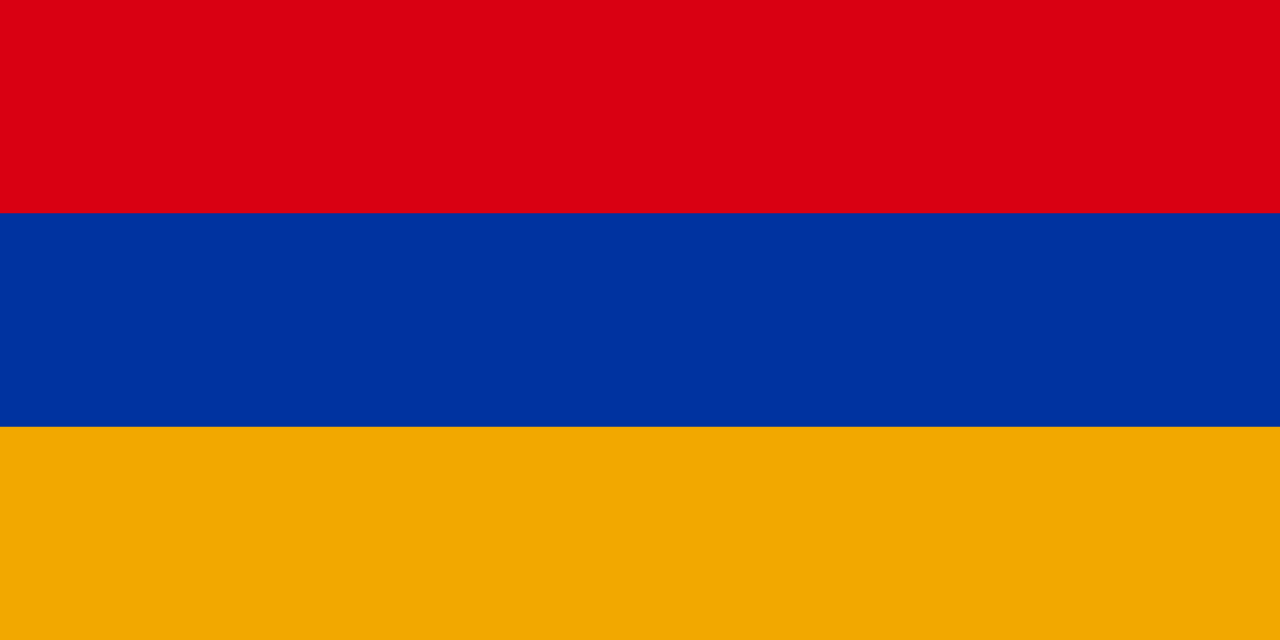
Few national emblems carry their history as openly as the Armenian tricolor. Three broad horizontal stripes of red, blue, and orange stretch across the cloth, and each band speaks to a different chapter of one of the world's oldest continuous cultures. To Armenians at home and across a vast worldwide diaspora, this banner is shorthand for survival, memory, and creative spirit. It is a flag that was lost, mourned, and then deliberately reclaimed, which gives its simple stripes an emotional weight far heavier than their plain geometry suggests.
What looks at first glance like a clean, modern triband is in fact a revival of a design first raised by the short-lived First Republic of Armenia in 1918. When Armenia regained its independence at the close of the Soviet era, lawmakers reached back into that earlier moment of self-rule rather than inventing something new. The result is a flag that connects the present nation directly to the brief democratic state that preceded decades of Soviet rule.
The Three Colors and What They Stand For
The Armenian flag uses a tightly defined palette of red, blue, and orange, with each stripe assigned a distinct meaning rooted in the country's experience. The top red band represents the blood shed by Armenians in defense of their homeland and faith, a reference to centuries of struggle for the right to exist as a people. The middle blue stripe stands for the clear Armenian sky and the will to live peacefully beneath it. The lower orange band symbolizes the creative talent and hardworking nature of the Armenian people.
That bottom stripe is the source of one of the flag's most charming details. The orange is frequently described as apricot, a fruit so closely tied to Armenia that its scientific name, Prunus armeniaca, literally means "Armenian plum." For many Armenians, the warm apricot tone is not just a color but a taste of home, linking the flag to the orchards and harvests of the land itself.
A Closer Look at the Design
The construction of the flag could hardly be simpler. It is a horizontal triband: three equal stripes stacked one above the other, with no charges, seals, crests, or text interrupting the fields of color. Red sits on top, blue runs through the center, and orange anchors the bottom. The proportions follow a standard rectangular ratio, and the bands are of equal height, giving the flag a balanced, unfussy appearance.
This minimalism is intentional and effective. Because there is no emblem to render, the design reads cleanly at any size, from a tiny lapel pin to a stadium-sized banner. The strength of the flag lies entirely in its color combination, which is unusual enough to be instantly recognizable once you know it. The clarity also makes it easy to reproduce by hand, a practical virtue for a symbol carried in protests, parades, and homes around the world.
How the Flag Evolved Over Time
The story of this flag is really the story of Armenia's two windows of independence. The original tricolor flew over the First Republic of Armenia, founded in 1918 in the turbulent aftermath of empire and war. That republic survived only a couple of years before being absorbed into the Soviet Union, and its flag disappeared from official use. Through the Soviet decades, Armenia flew red banners in the style of the other Soviet republics, and the tricolor lived on chiefly in the diaspora and in private memory.
The turning point came in 1990, as the Soviet system weakened and Armenia moved toward sovereignty. The country's legislature readopted the red, blue, and orange tricolor, restoring the emblem of the First Republic. When full independence arrived the following year, the flag was already in place, a tangible thread connecting the new state to its 1918 predecessor. In this sense the flag was not so much created as recovered, a deliberate act of historical continuity.
Comparing It to Other Tricolors
Horizontal tricolors are common around the world, so it is worth noting what sets the Armenian version apart. Many people first reach for comparisons to other red-blue flags, but the orange band is the decisive feature. Few national flags use orange as a primary horizontal stripe, which means that once the apricot tone is in the mix, confusion with most European tricolors largely evaporates.
Consider a few near-neighbors in the design space:
- Netherlands and Luxembourg: Both use red, white, and blue horizontal bands, sharing the triband format but with an entirely different palette and a white center rather than blue.
- Russia: Also a horizontal red-blue-white triband, with the colors stacked in a different order and no orange anywhere.
- Colombia: Features a yellow stripe that can read as orange-adjacent, but its bands are unequal and paired with blue and red in a distinct arrangement.
- India: Includes a saffron (deep orange) top stripe, but with white and green bands and a navy wheel at the center, making the resemblance superficial at best.
Place the Armenian flag beside any of these and the differences are immediate. The specific sequence of red over blue over apricot, with three equal bands and no central emblem, is a combination that belongs to Armenia alone.
Cultural Meaning and National Identity
For a nation whose people are spread across continents, the flag carries an outsized role in holding identity together. Armenian communities in the Middle East, Europe, the Americas, and beyond fly the tricolor at churches, cultural centers, and commemorations, using it as a rallying point for a shared heritage that survived deportation, massacre, and exile. The red stripe in particular resonates during remembrance of the suffering endured by Armenians, while the whole banner serves as a statement that the nation endured.
Within Armenia, the flag appears at every layer of public life, from government buildings perched above the capital to schools, monuments, and the slopes near Mount Ararat, the snow-capped peak that looms over the national imagination even though it sits across the border. Readers curious about the wider landscape, language, and traditions behind the banner can explore our armenia country guide for the fuller picture. The tricolor is the visual anchor for all of it, instantly summoning a sense of place and belonging.
The Flag in Modern Life
Today the tricolor is woven into the rhythm of Armenian civic life. It is raised on Independence Day and during national commemorations, draped over public squares, and waved at festivals that celebrate everything from music to the apricot harvest. The colors turn up in everything from official seals to street decorations, keeping the palette constantly present in the visual environment.
Sport gives the flag some of its most joyful outings. Armenian fans bring the red, blue, and orange to football matches, chess tournaments, wrestling mats, and weightlifting platforms, where the country has long punched above its weight. At international competitions, athletes drape themselves in the tricolor after a win, and the flag rises during medal ceremonies, broadcasting Armenia's presence to a global audience. Among the diaspora, those same colors appear at community gatherings and demonstrations, ensuring the banner is never far from view.
Here are a few quick facts worth keeping in mind:
- The flag is a horizontal triband of red, blue, and orange in equal bands.
- It was readopted in 1990, reviving the design of the First Republic of Armenia from 1918.
- The bottom orange stripe is often described as apricot, echoing a fruit deeply associated with the country.
- Armenia sits at the crossroads of Asia, in the South Caucasus region, bridging Europe and Asia.
- The design carries no emblem or text, relying entirely on its color combination for recognition.
Frequently Asked Questions
When was the Armenian flag adopted?
The current flag was adopted in 1990, as Armenia moved toward independence at the end of the Soviet period. Rather than designing a brand-new banner, lawmakers restored the red, blue, and orange tricolor that had first flown over the First Republic of Armenia in 1918, reconnecting the modern state to that earlier era of self-rule.
What do the colors of the Armenian flag mean?
Each stripe has its own meaning. The red band represents the blood shed by Armenians defending their homeland; the blue band stands for the Armenian sky and the desire to live in peace; and the orange (often called apricot) band symbolizes the creative talent and industrious character of the Armenian people.
Who designed the Armenian flag?
The flag is not credited to a single individual designer in the way some modern flags are. It is a revival of the 1918 First Republic flag, so the modern banner is best understood as a restoration of an existing historical design rather than a new creation. The 1990 adoption was a legislative decision to bring back that earlier tricolor.
What continent is Armenia on?
Armenia lies in Asia, specifically in the South Caucasus region between the Black and Caspian seas. Because of its location at the meeting point of Europe and Asia, it is often discussed as a transcontinental or Eurasian country, and it maintains deep cultural and political ties to both regions.