
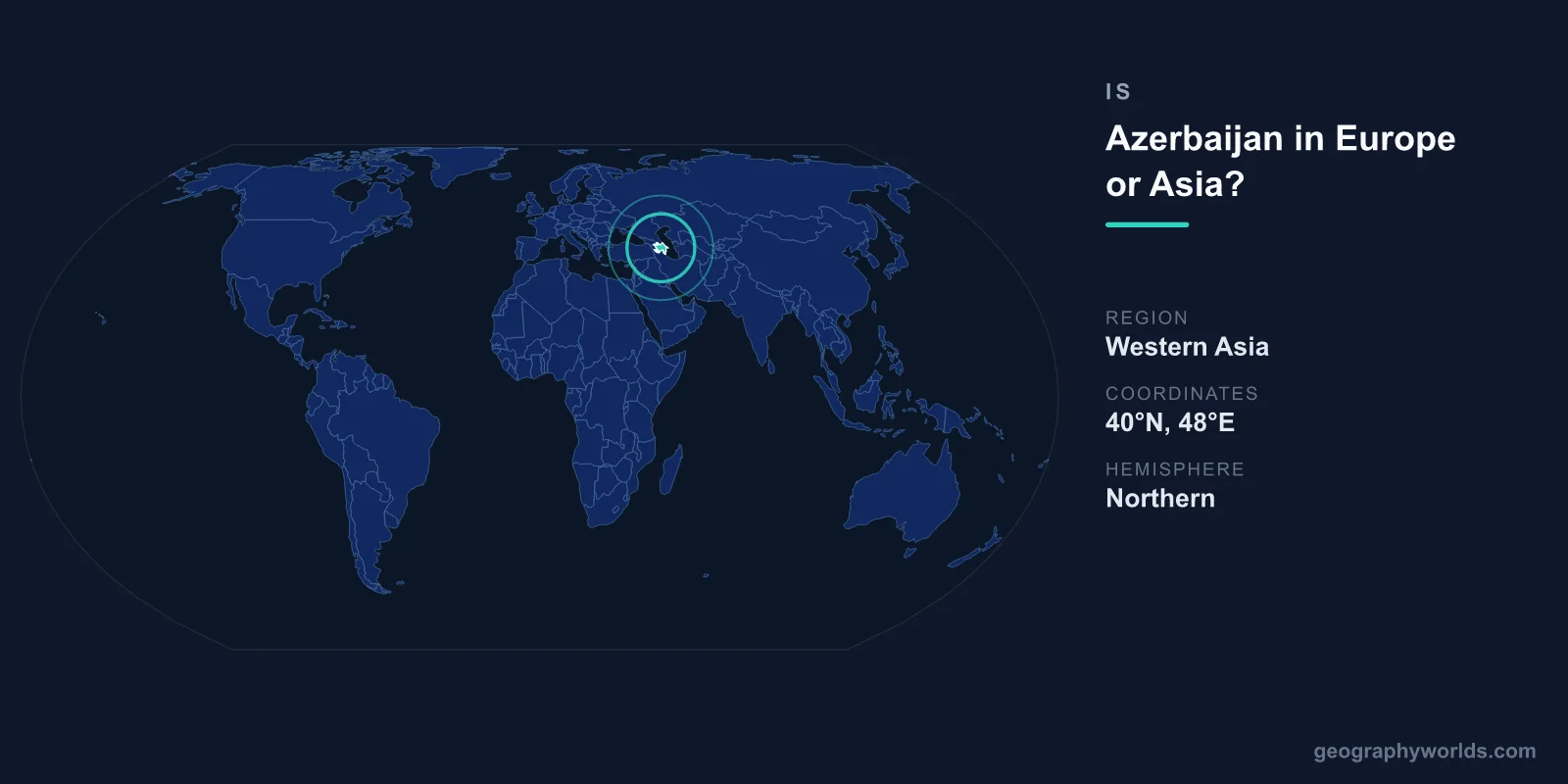
Azerbaijan is usually classed as an Asian country that also has a foothold in Europe. The most widely used boundary between the continents follows the crest of the Greater Caucasus mountains, which runs through northern Azerbaijan. That puts a strip of the country's north-east in Europe and the rest, including the capital Baku, in Asia. The United Nations statistics division places Azerbaijan in Western Asia. Politically and culturally, however, it takes part in many European institutions, from the Council of Europe to Eurovision and UEFA, which is why it so often appears on European lists as well.
Three Ways to Draw the Line
There is no natural wall between Europe and Asia in the Caucasus. The boundary is a convention, and geographers have drawn it in at least three places. Each gives a different answer for Azerbaijan.
The Greater Caucasus watershed is the line most atlases use today. It runs along the main ridge from the Black Sea to the Caspian. Azerbaijan's highest mountain, Bazardüzü, at 4,466 m, stands right on it, on the border with Russia's Dagestan. North of the ridge, the districts that slope down towards the Caspian coast, around Quba, Qusar and Khachmaz, fall in Europe. The rest of the country, south of the ridge, including Baku, the Kura valley and the Karabakh region, is in Asia.
The Kuma–Manych Depression, a low-lying valley in southern Russia north of the Caucasus, was long used by Soviet and Russian geographers. It puts the whole Caucasus, and all of Azerbaijan, in Asia.
An older convention, used by some nineteenth-century geographers, followed rivers south of the mountains: the Rioni and Kura, or in some versions the Aras. Because the Aras forms Azerbaijan's southern border with Iran, a line along it would put almost all of Azerbaijan in Europe. That convention has largely fallen out of use, but it explains why some older maps show the Caucasus as European.
Azerbaijan's neighbours face the same question. Georgia and Armenia are covered in our explainers on whether Georgia is in Europe or Asia and the same question for Armenia.
The Land Itself
Azerbaijan covers about 86,600 km², a little larger than Austria and a little smaller than Portugal, and has about 10.2 million people. Its landscape runs in bands. The Greater Caucasus rises steeply in the north. The broad, dry lowland of the Kura and Aras rivers occupies the centre, and the Lesser Caucasus and the Talysh mountains near Iran rise in the west and south. To the east is the Caspian Sea, the largest enclosed body of water on Earth. Its surface lies about 28 m below sea level, so Baku, on the Absheron Peninsula, is the lowest-lying national capital in the world.
The Absheron Peninsula is also where Azerbaijan's most unusual geology shows. The country has several hundred mud volcanoes, a large share of all those known on land. Some bubble grey mud at Gobustan, south of Baku, where the rock also carries thousands of prehistoric carvings, a World Heritage Site. At Yanar Dag, a hillside of natural gas has burned continuously for decades, and the Ateshgah temple near Baku was built around jets of burning gas that attracted Zoroastrian and Hindu worshippers.
Between Persia and Russia
For most of its history, the land that is now Azerbaijan looked south and east rather than west. In antiquity it was home to Caucasian Albania, a kingdom unrelated to Albania in the Balkans, and for long periods it was ruled by Persian empires. The Safavid dynasty that made Iran Shia in the sixteenth century was itself of Turkic-speaking origin from this region. The shift towards Europe came through Russia. In two wars in the early nineteenth century, the Russian Empire took the khanates north of the Aras River from Persia, and the Treaties of Gulistan in 1813 and Turkmenchay in 1828 made the river the border. That line divided the Azerbaijani people between two states, where they remain today.
After the Russian Revolution, the Azerbaijan Democratic Republic, declared in 1918, became the first parliamentary republic in the Muslim world. It gave women the vote in 1918, before the United Kingdom or the United States granted women equal suffrage. It lasted only until the Red Army arrived in 1920, and Azerbaijan was then part of the Soviet Union until 1991.
Oil Made Baku European
Much of Azerbaijan's European connection came through oil. In the late nineteenth century Baku became one of the first great oil cities in the world. Investors including the Nobel brothers and the Rothschilds built refineries, pipelines and the first oil tankers, and around 1900 Baku produced about half of the world's oil. The wealth paid for a boulevard of European-style mansions in the city centre, designed by architects trained in St Petersburg and Western Europe.
After independence in 1991, oil and gas tied Azerbaijan to Europe again. The Baku–Tbilisi–Ceyhan pipeline, opened in 2006, carries Caspian oil about 1,770 km through Georgia to Turkey's Mediterranean coast, bypassing Russia. The Southern Gas Corridor, completed in 2020, sends Azerbaijani gas across Turkey, Greece and Albania to Italy, and the European Union has sought more of it as an alternative to Russian gas.
European Institutions, Asian Neighbours
In political and cultural life Azerbaijan leans partly towards Europe. It joined the Council of Europe in 2001. It competes in UEFA football and the Eurovision Song Contest, which it won in 2011, hosting the contest in Baku the next year. It staged the first European Games in 2015, and Baku has hosted a Formula One Grand Prix since 2016. It is not an EU candidate and has not sought to be, and its relations with European bodies have been strained. In 2024 the Parliamentary Assembly of the Council of Europe declined to ratify its delegation's credentials, citing human rights concerns.
Its other ties run east and south. Azerbaijani is a Turkic language closely related to Turkish, written in a Latin alphabet since the early 1990s, and Azerbaijan is a member of the Organization of Turkic States and the Organisation of Islamic Cooperation. Most Azerbaijanis are Shia Muslims, like the Azerbaijanis of north-western Iran, who outnumber those in Azerbaijan itself, although the state is secular. Baku hosted the UN climate conference, COP29, in November 2024.
How International Bodies Classify It
Different organisations answer the question differently, depending on their purpose. The UN statistics division lists Azerbaijan in Western Asia, with Georgia, Armenia, Turkey and the Arab states. The World Bank groups it in its Europe and Central Asia region, along with the other former Soviet republics. In sport it is European: its national teams play in UEFA competitions, and its Olympic committee belongs to the European Olympic Committees. For the European Union it is part of the Eastern Partnership, a neighbourhood policy rather than a membership track.
Nine Climates in a Small Country
Azerbaijan's mix of mountains, lowland and sea gives it an unusual range of climates for its size. Azerbaijani sources often say the country has nine of the eleven main climate types. The central Kura plain is semi-desert, hot in summer and dry. In the far south, the Lankaran lowland near the Iranian border is humid and subtropical, green enough to grow tea and citrus. The high Caucasus has alpine conditions with permanent snow on the highest peaks. Baku, on its exposed peninsula, is famous for its wind. The cold northerly khazri blows so often that the city's name is popularly, though doubtfully, derived from a Persian phrase meaning "city of winds".
Nakhchivan and Karabakh
Azerbaijan's map has two features that shape its politics. The first is Nakhchivan, an exclave of about 5,500 km² separated from the rest of the country by a strip of southern Armenia. It borders Armenia, Iran and, along a frontier of only a few kilometres, Turkey. For decades Azerbaijan has sought a land route across Armenia to connect it. In August 2025 the leaders of Armenia and Azerbaijan initialled a peace agreement in Washington that included plans for a transit route through southern Armenia.
The second is Karabakh. Its mountainous part, Nagorno-Karabakh, had an ethnic Armenian majority and broke away in a war from 1988 to 1994, with Armenian forces also taking surrounding Azerbaijani districts. Azerbaijan retook most of that territory in a 44-day war in 2020. In September 2023 a one-day offensive ended the breakaway government, and almost all of the region's roughly 100,000 Armenians fled to Armenia. The self-declared republic formally dissolved on 1 January 2024.
So Which Is It?
If the question is geographic, most of Azerbaijan is in Asia, with a small European corner north of the Caucasus crest. That puts it in the same small group of transcontinental countries as Russia, Turkey, Kazakhstan and Georgia, each divided by a line on a map rather than by anything a traveller would notice on the ground. If it is political or cultural, Azerbaijan belongs to both: a secular Muslim, Turkic-speaking country that sends a team to the European football championships and a song to Eurovision. Its long Caspian shoreline, the defining edge of the country, is described in our guide to the Caspian Sea.