

The Arctic is the cold, icy region at the very top of the Earth, around the North Pole. Its usual southern edge is the Arctic Circle, an imaginary line at about 66°33′ north. Inside it lie the frozen Arctic Ocean and the northern lands of eight countries: Canada, Denmark (through Greenland), Finland, Iceland, Norway, Russia, Sweden and the United States (through Alaska). In summer the sun can shine all night, and in winter it can stay hidden for weeks. Polar bears, Arctic foxes, narwhals and walruses live here, and so do people. The Inuit, the Sámi, the Nenets and other Indigenous peoples have made their homes in the Arctic for hundreds or thousands of years.
Where the Arctic Circle Draws Its Line at 66°33′N
Look at a globe and find the North Pole. Now move your finger down until you reach a dotted ring. That ring is the Arctic Circle. It sits at about 66°33′ north of the Equator. Everything north of it is usually called the Arctic.
The line marks a special place. On at least one summer day there, the sun does not set. On at least one winter day, it does not rise.
Here is a strange fact. The Arctic Circle moves. Earth wobbles slowly as it spins, and this shifts the line. Right now it is creeping north by about 14.5 metres every year. That is roughly the length of a school bus, every single year.
The Arctic Circle crosses the Arctic Ocean, Norway, Sweden, Finland, Russia, Alaska, Canada and Greenland. In Iceland it only touches one tiny island called Grímsey. In Canada, the Arctic lands belong to Yukon, the Northwest Territories and Nunavut.
People live inside the circle too, and some of their towns are big. Murmansk in Russia had 295,374 people when it was last counted. That makes it the largest city north of the Arctic Circle. Salekhard in Russia is special. It is the only city in the world that sits right on the Arctic Circle itself.
Arctic Sea Ice: Biggest in March, Smallest in September
The Arctic is mostly an ocean, not a continent. That is the big difference between the Arctic and Antarctica, which is land covered in ice. In the Arctic, the ocean itself freezes into a floating lid called sea ice.
Sea ice grows and shrinks like breathing. It spreads out through the long, dark winter and reaches its biggest size, called the maximum, near the end of March. Then the summer sun melts it. It shrinks to its smallest size, called the minimum, in September.
Scientists have measured sea ice from satellites since 1979. The US National Snow and Ice Data Center keeps the records. Those records show the ice is getting smaller. In September 2007 the minimum fell to about 4.16 million square kilometres, a record at the time. In 2012 it dropped to about 3.39 million square kilometres. That is still the smallest ever measured. In 2020 it reached 3.74 million square kilometres, the second smallest up to that time.
Winter ice is shrinking too. In March 2026 the sea ice topped out at about 14.22 million square kilometres. That was one of the lowest winter peaks in more than 40 years of satellite watching.
Why does it matter? White ice works like a mirror. It bounces sunlight back into space. Dark ocean water soaks the sunlight up and gets warmer. More warm water melts more ice, and the cycle keeps going. Scientists call an Arctic summer with less than 1 million square kilometres of ice “ice-free”. A 2021 report by the IPCC, the United Nations climate science panel, said this will likely happen in at least some Septembers before 2050.
Midnight Sun and Polar Night in Utqiagvik and Murmansk
Earth spins on a tilted axis. For half the year, the North Pole leans toward the sun. For the other half, it leans away.
In summer comes the midnight sun. The sun circles around the sky and never sets. In winter comes the polar night. The sun never rises above the horizon at all.
Take Utqiagvik in Alaska, the northernmost town in the United States. It used to be called Barrow, and about 5,000 people live there. Around 10 or 11 May, the sun stops setting. It stays up for 83 days in a row, until 1 or 2 August. Then, on about 18 November, the sun goes down and does not come back until about 23 January. That is a polar night of about 66 days.
Polar night is not pitch black all day. Even on the darkest December day, Utqiagvik gets about three hours of soft twilight around noon.
Closer to the Arctic Circle, the dark season is shorter. In Murmansk, three degrees north of the circle, the sun stays below the horizon for about 20 days on each side of the winter solstice. At the North Pole itself, the sun rises once a year and sets once a year. That gives roughly six months of day and six months of night.
Polar Bears, Arctic Foxes, Narwhals and Walruses
Polar bear
The polar bear is the largest bear in the world and the largest meat-eater that lives on land. Adult males weigh 300 to 800 kilograms. Under its white fur, its skin is black, and a thick layer of fat keeps it warm. Polar bears hunt seals, mostly ringed seals, from the sea ice. They often wait beside a breathing hole for a seal to pop up. Scientists think there are about 22,000 to 31,000 polar bears. The IUCN lists them as vulnerable, mainly because melting sea ice makes hunting harder.
Arctic fox
The Arctic fox is small. Males weigh about 3.5 kilograms on average, about the same as a house cat. Its fur gives the best insulation of any mammal. Most Arctic foxes are brown in summer and turn pure white in winter, which hides them against the snow. A special blood flow keeps their paw pads from freezing on the ice. They eat lemmings, birds and eggs, and scraps left by polar bears.
Narwhal
The narwhal is a whale with a tusk. The tusk is really a long tooth that grows out through the left side of the upper lip. In males it can reach 1.5 to 3 metres long. Narwhals live in the cold waters of Canada, Greenland and Russia. They can dive as deep as 2,370 metres, which makes them among the deepest-diving whales.
Walrus
Both male and female walruses have tusks, and they can grow up to 1 metre long. Walruses use them to haul themselves out of the water onto the ice. That is why their scientific name, Odobenus, comes from Greek words meaning “tooth walker”. Big Pacific males can weigh more than 2,000 kilograms. Walruses rest together in big crowds on ice and beaches. They feed on clams and other shellfish on the shallow seabed.

The Inuit, the Sámi and the Nenets
About a thousand years ago, around the year 1000, a people called the Thule began moving east from Alaska across the Arctic. The Inuit are their descendants. Today Inuit communities live in Alaska, northern Canada and Greenland, and on the Chukotka coast in Russia. The word for one person is Inuk. Many Inuit find the old English name “Eskimo” offensive, so it is best to say Inuit.
In Canada, the territory of Nunavut was created in 1999 so that Inuit could have their own government. Its capital is Iqaluit on Baffin Island. One of Nunavut’s official languages is Inuktitut, which in Nunavut is mostly written with symbols called syllabics. The word Inuktitut looks like this: ᐃᓄᒃᑎᑐᑦ. In Greenland most people are Inuit too. In 2022 the whole island had just 56,583 people. That makes it the least densely populated country in the world. In Greenlandic, Greenland is called Kalaallit Nunaat, “land of the Kalaallit”.
The Sámi live in Sápmi, a homeland that stretches across northern Norway, Sweden and Finland and Russia’s Kola Peninsula. Their languages belong to the same language family as Finnish. The best-known Sámi job is reindeer herding. In some areas of the Nordic countries, the law keeps reindeer herding for Sámi people only. The old English word “Lapp” is seen as offensive by many Sámi, who prefer their own name.
The Nenets live in the Russian Arctic, near the coast of the Arctic Ocean. Russia’s 2021 census counted almost 50,000 Nenets. Most live in the Yamalo-Nenets and Nenets regions. Their name for themselves means “real humans”. Many Nenets families follow their reindeer herds across the tundra. Oil and gas drilling on their land is a big worry for them today.
Other Arctic peoples include the Chukchi, Evenks, Yupik and Gwichʼin. Meet more in our guide to Arctic Indigenous peoples.
Peary, Henson and the 1926 Flight of the Norge
Explorers once raced to be first at the North Pole, and people still argue about who won.
Robert Peary was an officer in the United States Navy. He made Arctic journeys for about 23 years. His closest teammate was Matthew Henson, a Black American explorer born in Maryland in 1866. Henson went with Peary on seven Arctic voyages. He learned the Inuit language and became expert at driving dog sleds the Inuit way. Inuit men and women did much of the hard work on these expeditions too, and four Inuit men were in the final party with Peary and Henson.
In 1909 Peary’s team said it reached the North Pole on 6 April. Henson later said he was the first of the group to get there. Another American, Frederick Cook, claimed he got there a year earlier. For years, most people believed Peary. Now many experts doubt both men. In 1989 the British explorer Wally Herbert studied Peary’s records. He decided Peary did not reach the Pole, though he may have come within about 97 kilometres.
The first trip to the North Pole that experts count as verified came in 1926. It was made in an airship, a huge balloon with engines, called the Norge. The Norwegian explorer Roald Amundsen led the trip. The Italian engineer Umberto Nobile designed and flew the airship. An American, Lincoln Ellsworth, helped pay for it.
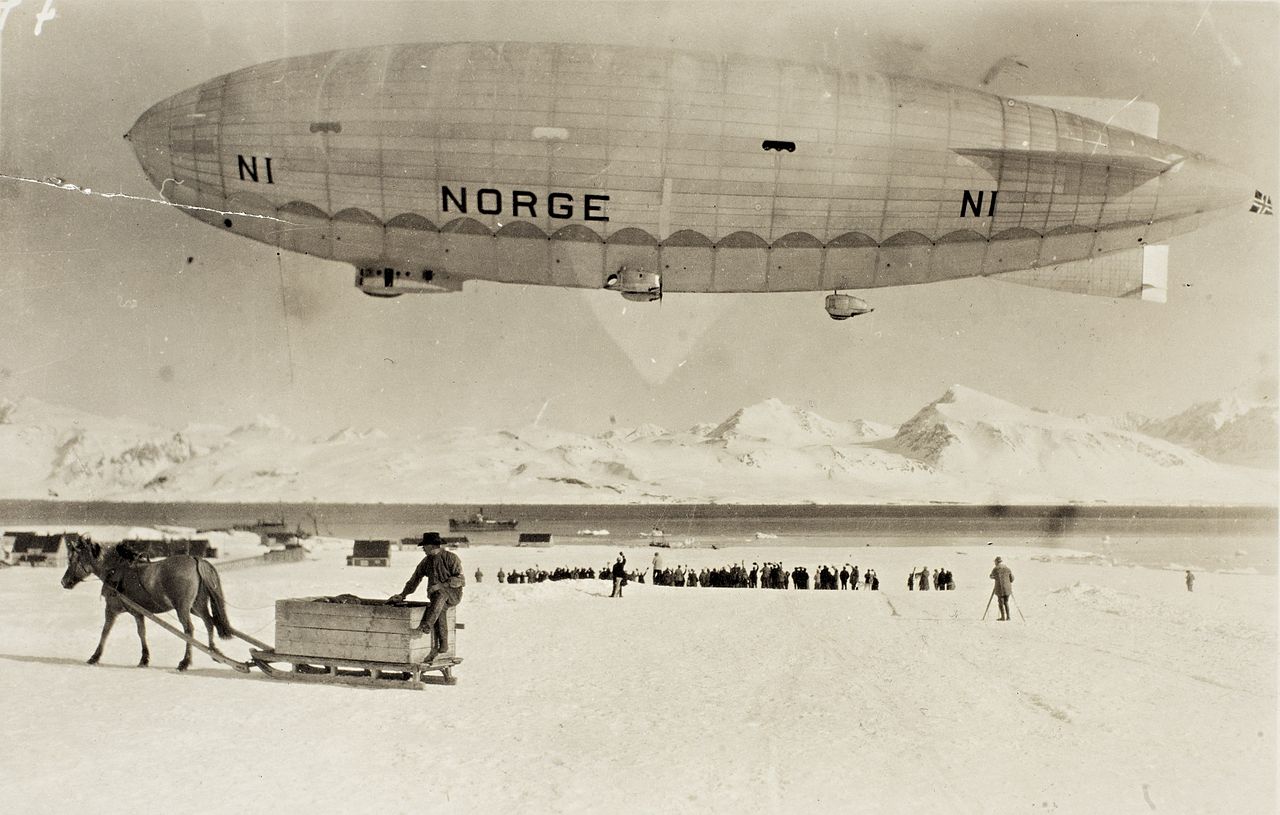
The Norge took off from Ny-Ålesund on Svalbard, Norway, on 11 May 1926. Sixteen men were on board, plus Nobile’s little dog, Titina. The airship floated right over the North Pole. Then it kept going across the frozen ocean and landed in the village of Teller, Alaska, on 14 May. It was the first aircraft to cross the polar ice between Europe and America.
If you want to see how the top of the world compares with the bottom, read our Arctic vs Antarctic comparison, then head south with Antarctica for kids.