
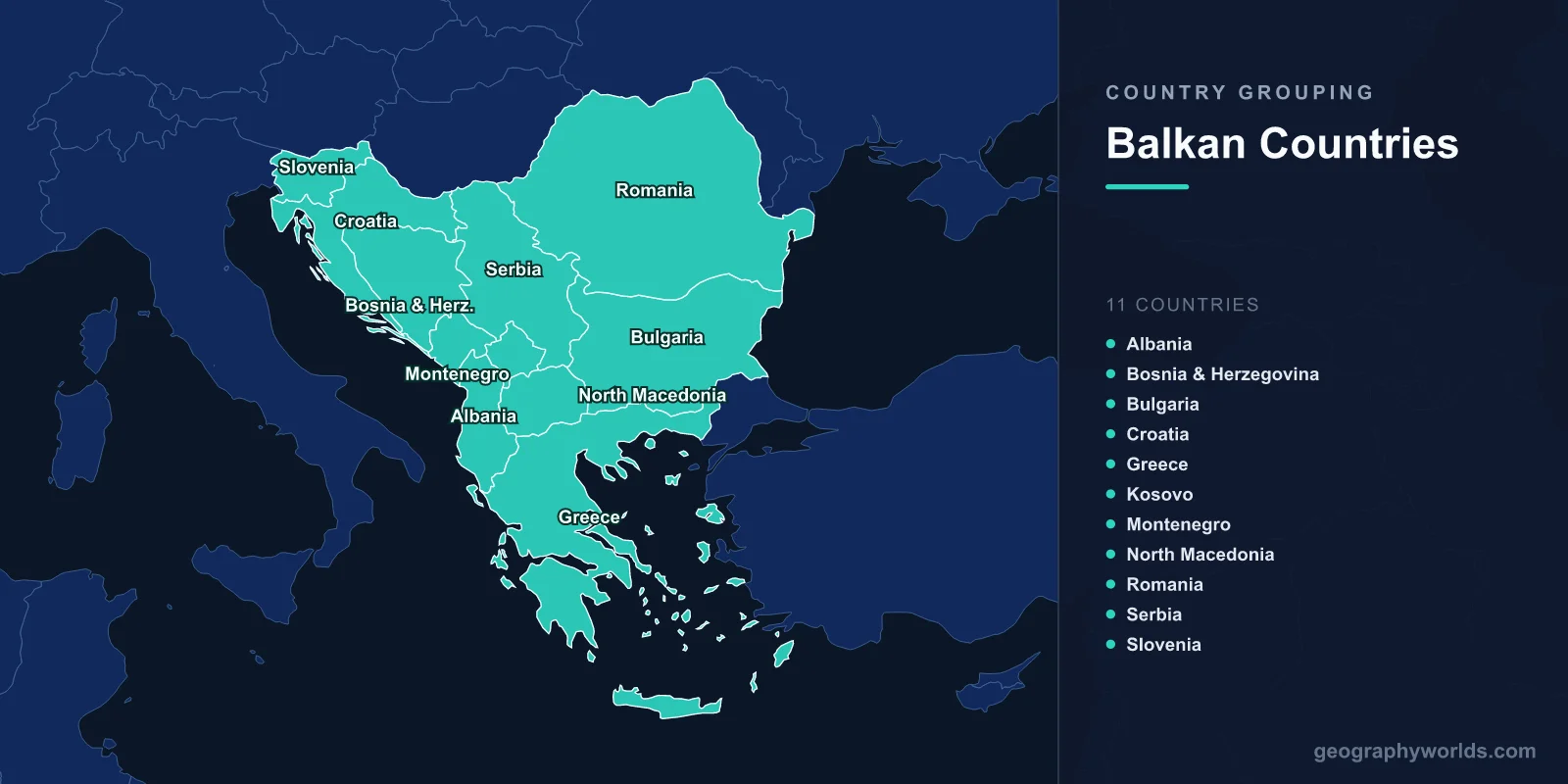
Introduction to Balkan Countries
The Balkan countries form one of Europe's most historically layered and geographically dramatic regions, spanning the mountainous peninsula of Southeast Europe between the Adriatic Sea to the west and the Black Sea to the east. Eleven nations — Albania, Bosnia and Herzegovina, Bulgaria, Croatia, Greece, Kosovo, Montenegro, North Macedonia, Romania, Serbia, and Slovenia — share this complex corner of the continent, each shaped by centuries of imperial rule, religious crosscurrents, and fierce struggles for national identity. The very word "Balkan" derives from the Turkish for "chain of wooded mountains," and the region's rugged terrain has long fostered distinct communities separated by valleys and ridges. From Greece's ancient civilization and Bulgaria's medieval empire to the twentieth-century tragedy of Yugoslavia's dissolution, the Balkan countries embody a story of resilience, cultural richness, and ongoing transformation as several nations pursue European Union membership while others consolidate their place within it.

Countries in Balkan Countries
- Albania
- Bosnia and Herzegovina
- Bulgaria
- Croatia
- Greece
- Kosovo
- Montenegro
- North Macedonia
- Romania
- Serbia
- Slovenia
Location: Southeast Europe, the Balkan Peninsula between the Adriatic, Black, and Mediterranean seas
Shared Characteristics: Ottoman and Habsburg heritage, religious and ethnic diversity, EU integration path, mountain terrain
History
The Balkans have served as a crossroads of empires since antiquity. Greece gave birth to Western civilization, democracy, and philosophy, while the Roman Empire built roads, aqueducts, and cities across the peninsula — Diocletian's Palace in Split, Croatia, remains one of the best-preserved Roman monuments anywhere. After Rome's fall the region was divided between the Latin West and the Byzantine East, a split that entrenched both Catholic and Orthodox Christianity. The Ottoman Empire conquered most of the Balkans by the mid-fifteenth century and ruled for roughly five hundred years, leaving indelible marks on architecture, cuisine, music, and language. Ottoman control also introduced Islam, creating the religious mosaic still visible today in Bosnia, Kosovo, and Albania. The nineteenth century brought nationalist uprisings and the gradual retreat of Ottoman power, culminating in the Balkan Wars of 1912 and 1913 that redrew the map. After World War I, the Kingdom of Serbs, Croats, and Slovenes — later renamed Yugoslavia — attempted to unite the South Slavic peoples under one state. Josip Broz Tito held the federation together from 1945 until his death in 1980, but rising nationalism led to Yugoslavia's violent breakup in the 1990s. Wars in Croatia (1991-1995), Bosnia (1992-1995), and Kosovo (1998-1999) caused over 140,000 deaths, displaced millions, and left deep scars that continue to shape regional politics. Greece, meanwhile, followed a different trajectory, joining NATO in 1952 and the European Economic Community in 1981, firmly anchoring itself in Western institutions.
Geography & Climate
The Balkan Peninsula is defined by its dramatic mountainous terrain. The Dinaric Alps stretch along the western coast from Slovenia to Albania, while the Balkan Mountains cross Bulgaria from west to east, and the Rhodope and Pindus ranges add further relief. Greece's landscape includes thousands of islands scattered across the Aegean and Ionian seas — around 6,000 in total, though only about 200 are inhabited. The Adriatic coastline of Croatia, Montenegro, and Albania offers stunning fjord-like bays, medieval walled towns, and crystal-clear waters, with Croatia alone claiming over 1,200 islands. Romania's Carpathian Mountains and the Danube Delta — Europe's second-largest river delta and a UNESCO Biosphere Reserve — add further geographic variety. The Danube River, Europe's second longest, forms the northern boundary of the peninsula as it flows through Serbia and Romania before emptying into the Black Sea. Lake Ohrid, shared between North Macedonia and Albania, is one of Europe's oldest and deepest lakes, home to endemic species found nowhere else on Earth. Climate varies from Mediterranean along the coasts, with hot dry summers and mild winters, to continental and alpine conditions in the mountainous interior, where heavy snowfall supports ski resorts in Slovenia, Bulgaria, and Romania.
Culture & Society
Balkan culture is an extraordinary tapestry woven from Slavic, Greek, Latin, Turkish, and Albanian threads. Three major religions coexist: Roman Catholicism predominates in Croatia and Slovenia, Eastern Orthodoxy in Greece, Serbia, Bulgaria, Romania, and parts of North Macedonia, and Islam in Albania, Kosovo, Bosnia, and parts of North Macedonia. This religious diversity is architecturally visible in cities like Sarajevo, where a Catholic cathedral, Orthodox church, synagogue, and mosque stand within a few hundred meters of each other. Music is a defining cultural force — from Serbia's brass bands at the famous Guca Trumpet Festival to Greek rebetiko, Bulgarian women's choirs recognized by UNESCO, and Albanian polyphonic singing. Cuisine shares common Ottoman-era foundations: grilled meats like cevapcici and pljeskavica, layered pastries such as burek and banitsa, stuffed peppers, and strong Turkish-style coffee are staples across borders, while each country adds local specialties like Greek moussaka, Romanian mici, and Bulgarian shopska salad. The region has produced globally celebrated artists and athletes, including Nobel Prize-winning author Ivo Andric from Bosnia, filmmaker Emir Kusturica from Serbia, tennis champion Novak Djokovic, and football star Luka Modric from Croatia.
Economy
The economies of the Balkan countries span a wide range of development. Greece, despite its debt crisis of the 2010s, has the region's largest economy driven by shipping, tourism, and services. Slovenia boasts the highest GDP per capita in the former Yugoslav states, with a diversified economy including automotive manufacturing, pharmaceuticals, and technology. Croatia's economy relies heavily on Adriatic tourism, which generates roughly 20 percent of GDP. Romania has emerged as a major IT outsourcing hub and automotive manufacturer, with Bucharest developing a vibrant startup scene. Bulgaria attracts foreign investment through low corporate tax rates and a skilled workforce. Serbia has positioned itself as a regional manufacturing center, courting investment from both Western and Chinese firms. Albania, North Macedonia, Kosovo, Bosnia, and Montenegro are at earlier stages of development, with tourism, agriculture, remittances, and services forming the economic backbone. Across the region, brain drain remains a pressing challenge as young professionals emigrate to Western Europe in search of higher wages and better opportunities. EU accession is the primary economic aspiration for non-member states: Croatia joined in 2013, while Serbia, Montenegro, Albania, and North Macedonia are at various stages of the accession process, and Bosnia and Kosovo have candidate or potential candidate status.
The Region Today
Today the Balkan countries are navigating a complex path between European integration, internal reform, and geopolitical pressures. Greece, Slovenia, Croatia, Romania, and Bulgaria are EU members, while the remaining countries are at various stages of the accession process. The legacy of the 1990s wars continues to shape politics in Bosnia, Kosovo, and Serbia, where unresolved status questions and ethnic tensions occasionally flare. Kosovo, which declared independence from Serbia in 2008, is recognized by over 100 countries but not by Serbia, Russia, or China. Despite these challenges, the region is experiencing a tourism boom — Croatia's Dalmatian coast, Montenegro's Bay of Kotor, Albania's Riviera, and Greece's islands draw tens of millions of visitors annually. A younger generation is building startups, strengthening regional cooperation, and pushing for transparency and democratic reforms. Infrastructure investment, including new highways and rail links, is gradually improving connectivity across a region that remains one of Europe's most underexplored and rewarding destinations.
Interesting Facts About Balkan Countries
- Greece has more archaeological museums than any other country in the world
- Bosnia's Stari Most bridge in Mostar was rebuilt stone by stone after its 1993 destruction and is a UNESCO site
- Albania has over 170,000 communist-era bunkers — roughly one for every eleven inhabitants
- Croatia invented the necktie — the word "cravat" comes from "Croat" after soldiers popularized the style in France
- Romania's Palace of the Parliament in Bucharest is the heaviest building on Earth at over 4 billion kilograms
- Bulgaria is one of the oldest states in Europe, founded in 681 CE and never changing its name
Conclusion
Balkan Countries (Albania, Bosnia and Herzegovina, Bulgaria, Croatia, Greece, Kosovo, Montenegro, North Macedonia, Romania, Serbia, Slovenia) represent a fascinating regional grouping with shared history, cultural ties, and common challenges. Whether you're studying world geography, planning travel, or simply curious about how the world's nations connect, understanding these regional groupings provides valuable context for making sense of our complex and interconnected world.