
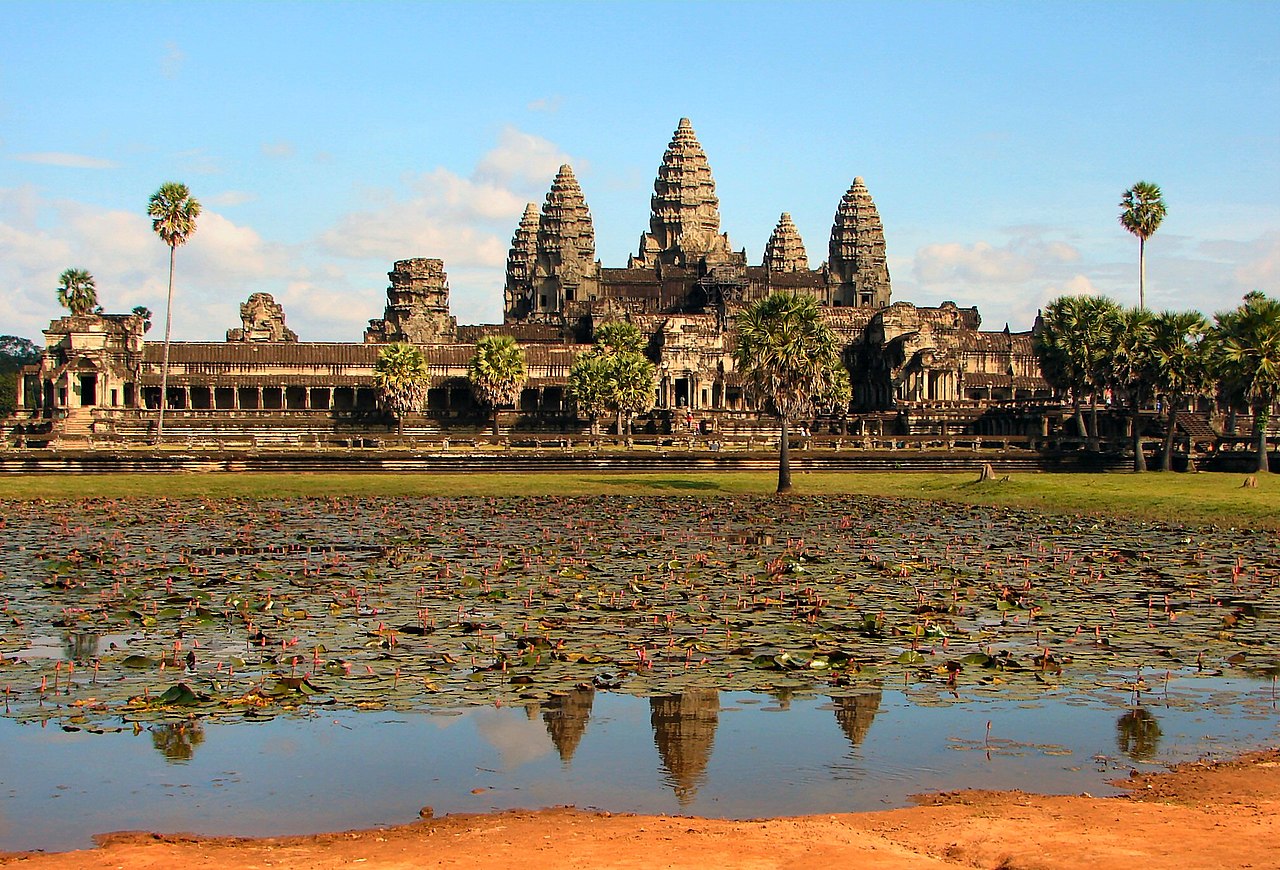
Cambodia is a Southeast Asian country, 181,035 km² with population of 17 million. The country occupies the lower Mekong River basin between Thailand (north and west), Laos (northeast), and Vietnam (east), with a 443 km Gulf of Thailand coastline (south). Cambodia is the former heartland of the famous Khmer Empire (802-1431 CE), which at its peak was Southeast Asia's largest and most powerful empire and built the famous Angkor Wat temple complex around 1113-1150. The famous Angkor was the world's largest preindustrial city at its peak with population of 750,000-1 million (when London had only 50,000). Cambodia experienced the catastrophic Khmer Rouge regime (1975-1979) under Pol Pot, which killed an estimated 1.5-2 million Cambodians (25% of population) through the famous "Killing Fields" genocide. The country has rebuilt since the 1990s peace agreements and is now one of Southeast Asia's fastest-growing economies with extensive tourism, garment, and agricultural sectors.
Major destinations include Angkor (UNESCO World Heritage — the famous temple complex 400 km² in area near Siem Reap with Angkor Wat — the world's largest religious monument and one of the world's most photographed buildings, the famous Bayon temple with 216 smiling face sculptures, Ta Prohm — the famous "Tomb Raider temple" with massive jungle tree roots growing through ruined stones, Banteay Srei — the famous "Citadel of Women" with intricate pink sandstone carvings, Preah Khan, Pre Rup, Angkor Thom with the South Gate, and dozens of additional smaller temples), Siem Reap (the famous tourist gateway to Angkor — with the famous Pub Street nightlife district, the famous Cambodian Cultural Village, the famous Phare Cambodian Circus, the famous Angkor National Museum, and the famous Apsara dance performances), Phnom Penh (the capital and largest city — population 2 million metropolitan, with the famous Royal Palace — current residence of King Norodom Sihamoni, the famous Silver Pagoda, the famous National Museum housing extensive Khmer artifacts, the famous Tuol Sleng Genocide Museum at the former S-21 prison, the famous Choeung Ek Killing Fields, and the famous Central Market — Phsar Thmey), the famous Tonlé Sap Lake (Southeast Asia's largest freshwater lake with extensive floating villages including Chong Kneas, Kompong Phluk, and Kampong Khleang), the famous Cambodian coast (with Sihanoukville — the famous beach city with extensive Chinese-financed development, Kep — the famous quieter colonial-era seaside town with extensive crab and seafood culture, Koh Rong and Koh Rong Samloem — the famous backpacker beach islands, and Otres Beach), the famous Battambang (with the famous Bamboo Train and extensive French colonial architecture), the famous Ratanakiri and Mondulkiri provinces (the famous northeastern wilderness with hilltribe villages and extensive jungle), and the famous Preah Vihear Temple (UNESCO World Heritage on the Thai border).
Cambodia has three distinct seasons rather than the standard tropical "wet and dry" pattern: cool dry (November-February), hot dry (March-May), and wet (June-October). The country's signature experience — Angkor Wat — is accessible year-round but dramatically different in each season.
Quick verdict
Best overall: November through February. Cool dry season — pleasant for all-day Angkor walking, low humidity, manageable nights.
Best for budget travelers: September-October (end of monsoon) and May (before peak heat). Lower prices, manageable weather.
Best for the coast (Sihanoukville, Kep, Koh Rong): November through April.
Best for the temples without crowds: Late September or early November. Lush green surroundings, fewer tour groups.
Avoid if you can: March-May (extreme heat at Angkor); peak Chinese New Year week (Khmer New Year crowds also).
Cool dry season (November to February): peak season
This is when Cambodia tourism is built for. The northeast monsoon brings cool, dry weather. Siem Reap (gateway to Angkor) sits at 22-28 °C in cool dry — daytime warm but not brutal, evenings comfortable for outdoor dining. Humidity is at its annual low.
Angkor Wat is at its peak experience. The sunrise crowds at Angkor Wat are heaviest in this season — get there by 5:00 am to secure a viewing position. The famous temples (Bayon, Ta Prohm, Banteay Srei) are at their most accessible.
December and January are full peak. Crowds peak around Christmas through Chinese New Year (late January or February depending on year). Hotel prices in Siem Reap reach annual highs. Book 3-6 months ahead for these months.
The coast (Sihanoukville, Kep, Koh Rong, Koh Rong Samloem) is in its prime season. Daytime around 28-31 °C, sea around 26-27 °C, calm conditions.
Hot dry season (March to May): the difficult months
March warms rapidly. By April, Siem Reap and Phnom Penh routinely see 35-40 °C. The famous Khmer New Year (Chol Chnam Thmey, mid-April) brings massive domestic tourism — the entire country goes on holiday for 3 days, with many businesses closing.
April and May are genuinely uncomfortable at the temples. Walking Angkor Wat in 40 °C heat is exhausting; the gray stone radiates heat. Most travelers find their useful sightseeing window shrinks dramatically — early morning and late afternoon only.
The compensation: significantly lower prices and dramatically reduced crowds outside Khmer New Year. Sites that are mobbed in January become walkable. Hotel rates drop 30-40%. For travelers who can plan around the heat (early starts, midday breaks), the hot dry season offers good value.
The coast is at its hottest. Sea temperatures climb past 28 °C — almost too warm to be refreshing.
Wet season (June to October): the misunderstood months
The southwest monsoon brings rain. Typical pattern: bright sunny mornings, afternoon thunderstorms (1-2 hours), clearing evenings. The pattern is predictable; most travelers can plan around it.
June is the start of the rains. Temperatures cool from the hot dry season — Siem Reap drops to 25-30 °C. The countryside greens up rapidly; rice paddies fill with water. The Tonlé Sap Lake begins its dramatic seasonal expansion.
July and August are full monsoon. Daily afternoon rains. Lush green landscapes. The famous floating villages on the Tonlé Sap are at their most accessible — the lake expands to four times its dry season size.
September is the wettest month. Heavy rainfall, dramatic skies, dramatic landscapes. This is the cheapest and least crowded month for Angkor Wat. The temples surrounded by lush vegetation are particularly photogenic. Some flooding can affect road access to remote sites.
October is transitional. The wet season tapers through the month. Late October sees clearer skies and dropping humidity. Prices remain at off-season levels until early November.
Angkor Wat timing specifics
The Angkor Wat archaeological park is massive — over 400 km². Most visitors spend 2-3 days exploring with a tuk-tuk or bicycle. The light at the famous sites changes dramatically throughout the day:
Sunrise at Angkor Wat: November-February is peak, with the most reliable sun and dramatic reflections in the lotus ponds. Get there by 5:00 am.
Bayon faces: Best morning light, before 9 am or after 4 pm.
Ta Prohm: Best mid-morning or late afternoon for filtered jungle light.
Banteay Srei: Best mid-afternoon when pink stone glows.
Three-day passes give time to revisit key sites in different light. One-day passes (for budget travelers) work best in cool dry season when you can comfortably move all day.
Phnom Penh and the coast
Phnom Penh follows similar patterns to Siem Reap but slightly hotter. Best November-February. The famous Royal Palace, Killing Fields, and Tuol Sleng Museum are accessible year-round but more comfortable in cool dry season.
The Cambodian coast (Sihanoukville, Kep, Koh Rong, Koh Rong Samloem) has its dry season November-April. The islands are particularly beautiful December-March. Avoid the coast in monsoon — heavy rains, rough seas, many businesses closed.
Festivals worth timing around
Khmer New Year (Chol Chnam Thmey, mid-April) — three-day domestic holiday with massive crowds at temples. Water Festival (Bon Om Touk, November full moon) — boat races in Phnom Penh, country at its most festive. Pchum Ben (September-October, Ancestors' Day) — domestic travel surge. Bonn Khmer New Year (April) is the country's biggest holiday.
Verdict by traveler type
First-time visitor doing Angkor + Phnom Penh: November through February.
Photographer: Late September-October for green temples or December-January for golden light.
Budget traveler: September-October (end of monsoon) or May (before peak heat).
Beach holiday (Koh Rong): December-March.
Crowd avoidance: September (rainy but quiet) or early November (transitional).
Combined Angkor + Vietnam trip: November-February (both work simultaneously).
Bottom line
Cambodia rewards November-February visits more strongly than most Southeast Asian destinations because the famous Angkor experience is so heat-sensitive. Walking ancient stone monuments in 40 °C is genuinely unpleasant. The cool dry season delivers Cambodia at its best despite the crowds and higher prices. Budget-conscious travelers should aim for the late wet season (September-October) when prices are low and weather is recovering.