
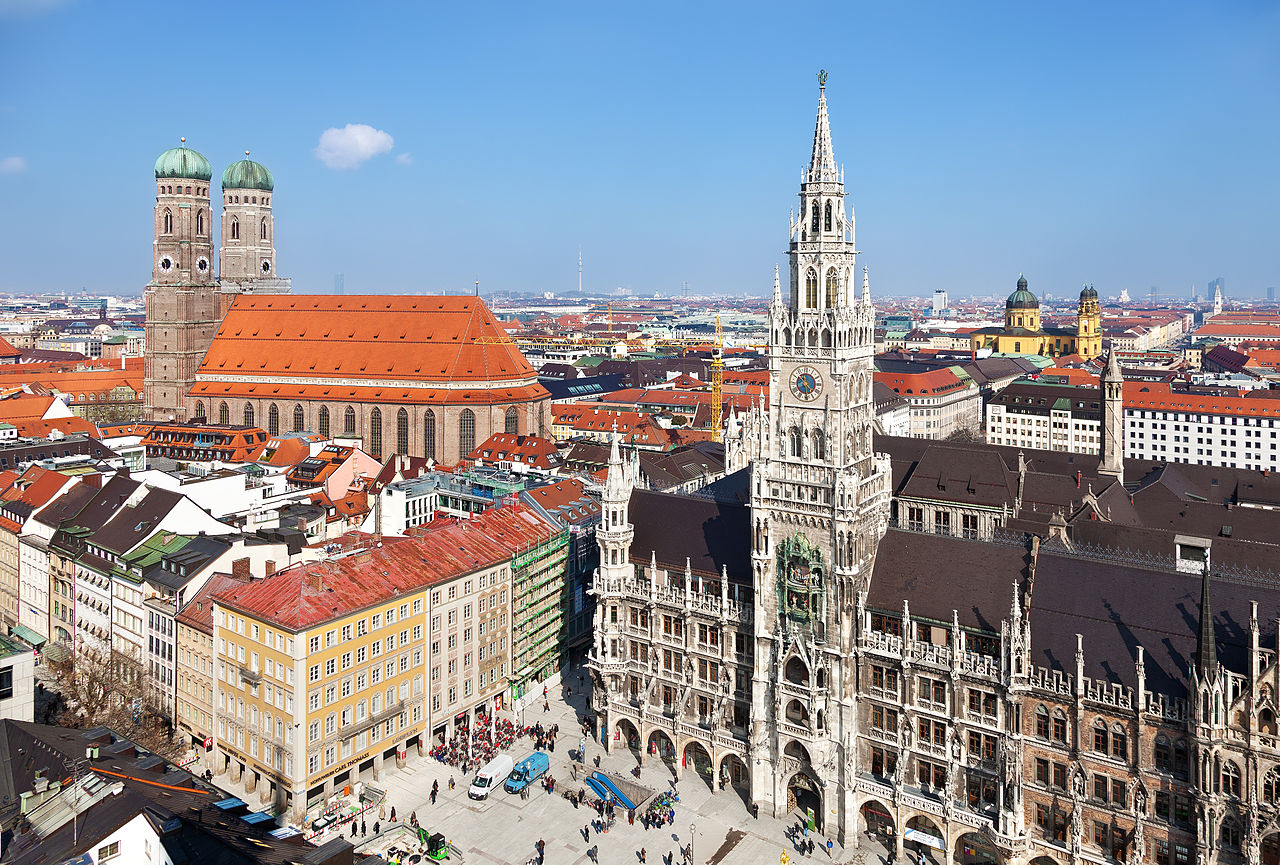
Munich (München) is the capital of Bavaria and Germany's third-largest city, with 1.5 million city residents and 6 million in the metropolitan area. The city sits on the Isar River in southern Germany, 70 km north of the Bavarian Alps, providing the natural gateway to Alpine Europe. Munich's cultural identity is distinctly Bavarian rather than generally German — Catholic rather than Protestant, with strong regional dialect, traditional Tracht clothing (Lederhosen, Dirndl) worn at festivals, and the famous beer culture protected by the Reinheitsgebot (the 1516 Bavarian Beer Purity Law). Beyond Oktoberfest, the city holds Marienplatz (the central square with the New Town Hall and its 43-bell glockenspiel, the Old Town Hall, and the famous twin-spired Frauenkirche cathedral), the Residenz (the former Bavarian royal palace), the Pinakothek museums trio (Alte, Neue, Moderne — among Europe's best art collections), the Englischer Garten (one of the world's largest urban parks, larger than New York's Central Park, with the famous Eisbach River surf wave attracting year-round surfers), the BMW Museum and BMW Welt, the Allianz Arena (Bayern Munich's stadium with the famous color-changing facade), the Schloss Nymphenburg (the summer palace), and the Hofbräuhaus (the famous 1589 royal brewery). Day trips reach Neuschwanstein Castle (Ludwig II's famous fairytale castle, 2 hours south — the inspiration for Disney's logo), the Berchtesgaden National Park (with the Königssee fjord-like lake and the Eagle's Nest historical site), Salzburg (90 minutes by train into Austria), and the Romantic Road northwest. Climate is humid continental (Dfb in Köppen) with cold winters, warm summers, and reliable shoulder seasons.
Quick verdict
Best overall: May-July (warm weather, peak beer garden season).
Best for Oktoberfest: Mid-September-first weekend of October (16-18 days).
Best for Christmas markets: Late November-December 24.
Best for the Bavarian Alps and Neuschwanstein day trips: May-September.
Best for skiing (Garmisch-Partenkirchen): December-March.
Best for the Tollwood Summer Festival: Late June-late July.
Best for the Tollwood Winter Festival: Late November-late December.
Best for the Frühlingsfest (the famous "Spring Oktoberfest"): Late April-early May.
Best for Starkbierzeit ("strong beer season"): Mid-March-early April.
Best for budget travelers: November (excluding Christmas markets) and February.
Avoid if you can: Munich during Oktoberfest if seeking quieter city experience (hotel rates triple, accommodation books 12+ months ahead); the Hofbräuhaus during peak summer tourism hours (impassable); Neuschwanstein in August without timed-entry booking (sells out daily).
Spring and summer (May-July) — Munich at its most enjoyable
The city's authentic peak — when Bavarians return to outdoor culture. Daytime 18-25 °C with occasional 28-32 °C heatwaves; overnight lows 10-15 °C; rainfall moderate; daylight extending to 16+ hours by midsummer. The famous Munich beer gardens come alive — the Hirschgarten (the city's largest with 8,000 seats), the Augustiner-Keller (typically considered the most authentic), the Englischer Garten's Chinesischer Turm (Chinese Tower) beer garden, the Viktualienmarkt's outdoor seating, and dozens of smaller beer gardens throughout the city. The Bavarian beer garden tradition (bring your own food, buy only beer; large communal tables; chestnut tree shade) provides a distinctively Bavarian summer experience.
Marienplatz comes alive with daily glockenspiel performances (11 am, noon, 5 pm) on the 1908 New Town Hall facade — the 43-bell mechanical clock with 32 life-size figures performing scenes from Munich history. The Viktualienmarkt food market (open since 1807) provides extensive Bavarian and international food culture. The Englischer Garten — bigger than New York's Central Park — provides cycling paths, the famous Eisbach standing wave for urban surfers (year-round), and the famous nude sunbathing tradition at the Schönfeldwiese meadow.
The Bavarian Alps become accessible. Neuschwanstein Castle — Ludwig II's famous neo-Romantic castle perched above the village of Hohenschwangau — provides Bavaria's iconic single attraction. Book timed-entry tickets weeks ahead. The neighboring Hohenschwangau Castle (Ludwig II's childhood home) and the famous Marienbrücke (Mary's Bridge) viewpoint provide the iconic Neuschwanstein photographs. The Königssee (the famous fjord-like alpine lake in Berchtesgaden National Park, with electric boats only — preserving the lake's acoustic purity), Garmisch-Partenkirchen (host of the 1936 Winter Olympics, with the Zugspitze cable car to Germany's highest peak at 2,962 m), and the Eagle's Nest at Berchtesgaden (Hitler's mountain retreat, now a restaurant with extraordinary views) provide major day trips.
Oktoberfest (mid-September-first weekend of October)
The world's largest folk festival. Munich's Oktoberfest at the Theresienwiese fairgrounds typically opens the third Saturday of September with the mayor's "O'zapft is!" (it's tapped!) ceremony and runs 16-18 days through the first weekend of October — the German Unity Day weekend. The festival features 14 massive beer tents seating 100,000+ simultaneously, serving 7-8 million liters of beer to 6+ million visitors over the period. The famous beer tents include the Hofbräu-Festzelt (the largest), the Hacker-Festzelt ("Himmel der Bayern" — Heaven of the Bavarians), the Augustiner-Festhalle, and the Schottenhamel-Festzelt (where the opening ceremony occurs). Beer is served exclusively in 1-liter Maß steins at €15-18 each (2024 prices). Traditional Bavarian food — Schweinshaxe (pork knuckle), Hendl (roast chicken), Brezn (giant pretzels), Weisswurst (white sausage with sweet mustard) — defines the gastronomy.
Oktoberfest accommodation books 12+ months ahead; hotel rates triple. Tent reservations (which guarantee a table for your group, with required food and beer minimums) book 6-9 months ahead and are essential for weekend evenings. Many tents accept walk-up visitors weekday afternoons. The traditional Bavarian dress (Lederhosen for men, Dirndl for women) is appropriate — most attendees wear it. The famous Wiesn Trachten- und Schützenzug parade (the first Sunday) is the world's largest folkloric parade.
Christmas markets (late November-December 24)
Munich's defining winter event. The main Christmas market at Marienplatz, the Medieval Christmas Market at Wittelsbacherplatz (the famous historic medieval-themed market), the Tollwood Winter Festival at Theresienwiese, the Schloss Nymphenburg Christmas Market, and dozens of neighborhood markets transform the city. Traditional Bavarian Christmas foods (Glühwein mulled wine, Lebkuchen gingerbread, gebrannte Mandeln roasted almonds, Stollen Christmas cake) provide cultural depth. Daytime in December 1-5 °C with occasional snow and -10 °C cold snaps; reliable Christmas atmosphere through December 23-24 (markets close abruptly Christmas Eve).
Winter (January-March) and skiing
Munich's quietest tourism. Daytime -3 to 5 °C with reliable snow at higher elevations. Garmisch-Partenkirchen (90 minutes by train) provides Bavaria's premier skiing — the Zugspitze (Germany's highest peak), the Garmisch Classic ski area, and the famous Kandahar World Cup downhill course. The famous Starkbierzeit ("strong beer season") in mid-March-early April features the famous Doppelbock beers (Salvator at Paulaner, Maximator at Augustiner) traditionally brewed by monks for sustenance during Lenten fasting.
Munich's museums and indoor culture provide year-round depth. The Alte Pinakothek (with extensive Rubens, Dürer, and Raphael), the Neue Pinakothek (19th-century European art), the Pinakothek der Moderne (modern and contemporary), the Lenbachhaus (the famous Blue Rider movement museum), the Deutsches Museum (one of the world's largest science and technology museums), the BMW Welt and Museum, and the Residenz Museum all provide indoor cultural anchors.
Festivals & cultural events
Oktoberfest (mid-September-first weekend of October): World's largest folk festival.
Frühlingsfest (late April-early May): "Spring Oktoberfest" at Theresienwiese.
Starkbierzeit (mid-March-early April): Strong beer season at major Munich breweries.
Tollwood Summer Festival (late June-late July): Major arts and music festival.
Tollwood Winter Festival (late November-late December): Major Christmas-season cultural festival.
Munich Christmas Market (late November-December 24): Major Bavarian Christmas tradition.
BMW Open Tennis (late April-early May): Major ATP tennis event.
Munich Marathon (mid-October): Major running event.
Auer Dult (three times yearly): Traditional Munich fair.
Corpus Christi procession (late May-early June): Major Bavarian Catholic celebration.
Munich Opera Festival (late June-late July): Premier classical music event.
Cultural and practical notes
German is the official language; English is widely spoken in tourism and business contexts. Bavarian dialect distinct from standard German. Euro is the currency. Tipping 10% appreciated. Driving on the right side. EU/Schengen Area member. Visa-free for most Western nationalities.
Practical considerations
Munich Airport (MUC) is the main hub — Germany's second-busiest after Frankfurt, with extensive global connections. The S-Bahn (S1 and S8 lines) provides 40-minute connections to the city center. Internal Munich travel by the famous U-Bahn (subway), S-Bahn (suburban), trams, and buses — the MVV transit network is among Europe's best. The city is highly walkable; the historic core is compact. ICE high-speed trains connect to Berlin (4 hours), Paris (6 hours), Vienna (4 hours), and Zurich (3.5 hours).
Traveler-type advice
First-time visitors: May-July for ideal weather.
Oktoberfest travelers: Mid-September-first weekend of October; book 12+ months ahead.
Christmas market travelers: Late November-late December.
Cultural travelers (Pinakothek, Deutsches Museum): Year-round.
Skiers: December-March at Garmisch.
Bavarian Alps and Neuschwanstein travelers: May-October.
Beer enthusiasts: May-July for beer gardens; mid-March-April for strong beer season; September-October for Oktoberfest.
Budget travelers: November (excluding Christmas market period) and February.
Combined Central Europe travelers: Munich pairs naturally with Salzburg (90 minutes), Vienna (4 hours), and Prague (5 hours).
Bottom line
Munich rewards May-July for the authentic Bavarian summer experience (beer gardens, Alps day trips, walking weather). Oktoberfest in mid-September-early October provides the world's largest folk festival but at extreme cost and crowding. Christmas markets (late November-December 24) provide distinctive winter culture. Each season delivers a fundamentally different Munich. Allow 3-4 days for the city itself; add 2-3 days for the Bavarian Alps day trips to Neuschwanstein, Garmisch, or Berchtesgaden.