
Introduction
Brazil 🇧🇷 and Argentina 🇦🇷 are the two heavyweights of South America, joined at the hip by football rivalry yet separated by language, scale, and landscape. This comparison sets them side by side across area, population, capitals, climate, and the natural wonders that define each country.
Whether you are revising for a geography class, mapping out a trip, or simply curious how these neighbors differ, the figures below give you the essentials at a glance.
Size & Geography
| Feature | Brazil 🇧🇷 | Argentina 🇦🇷 |
|---|---|---|
| Area | 8,515,767 km² | 2,780,400 km² |
| Continent | South America | South America |
| Region | South America | South America |
| Land Borders | All South American countries except Chile and Ecuador | Chile, Bolivia, Paraguay, Brazil, Uruguay |
| Landscape | Amazon basin, highlands, coastal mountains, wetlands | Pampas plains, Andes mountains, Patagonian steppe, subtropical north |
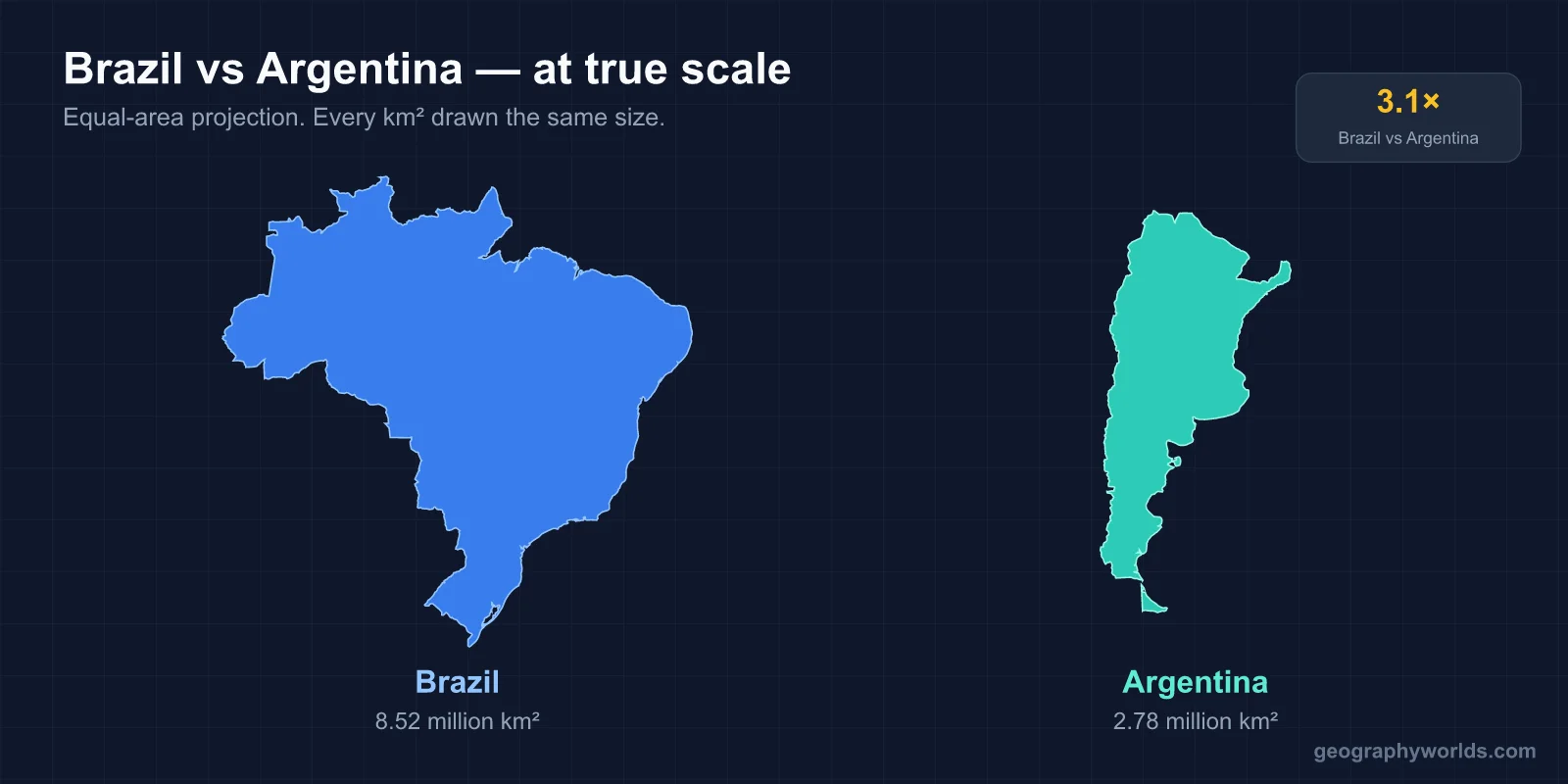
Size is the first thing that sets these two apart. At 8,515,767 km², Brazil is about 3.1 times the area of Argentina (2,780,400 km²) and shares a border with nearly every country on the continent. Its terrain runs from the Amazon basin and interior highlands to coastal mountains and vast wetlands. Argentina is narrower but stretches far to the south, its geography defined by the fertile Pampas plains, the Andes along the Chilean frontier, and the windswept Patagonian steppe giving way to a subtropical north.
Population & Demographics
| Metric | Brazil 🇧🇷 | Argentina 🇦🇷 |
|---|---|---|
| Population | 213.6 million | 46.0 million |
| Population Density | 25.1 per km² | 16.5 per km² |
Brazil is by far the more populous nation, home to 213.6 million people against Argentina's 46.0 million, a gap of roughly 4.6 to 1. Even though Brazil is the larger country, it is also the more crowded of the two on average, at 25.1 people per km² compared with Argentina's 16.5, a difference of about 8.5 people per km².
Capital Cities
Brazil governs from Brasília, a planned modernist capital carved out of the central highlands in the 1950s. Argentina is run from Buenos Aires, the historic Atlantic-coast metropolis on the Río de la Plata. Both cities anchor their countries politically, though they could hardly differ more in age and character.
Language, Currency & Culture
| Aspect | Brazil 🇧🇷 | Argentina 🇦🇷 |
|---|---|---|
| Languages | Portuguese (official) | Spanish (official) |
| Currency | Brazilian Real (BRL) | Argentine Peso (ARS) |
Language is the clearest cultural divide between the two. Brazil is the only major Portuguese-speaking nation in South America, while Argentina speaks Spanish like most of its neighbors. The two currencies follow suit, with the Brazilian Real (BRL) circulating in one and the Argentine Peso (ARS) in the other, each reflecting a separate colonial inheritance and a distinct path through the centuries since.
Climate & Natural Features
| Aspect | Brazil 🇧🇷 | Argentina 🇦🇷 |
|---|---|---|
| Climate | mostly tropical; temperate in south | mostly temperate; arid in southeast; subantarctic in southwest |
| Key Features | Amazon Rainforest, Pantanal wetlands, Iguazu Falls, Sugarloaf | Andes, Patagonia, Iguazu Falls, Tierra del Fuego, Pampas |
| Economy | agriculture (soy, coffee), mining, aerospace, oil | agriculture (beef, soy), mining, automotive, IT |
Brazil sits mostly in the tropics, turning temperate only in the south, and its landmarks read like a list of natural superlatives: the Amazon Rainforest, the Pantanal wetlands, Iguazu Falls, and the Sugarloaf rising over Rio. Argentina is mostly temperate, with arid country in the southeast and a subantarctic chill in the southwest, and it lays claim to the Andes, Patagonia, its own share of Iguazu Falls, the southern tip of Tierra del Fuego, and the open Pampas. The two even share Iguazu Falls, which straddles their common border. Their economies differ in emphasis: Brazil leans on soy and coffee, mining, aerospace, and oil, while Argentina is built on beef and soy, mining, automotive production, and a growing IT sector.
What Makes Each Country Unique
Brazil is internationally renowned for Carnival, the Amazon Rainforest, samba and bossa nova, football (soccer), and Christ the Redeemer. Brazil contains about 60% of the Amazon Rainforest, which produces roughly 20% of the world's oxygen.
Argentina is best known for tango dancing, beef and asado culture, Patagonia, Iguazu Falls, and football legends like Maradona and Messi. Argentina named a glacier (Perito Moreno) that is one of the few in the world still growing — it advances about 2 meters per day.
Key Differences at a Glance
- Area: Brazil (8,515,767 km²) vs Argentina (2,780,400 km²) — Brazil is 3.1x larger
- Population: Brazil (213.6 million) vs Argentina (46.0 million) — Brazil is 4.6x more populous
- Capitals: Brasília vs Buenos Aires
- Currency: Brazilian Real (BRL) vs Argentine Peso (ARS)
- Continents: South America vs South America
- Density: Brazil is more densely populated (difference of ~8.5 people per km²)
- Languages: Portuguese (official) vs Spanish (official)
Verdict
Brazil and Argentina are the giants of South America, and on the numbers Brazil dominates: it is both the larger country (3.1x the area) and the more populous one (4.6x the people). But raw scale only tells part of the story, since the two are distinguished as much by language and landscape as by size.
Brazil's identity is bound up with its mostly tropical climate and icons like the Amazon Rainforest, its economy resting on soy, coffee, mining, aerospace, and oil. Argentina, mostly temperate and shading into subantarctic in the far south, is defined by the Andes, Patagonia, and the Pampas, with beef and soy, mining, automotive, and IT driving its economy. Same continent, two very different worlds.
Together they form the cultural and economic core of the continent. Whether you are planning a visit, studying world geography, or simply satisfying your curiosity, knowing how they compare paints a richer picture of South America.
Test Your Knowledge!
Think you know your countries? Try our interactive geography quiz!
Play Geography Games →