
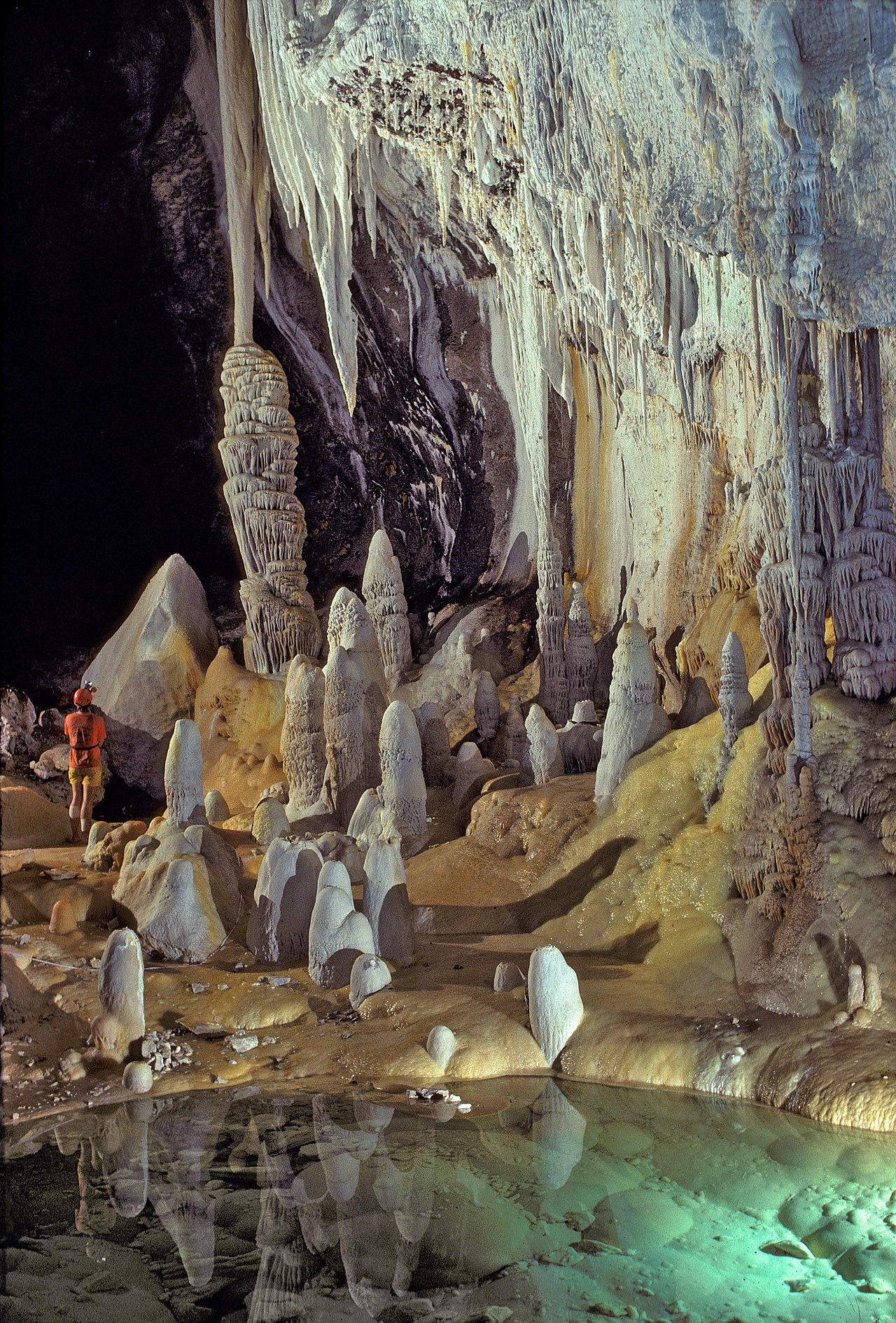
A cave is a natural hollow space under the ground big enough for a person to get into. Most are made by water slowly dissolving rock over hundreds of thousands of years. Others are made by lava, waves, ice or moving rock. Caves preserve things almost perfectly, which is why some of the oldest art humans ever made is still on cave walls after 40,000 years.

Water Eats Rock
The most common caves are in limestone, and they exist because of a very slow chemical reaction.
Rain absorbs a little carbon dioxide from the air and from soil as it soaks down. That makes it a weak acid — carbonic acid, the same thing that makes fizzy drinks slightly sharp. Limestone is made of calcium carbonate, and weak acid dissolves it.
Water trickles down cracks in the rock and slowly widens them. Over tens of thousands of years, a crack you could not fit a coin into becomes a passage you can walk down, then a chamber. Landscapes full of these caves, sinkholes and disappearing rivers are called karst.
Stalactites and Stalagmites
These are the icicle-shaped formations, and everyone mixes them up.
Stalactites hang from the ceiling. Stalagmites grow up from the floor. Two ways to remember: stalactites hold tight to the ceiling, and stalagmites might reach the top one day. Or note that stalactite has a C for ceiling and stalagmite has a G for ground.
They form from the same drips. Water carrying dissolved limestone seeps through the ceiling, and when it meets the cave air some of the carbon dioxide escapes, so a tiny ring of calcite is left behind. Drip by drip the ring becomes a straw and then a cone. Where a stalactite and stalagmite eventually meet, they form a column.
How Slow Is Slow?
A stalactite typically grows around 0.1 to 0.3 millimetres a year. That is roughly a centimetre a century.
So a stalactite a metre long has been dripping for something like ten thousand years. Some of the largest formations in the world have been growing since before the last ice age ended.
This is why cave guides ask people not to touch them. Oil from human skin coats the surface and stops the water depositing calcite there, and a fingerprint can halt growth on that spot permanently.
Grow a Stalactite at Home
Fill two jars with hot water and stir in as much bicarbonate of soda or Epsom salts as will dissolve. Put the jars a few centimetres apart on a tray.
Take a piece of thick wool or cotton string, put one end in each jar, and let the middle dip down between them. Leave it somewhere undisturbed.
Within a few days a small stalactite will form at the lowest point of the string, with a matching stalagmite building up on the tray underneath. You are watching the exact same process as a real cave, just with a different mineral and about a million times faster.
Caves That Are Not Made by Water
Lava tubes form when the outside of a lava flow cools and hardens while the molten rock inside keeps flowing and eventually drains away, leaving a tunnel. Hawaii, Iceland and the Canary Islands all have them. Kazumura Cave in Hawaii is over 65 kilometres long.
Sea caves are cut by waves pounding a weakness in a cliff. Fingal's Cave in Scotland is one, formed in hexagonal basalt columns, and the acoustics inside inspired a Mendelssohn overture.
Glacier caves are melted into ice by meltwater or warm air, and they change every year. Talus caves are just the gaps between fallen boulders. There are also caves formed by wind, by dissolving gypsum and salt, and even by acid rising from below rather than water sinking from above.
Life in Total Darkness
Animals that live their whole lives in caves are called troglobites, and they tend to look very strange.
Most are blind, and many have no eyes at all — eyes are expensive to build and useless in the dark, so evolution removes them. They are usually pale or completely white, because there is no reason to make pigment. Many have very long antennae, legs or whiskers to feel their way.
The olm, a cave salamander from Slovenia and Croatia, is the largest cave animal in Europe. It is blind, pale pink, can live over a hundred years, and can survive up to ten years without food. Local legends once claimed they were baby dragons washed out of caves by floods.
Where the Food Comes From
Nothing grows in the dark, so cave ecosystems have to import their energy.
Most of it arrives as leaves and wood washed in by floodwater, or as bat droppings. A large bat colony can produce tonnes of guano a year, and entire food chains of beetles, mites and fungi live on it.
A few caves manage without any sunlight energy at all. In Movile Cave in Romania, sealed off for around five million years, the whole ecosystem runs on bacteria that get their energy from hydrogen sulphide gas. Thirty-three of the species found there live nowhere else on Earth.
Cave Art
Caves are stable, dark and dry, which makes them one of the few places where fragile things survive for tens of thousands of years.
The paintings at Lascaux in France are around 17,000 years old and show horses, bulls and deer in astonishing detail. Chauvet Cave, also in France, has art around 32,000 years old including lions and rhinos. In Sulawesi, Indonesia, a painting of a warty pig has been dated to at least 45,500 years, and a hunting scene there may be older still.
Lascaux was discovered in 1940 by four teenagers and a dog. It was opened to tourists, and the carbon dioxide and humidity from visitors began destroying the paintings within twenty years. It closed in 1963, and what people visit now is an exact replica built nearby.
People Have Always Used Caves
Caves offered shelter, a stable temperature and defensible entrances long before anyone built a house. Archaeologists find hearths, tools and bones in them going back hundreds of thousands of years.
Some are still lived in. Around 30 million people in China live in yaodong, cave homes cut into the soft loess hillsides of Shaanxi and Shanxi — cool in summer, warm in winter and cheap to make. Matmata in Tunisia has underground courtyard houses; Cappadocia in Turkey has entire cities carved into soft volcanic rock, including Derinkuyu, which went at least eight levels down and could shelter thousands of people with their livestock.
Caves are also good for storing things. Roquefort cheese must legally be ripened in the caves of Roquefort-sur-Soulzon, where the constant temperature and a naturally occurring mould give it its flavour, and Champagne is aged in chalk cellars dug by the Romans.
The Record Holders
Mammoth Cave in Kentucky is the longest cave system in the world, with over 685 kilometres of mapped passages — more than twice the next longest — and surveyors are still finding more.
Veryovkina Cave in Georgia is the deepest at over 2,200 metres. Reaching the bottom takes an expedition of weeks, with camps set up underground.
Son Doong in Vietnam, found by a local man in 1991 and explored by cavers in 2009, has the largest cross-section of any cave passage. Parts are over 200 metres high and 150 metres wide — big enough to fly a helicopter through — and it has its own jungle inside, growing under holes where the ceiling collapsed.
Sinkholes
Where a cave roof gets too thin, the ground above collapses into it. That hole is a sinkhole, and in karst country they can open with no warning.
Some are enormous. The Xiaozhai Tiankeng in China is around 660 metres deep and 600 metres across, with a forest growing at the bottom. The cenotes of Mexico's Yucatan Peninsula are flooded sinkholes, and there are thousands of them — the Maya considered them sacred and used them for offerings and as a water supply, because the peninsula has almost no surface rivers.
A ring of cenotes across the northern Yucatan traces the rim of the Chicxulub crater, made by the asteroid impact that ended the age of the dinosaurs 66 million years ago. The rock there fractured differently, and 66 million years later the caves formed along the crack.
Exploring Safely
Caving, or spelunking, is a real sport with real rules, and the first one is never go alone or without telling someone where you are going.
Cavers carry three independent light sources, because being underground without light is genuinely dangerous — a cave is darker than anywhere on the surface ever gets. They wear helmets, and they treat water as a serious hazard, since a cave passage can flood completely within minutes if it rains on the hills above.
The other rule is to leave no trace. Cave formations take thousands of years to grow and seconds to break, and rubbish and human waste do not decay quickly underground. Cavers use the phrase: take nothing but pictures, leave nothing but footprints, kill nothing but time. To keep exploring, read about how volcanoes work, which make lava tube caves, and how rivers work, which carve the rest.
