
Introduction
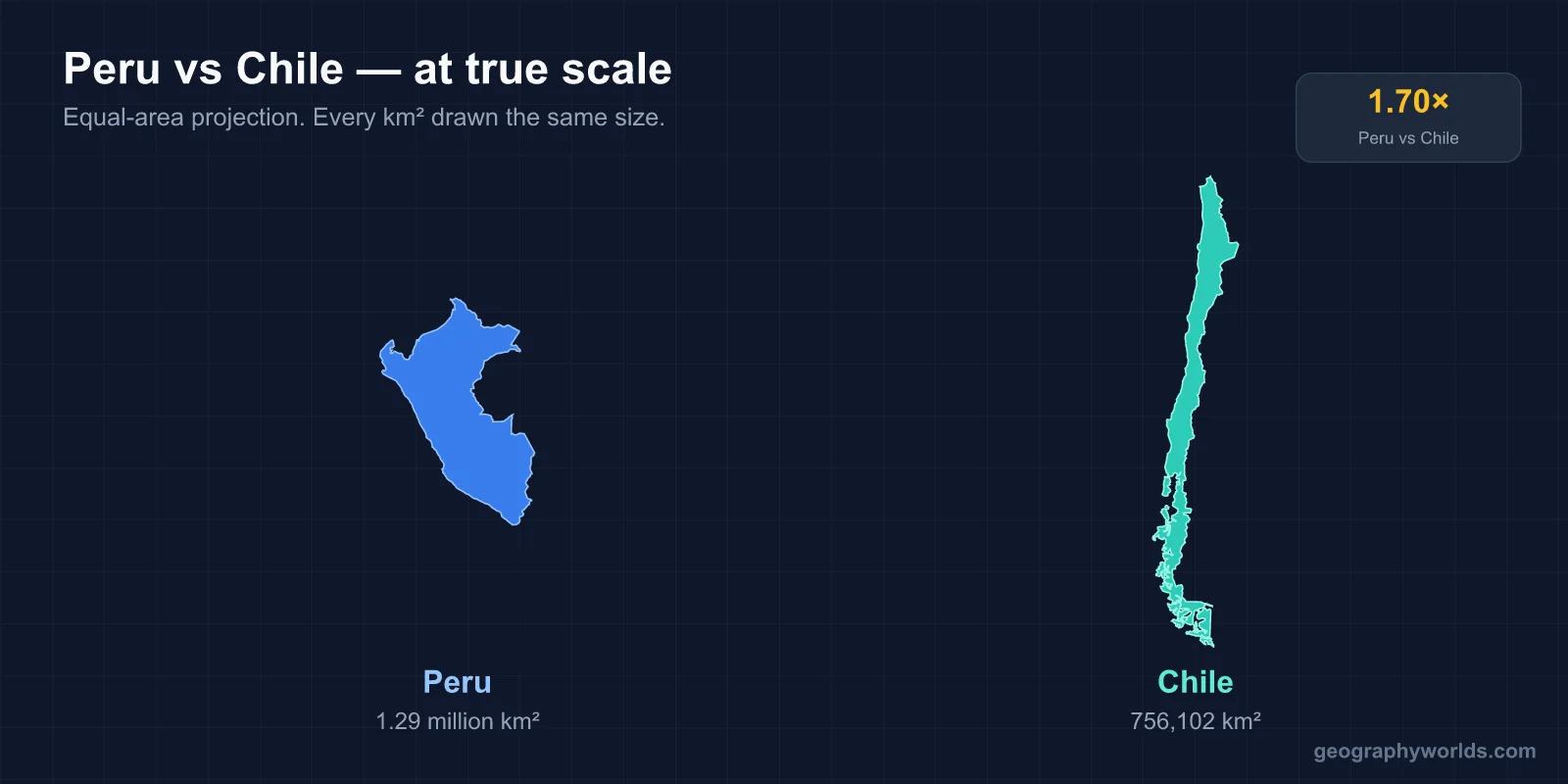
Chile 🇨🇱 and Peru 🇵🇪 sit side by side on South America's Pacific coast, sharing a long Andean border and a tangled colonial past. Yet for two neighbors, they feel remarkably different on the ground: one is a thin ribbon of land running thousands of kilometers north to south, the other a broad country reaching from the desert coast deep into the Amazon. This comparison looks at how they stack up across size, population, capitals, climate, and natural features.
Whether you are studying geography, planning a trip down the Pacific coast, or just curious how the two compare, the side-by-side tables below lay out the key facts and figures.
Size & Geography
| Feature | Chile 🇨🇱 | Peru 🇵🇪 |
|---|---|---|
| Area | 756,102 km² | 1,285,216 km² |
| Continent | South America | South America |
| Region | South America | South America |
| Land Borders | Peru, Bolivia, Argentina | Ecuador, Colombia, Brazil, Bolivia, Chile |
| Landscape | long narrow strip; Andes in east, Pacific coast, Atacama Desert | Andes mountains, Amazon basin, coastal desert |
Peru is the larger of the two by a clear margin, covering 1,285,216 km² against Chile's 756,102 km² — roughly 1.7 times the area. The shapes are just as telling as the totals. Chile is a long, narrow strip pinned between the Andes to the east and the Pacific to the west, with the Atacama Desert anchoring its north. Peru is wider and more layered, stepping from a desert coastline up over the Andes and down into the Amazon basin. The two also share a border with one another, along with Bolivia, while Peru reaches farther across the continent, touching Ecuador, Colombia, and Brazil as well.
Population & Demographics
| Metric | Chile 🇨🇱 | Peru 🇵🇪 |
|---|---|---|
| Population | 19.9 million | 34.9 million |
| Population Density | 26.4 per km² | 27.2 per km² |
Peru is home to about 34.9 million people, roughly 1.8 times Chile's 19.9 million. Density, on the other hand, lands almost in step: 27.2 people per km² in Peru versus 26.4 in Chile, a gap of only about 0.8. That near-tie is a bit deceptive, since both countries pack most of their populations into narrow habitable zones — Chile around its central valley near Santiago, Peru along its desert coast and Andean highlands — leaving the Atacama and the Amazon thinly settled.
Capital Cities
Santiago is the capital of Chile, set in the country's central valley, while Lima anchors Peru on the Pacific coast. Both are among South America's largest metropolitan areas and serve as the political and economic heart of their respective nations.
Language, Currency & Culture
| Aspect | Chile 🇨🇱 | Peru 🇵🇪 |
|---|---|---|
| Languages | Spanish (official) | Spanish (official), Quechua, Aymara |
| Currency | Chilean Peso (CLP) | Peruvian Sol (PEN) |
Spanish is the official language in both countries, a shared legacy of Spanish colonial rule. The difference is what sits alongside it: Peru also recognizes Quechua and Aymara as official languages, indigenous tongues still spoken widely in the Andean highlands and tied to the Inca and pre-Inca cultures rooted there. On money, the two go their separate ways — Chile uses the Chilean Peso (CLP), Peru the Peruvian Sol (PEN).
Climate & Natural Features
| Aspect | Chile 🇨🇱 | Peru 🇵🇪 |
|---|---|---|
| Climate | diverse; desert in north, Mediterranean in center, oceanic in south | varies from tropical in east to dry desert in west |
| Key Features | Atacama Desert, Patagonia, Easter Island, Torres del Paine | Machu Picchu, Andes, Amazon, Lake Titicaca, Nazca Lines |
| Economy | copper mining, agriculture (wine, fruit), fishing, forestry | mining (copper, gold), agriculture, fishing, textiles |
Chile's enormous north-south span gives it a climate that changes dramatically along its length: desert in the north, a Mediterranean band through the center, and cool, oceanic conditions in the far south. Peru's climate divides instead from east to west, running from tropical in the Amazonian east to dry desert along the western coast. The landmarks follow suit. Chile claims the Atacama Desert, the wild expanses of Patagonia and Torres del Paine, and remote Easter Island far out in the Pacific. Peru's draws are the ones the world pictures when it thinks of the Andes — Machu Picchu, the high lakeshore of Lake Titicaca, the Nazca Lines, and the headwaters of the Amazon.
Their economies rhyme more than they differ. Copper is central to both: Chile is a global heavyweight in copper mining and rounds out its output with wine and fruit agriculture, fishing, and forestry, while Peru mines copper and gold alongside agriculture, fishing, and textiles.
What Makes Each Country Unique
Chile is internationally renowned for the Atacama Desert (the driest place on Earth), Patagonia, Easter Island, and world-class wine. It is also the longest north-south country in the world, stretching over 4,300 km from the desert north to the glaciers of the south — yet averaging only 177 km wide, which is what gives it that famous sliver-on-the-map shape.
Peru is best known for Machu Picchu, the legacy of the Inca Empire, its celebrated ceviche, and Lake Titicaca, the world's highest navigable lake. Machu Picchu itself sat unknown to the outside world for centuries, only brought to international attention in 1911.
Key Differences at a Glance
- Area: Chile (756,102 km²) vs Peru (1,285,216 km²) — Peru is 1.7x larger
- Population: Chile (19.9 million) vs Peru (34.9 million) — Peru is 1.8x more populous
- Capitals: Santiago vs Lima
- Currency: Chilean Peso (CLP) vs Peruvian Sol (PEN)
- Continents: South America vs South America
- Density: Peru is slightly more densely populated (a gap of ~0.8 people per km²)
- Languages: Both use Spanish; Peru also recognizes Quechua and Aymara
Verdict
For two countries that share a border and a coastline, Chile and Peru carve out very different identities. Peru holds the edge in both land area (1.7x) and population (1.8x), and its layered geography from coast to Andes to Amazon gives it an unusual range within one set of borders. Chile counters with its own extreme — a country so long and thin it spans nearly every climate from desert to glacier.
Where Peru's appeal centers on the Andean past, with Machu Picchu and Lake Titicaca, Chile's leans on its dramatic extremes, from the Atacama Desert to Patagonia and far-flung Easter Island. Economically the two overlap heavily, with copper mining at the core of each, even as Chile adds its wine and Peru its gold. Taken together, they make one of the most rewarding comparisons in South America — close enough to feel paired, distinct enough to surprise.
Test Your Knowledge!
Think you know your countries? Try our interactive geography quiz!
Play Geography Games →