
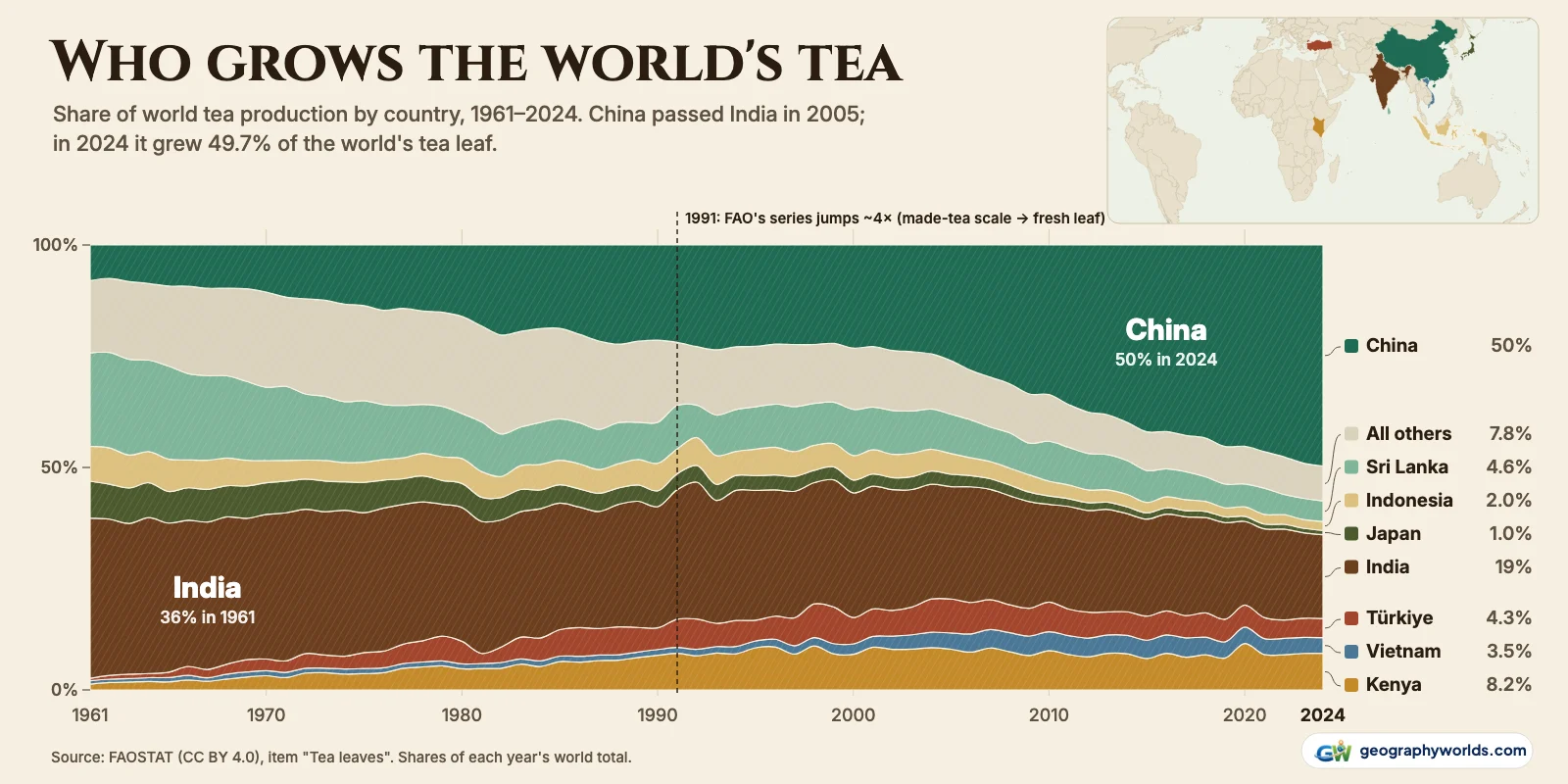
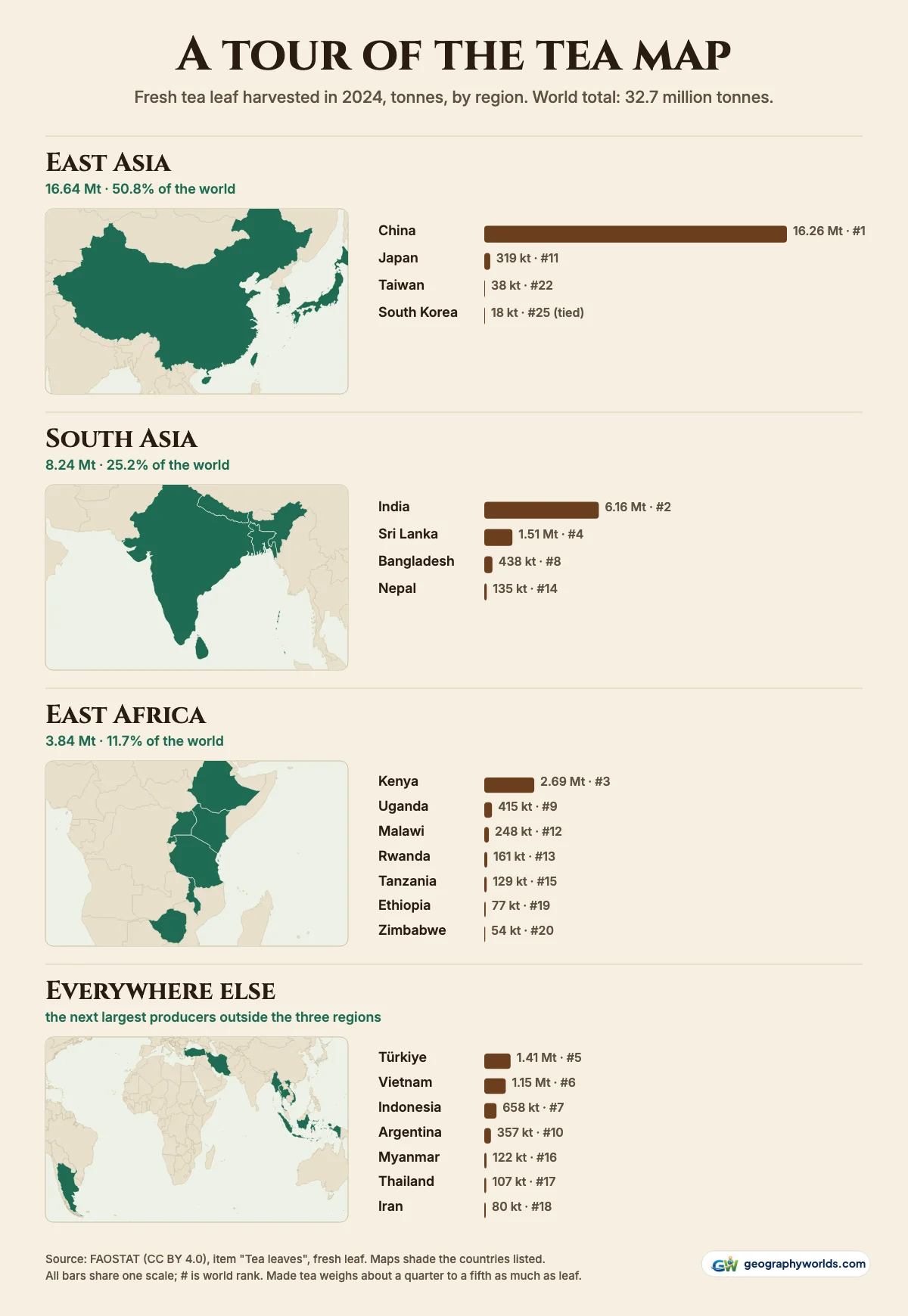
China produces the most tea of any country: 16.26 million tonnes of fresh tea leaf in 2024, 49.7% of the world's 32.73 million tonnes, according to the UN Food and Agriculture Organization (FAO). India is second with 6.16 million tonnes (18.8%) and Kenya third with 2.69 million (8.2%). Sri Lanka (1.51 million) and Türkiye (1.41 million) come next, followed by Vietnam, Indonesia, Bangladesh, Uganda and Argentina. Counted as made tea, the dried product sold in packets, the first three places are the same, but in the International Tea Committee's preliminary figures Türkiye moves ahead of Sri Lanka.
Those tonnages look about four times larger than the tea figures quoted elsewhere because they weigh a different thing. FAOSTAT's "Tea leaves" figures since 1991 are on the scale of fresh green leaf as it comes off the bush. Tea boards and the trade count made tea, which has lost most of its water in the factory. China's National Bureau of Statistics, for instance, reported 3.74 million tonnes of tea for 2024, and the International Tea Committee's preliminary world total for that year is 7.05 million tonnes. FAO's world figure is 4.6 times that. The ranking below uses FAO's leaf figures, checked against each leading producer's own made-tea count.
China: from fourth place in 1961 to half the world's leaf
FAO's series begins in 1961, when China was not the leader. It recorded 79,000 tonnes that year, 8.0% of world output, and ranked 4th. China's share climbed to 21.4% by 1990, 23.2% in 2000 and 33.6% in 2010. The decisive year was 2005: FAO has China at 4.07 million tonnes of leaf against India's 3.94 million, after trailing 3.63 to 3.82 the year before, and China has stayed ahead in every year since. FAO's tea secretariat, which compiles made-tea figures from national returns, dates the crossover to the same year: its 2008 market review lists China at 956,000 tonnes and India at 919,000 in 2005, after 854,000 against 896,000 in 2004.
In 2024 China grew 2.6 times as much leaf as India. FAO marks the 2024 figure as its own estimate and puts the year's growth at 5.6%. China's statistics bureau recorded growth of 5.5% and output of 3.74 million tonnes of made tea in its 2024 statistical communiqué, which makes FAO's leaf figure 4.35 times the bureau's. The China Tea Marketing Association, which surveys growers separately, puts the 2024 crop of crude dry tea at more than 3.49 million tonnes, according to its president. So China's own sources differ by up to a quarter of a million tonnes, but on any of them China grows roughly half of the world's tea: 49.7% of the leaf in FAO's data, 53% of made tea in the International Tea Committee's.
Most of that harvest stays at home, and most of it is green. FAO's tea group, in the same January 2024 review cited below, puts China's own consumption at 3 million tonnes in 2022, against production of 3.34 million, and its green tea output at 2.06 million tonnes a year in 2020–2022. China's older trade in pressed tea to Tibet is the subject of our guide to the Tea Horse Road.
South Asia: India's small growers and Sri Lanka's hill country
South Asia supplies 8.24 million tonnes of leaf, 25.2% of the world, almost all of it from India and Sri Lanka. In 1961 those two were the top producers in FAO's series, with India at 354,000 tonnes (36.0% of the world) and Sri Lanka, then Ceylon, at 206,000 (21.0%). The Ceylon Tea Museum's timeline also marks 1961 as the year Sri Lanka's production first exceeded 200,000 tonnes.
India's 2024 figure needs care. FAO imputed it at 6,156,031 tonnes of leaf, 2.0% more than in 2023. The Tea Board of India's final count went the other way: 1,303.53 million kg of made tea, down 6.5% from the 1,393.66 million kg of 2023. Both put India second. Small growers produced 707.67 million kg in 2024 and the big estates 595.86 million, so smallholders now account for 54% of India's tea.

Sri Lanka made 262.16 million kg of tea in 2024, up from 256.09 million, according to the broker Forbes & Walker. Low-grown tea made up 61% of it. The high-grown teas of the hill country came to 54.47 million kg, the lowest since 1992. FAO places Sri Lanka 4th with 1,514,024 tonnes of leaf, a figure it imputed rather than received, and one that sits oddly against the made-tea count, as the comparison further down shows.
East Africa: Kenya's climb from tenth to third
In 1961 Kenya produced 12,641 tonnes of tea and ranked 10th in FAO's series. In 2024 it harvested 2,687,200 tonnes of leaf, 4.2% more than in 2023. Kenya's Economic Survey 2025, from the national statistics office, gives the same 4.2% rise, to about 2.6 million tonnes of green leaf, as reported by the Kenya News Agency. As made tea, that was 598 million kg in 2024, up from 570 million in 2023, the Tea Board of Kenya told Food Business MEA: about 47 times what FAO recorded for the country in 1961.

FAO counts 12 tea-growing countries in Eastern Africa, which together harvested 3.84 million tonnes in 2024, 11.7% of the world. Uganda ranks 9th worldwide with 415,000 tonnes, Malawi 12th with 248,000, and Rwanda 13th with 161,000, from just 160 tonnes in 1961. Tanzania adds 129,000. The region's big rise came before the 1990s: its share of world output went from 4.8% in 1961 to 12.1% in 1990, and it was 11.7% in 2024. Our guide to the geography of tea-growing regions looks at where the plant grows around the world and why.
Türkiye, Vietnam and the rest of the map
Türkiye harvested 1,414,000 tonnes of leaf in 2024, an official figure that matches the 1.4 million tonnes in the agriculture ministry's July 2025 tea report. Nearly all of it grows on the Black Sea coast: Rize province alone accounts for 67.7%, and the state company ÇAYKUR bought 54% of the 2024 leaf.
Whether Türkiye is fourth or fifth depends on the source. FAO has Sri Lanka ahead, but Sri Lanka's figure is imputed. The International Tea Committee's preliminary made-tea figures for 2024, summarised in Tea & Coffee Trade Journal, list China and India, then Kenya, Türkiye, Sri Lanka, Vietnam and Indonesia. The Turkish ministry's own note for 2023 placed Türkiye sixth in dry tea, behind Vietnam and Sri Lanka. Places four to six are close, and their order changes with the measure and the year.
Vietnam is sixth in FAO's list with 1,154,510 tonnes, an official figure, 8.1 times its 142,000 tonnes of 1991. Indonesia, fifth in 1961 with 77,000 tonnes, is seventh with 658,000. Japan has slipped from 3rd in 1961 with 82,000 tonnes to 11th today with 319,000. Argentina, 10th with 357,000 tonnes, grows 95% of the Americas' tea, and the Americas produce only 1.1% of the world's; Europe's total is 232 tonnes.
One producer vanished from the list altogether. In 1990 the Soviet Union ranked 6th with 136,000 tonnes. Georgia was by far the Soviet Union's largest tea producer; with Azerbaijan it grew over 95 percent of Soviet tea, according to an FAO review of Georgia's tea sector, which describes a rapid and drastic decline once the Soviet market was lost. FAO records 2,600 tonnes for Georgia in 2024.
Leaf against made tea, country by country
FAO does not document a change of unit, but its series behaves like one. World output jumps from 2.52 million tonnes in 1990 to 10.76 million in 1991, a 4.3-fold step no harvest could make, and 22 of the 36 countries with official figures in 1990 switch to FAO estimates in 1991. Earlier figures are on the scale of made tea; later ones match fresh-leaf statistics. Türkiye goes from 122,754 tonnes in 1990 to 682,858 in 1991, and its 2024 figure matches the ministry's fresh-leaf count. FAO's item code (CPC 01620) maps to the trade headings for made green and black tea, so the label alone does not settle it. FAO's own tea group, which publishes made tea, put world output at 6.7 million tonnes in 2022, in its January 2024 review; FAOSTAT's leaf total for the same year is 30.53 million.
Set side by side, FAO's leaf and each country's made tea give a ratio of 4.35 for China, 4.72 for India and 4.49 for Kenya, all in the range of four to five kilograms of leaf per kilogram of tea. Sri Lanka's is 5.78. That outlier suggests FAO's imputed leaf figure for Sri Lanka runs high, and it explains why Sri Lanka sits fourth in FAO's ranking but fifth in the trade's.
The 2024 ranking in full
| Rank | Country | Tea leaf 2024 (tonnes) | Share of world | FAO flag | Made tea 2024, national figure |
|---|---|---|---|---|---|
| 1 | China | 16,260,900 | 49.7% | FAO estimate | 3.74 Mt (NBS) |
| 2 | India | 6,156,031 | 18.8% | imputed by FAO | 1.30 Mt (Tea Board) |
| 3 | Kenya | 2,687,200 | 8.2% | official | 0.60 Mt (Tea Board of Kenya) |
| 4 | Sri Lanka | 1,514,024 | 4.6% | imputed by FAO | 0.26 Mt (industry count) |
| 5 | Türkiye | 1,414,000 | 4.3% | official | |
| 6 | Vietnam | 1,154,510 | 3.5% | official | |
| 7 | Indonesia | 658,000 | 2.0% | FAO estimate | |
| 8 | Bangladesh | 437,652 | 1.3% | FAO estimate | |
| 9 | Uganda | 414,945 | 1.3% | imputed by FAO | |
| 10 | Argentina | 356,753 | 1.1% | official | |
| 11 | Japan | 319,300 | 1.0% | official | |
| 12 | Malawi | 247,670 | 0.8% | imputed by FAO | |
| 13 | Rwanda | 160,592 | 0.5% | official | |
| 14 | Nepal | 135,399 | 0.4% | imputed by FAO | |
| 15 | Tanzania | 128,783 | 0.4% | imputed by FAO |
How this was built
The ranking uses FAOSTAT's "Tea leaves" production series (item 667, bulk file of 31 December 2025), with regional totals removed and FAO's combined China entry replaced by mainland China and Taiwan. 46 countries reported a harvest in 2024. The chart at the top stacks each year's shares to 100 percent, which is far less distorted by the 1991 jump, though some countries' shares step that year: Türkiye's goes from 4.9% to 6.3%.
The whole series is yours to download the data as a CSV: 51 countries and territories, tonnes for every year since 1961 with the unit marked in each column name, FAO's data flag and each country's share of the 2024 total.
- FAO, FAOSTAT Crops and livestock products (QCL), item "Tea leaves" (code 667, CPC 01620), element Production: tonnes for every country, 1961–2024 (fresh leaf from 1991, made-tea scale before); bulk file dated 31 December 2025; CC BY 4.0 (FAO statistical database terms)
- National Bureau of Statistics of China, Statistical Communiqué on the 2024 National Economic and Social Development: tea output, made tea
- Tea Board of India, state-wise, region-wise and month-wise tea production, 2024 (Jan–Dec) final: made tea, million kg; the 2023 total is in the 2024 provisional table, https://www.teaboard.gov.in/pdf/State_Region_wise_tea_production_2024_and_2024_25_Apr_Dec_pdf4332.pdf
- Forbes & Walker Tea Brokers, Sri Lanka Tea Production, December 2024: made tea, kg
- TEPGE (Türkiye Ministry of Agriculture and Forestry), Tea market report, July 2025: fresh leaf, from TÜİK and ÇAYKUR
- FAO Intergovernmental Group on Tea, CCP:TE/24/2 (2024) and CCP:TE 08/2 (2008): world and country made-tea production
- Kenya: Economic Survey 2025 (KNBS) via Kenya News Agency; Tea Board of Kenya via Food Business MEA: green leaf tonnes and made tea kg
- International Tea Committee preliminary 2024 figures, via Tea & Coffee Trade Journal, The 2025 Global Tea Report: made tea
- Natural Earth country outlines (via world-atlas): public domain
Tea's great rival grows in a different belt of the world, and you can follow it in our ranking of the countries that produce the most coffee.