

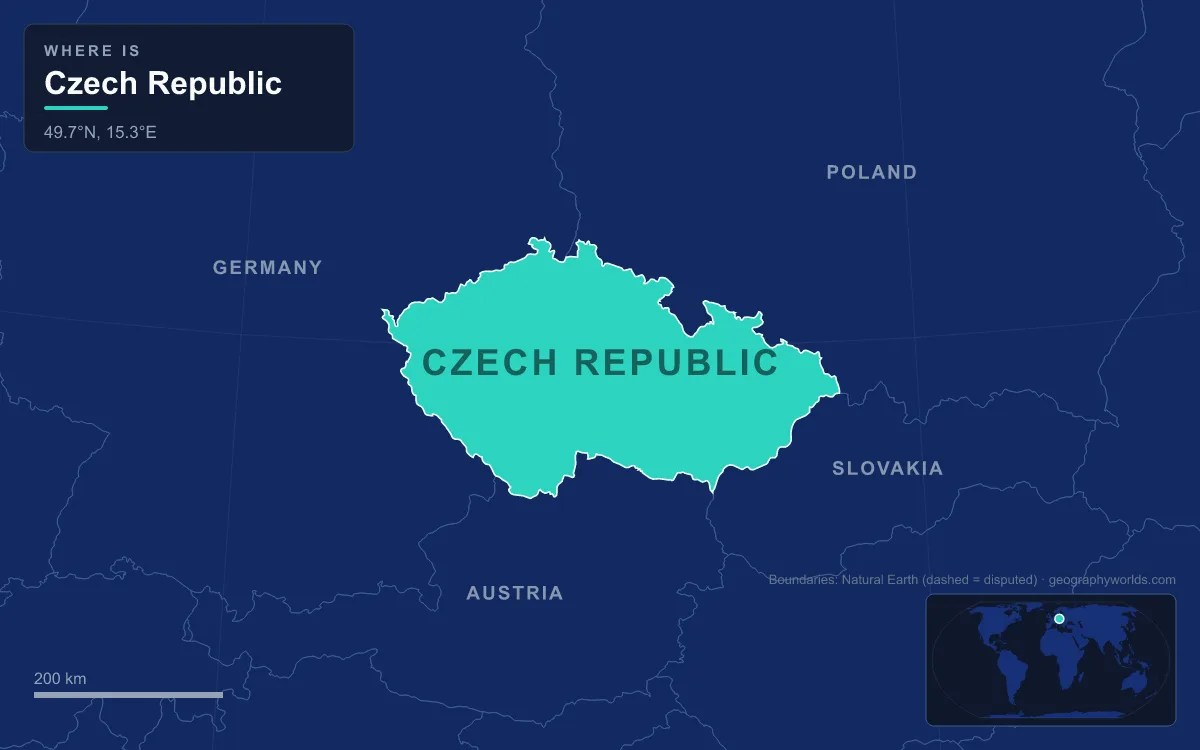
The most famous people from the Czech Republic include the writer Franz Kafka, author of The Metamorphosis; the composer Antonín Dvořák, whose "New World" Symphony premiered in New York in 1893; Gregor Mendel, whose pea experiments in Brno founded genetics; Václav Havel, the dissident playwright who became the country's first president; the tennis player Martina Navratilova, winner of a record nine Wimbledon singles titles; the runner Emil Zátopek, who won three golds at the 1952 Olympics; and the Art Nouveau artist Alfons Mucha. Most of them can be pinned to a single town on the map, so this guide travels from Prague through Brno and the Moravian towns to the villages of Bohemia, placing each person where they started.
Prague: Charles IV, Jan Hus, Kafka, Havel and Navratilova
Prague has produced more of these names than anywhere else, beginning with a king. Charles IV (1316–1378), born in the city, became King of Bohemia in 1346 (he was crowned in Prague the following year) and was crowned Holy Roman Emperor in 1355, made Prague an imperial capital. He granted privileges to Charles University in a Golden Bull of 7 April 1348, and it remains one of the oldest universities in the world in continuous operation. His name survives on the Charles Bridge, Charles Square and the spa town of Karlovy Vary.
Jan Hus (c. 1369–1415) was born to peasant parents in Husinec in southern Bohemia and took his name from the village, but his career belongs to Prague. He preached at the Bethlehem Chapel from 1402, served as rector of the university, and attacked the sale of indulgences a century before Martin Luther. Summoned to the Council of Constance, he refused to recant and was burned at the stake on 6 July 1415; his followers, the Hussites, fought off crusading armies for years afterwards. Ladislav Šaloun's memorial to him in the Old Town Square was unveiled in 1915, on the 500th anniversary of his death.
Franz Kafka (1883–1924) was born near that same square into a German-speaking Jewish family, trained as a lawyer and spent his working life in insurance. The Metamorphosis appeared in 1915; The Trial (1925) and The Castle (1926) were published after his death, against his instructions, by his friend and literary executor Max Brod, and the word "Kafkaesque" entered the language to describe the bewildering bureaucracies his characters face. Václav Havel (1936–2011), also Prague-born, wrote absurdist plays such as The Garden Party, co-founded the Charter 77 human-rights initiative, and spent nearly four years in prison between 1979 and 1983. His Civic Forum led the Velvet Revolution of 1989; he was the last president of Czechoslovakia and, from 1993 to 2003, the first president of the Czech Republic. The city's airport has carried his name since 2012.
Three Prague-born women made their names in very different ways. Madeleine Albright (1937–2022) left with her family after the 1948 communist coup and in 1997 became the first woman to serve as US Secretary of State. Věra Čáslavská (1942–2016) won seven Olympic gymnastics golds, three in Tokyo in 1964 and four in Mexico City in 1968, where she protested the Soviet-led invasion of her country by looking away during the Soviet anthem. Martina Navratilova (born 1956) grew up in Řevnice, south-west of the city, defected to the United States in 1975 and went on to win 18 Grand Slam singles titles, nine of them at Wimbledon.
Brno, the Moravian Capital: Mendel, Janáček, Gödel and Kundera
Brno, the country's second city, is where a scientist, a composer, a logician and a novelist of world rank either were born or did their defining work. Gregor Mendel (1822–1884) was born into a German-speaking family in Heinzendorf, now Hynčice, in Czech Silesia, and entered the Augustinian St Thomas's Abbey in Old Brno, where he later became abbot. Between 1856 and 1863 he cross-bred pea plants in the abbey garden, tracking seven traits such as seed colour and pod shape. He presented the results to Brno's Natural History Society in February and March 1865 and published them in 1866. They were largely ignored until 1900, when three botanists independently rediscovered his laws of inheritance.

Leoš Janáček (1854–1928) was born in the Moravian village of Hukvaldy, the son of a schoolmaster, but lived and taught in Brno. He built a modern musical language from Moravian folk song and the "speech melodies" of spoken Czech, and his opera Jenůfa premiered in Brno in 1904. His best-known works, including The Cunning Little Vixen, the Glagolitic Mass and the Sinfonietta of 1926, came in his final decade.
Kurt Gödel (1906–1978) was born in Brno, then Brünn in Austria-Hungary, into a German-speaking family that managed a textile firm. At the University of Vienna he proved his completeness theorem in 1929 and published the incompleteness theorems in 1931, which showed that any consistent formal system rich enough for arithmetic contains true statements it cannot prove. He emigrated to the United States in 1939. Milan Kundera (1929–2023) was born in Brno's Královo Pole district, the son of a musicologist who ran the city's Janáček music academy. His first novel, The Joke (1967), satirised the Communist Party; after 1968 his books were banned, and he left for France in 1975. Stripped of his Czechoslovak citizenship in 1979, he wrote The Unbearable Lightness of Being in exile. He received Czech citizenship again in 2019.
Příbor, Kopřivnice, Hodonín, Ivančice and Zlín: The Moravian Towns
A string of smaller Moravian towns claims a startling share of the country's best-known names. Sigmund Freud (1856–1939), the founder of psychoanalysis, was born to a Jewish wool merchant's family in Freiberg, now Příbor, in north-east Moravia. The family left Freiberg in 1859, going first to Leipzig and in 1860 to Vienna, where he built his career, so he is usually described as Austrian; the house where he was born is pictured below.

A short distance from Příbor lies Kopřivnice, where Emil Zátopek (1922–2000) was born the seventh child of a modest family. At 16 he went to work at the Baťa shoe factory in Zlín, and it was there that the factory sports coach ordered him into a race; he finished second of 100 and joined a local athletics club. At the 1952 Helsinki Olympics he won the 5,000 m, the 10,000 m and then the marathon, the first he had ever run; no one else has won all three at the same Games.
Tomáš Garrigue Masaryk (1850–1937) was born in Hodonín, on the Morava river by the Slovak border. A philosophy professor in Prague, he went into exile during the First World War to argue for Czech and Slovak independence, and in 1918 became the first president of Czechoslovakia, re-elected in 1920, 1927 and 1934 before resigning in 1935 at 85. Alfons Mucha (1860–1939), born in Ivančice south-west of Brno, became the face of Paris Art Nouveau after his poster for Sarah Bernhardt in Gismonda, and later spent 1912 to 1926 painting the twenty canvases of The Slav Epic, which he gave to the Czech nation in 1928.
Zlín also shaped a scientist. Otto Wichterle (1913–1998), who finished school in Prostějov, worked at Baťa's research institute during the war and led the team that produced Czechoslovakia's first synthetic fibre, silon, in 1941. Back in Prague, he produced the first four soft hydrogel contact lenses in late 1961 on an apparatus built from a Merkur children's construction kit and a bicycle dynamo.
Nelahozeves, Litomyšl, Čáslav and Kladno: Bohemia Beyond the Capital
Antonín Dvořák (1841–1904) was born in Nelahozeves on the Vltava north of Prague, the eldest son of a man who worked as an innkeeper, butcher and professional zither player. Johannes Brahms sat on the jury of the Austrian State Competition, which Dvořák first won in 1874, and after his third win in 1877 recommended him to the publisher Simrock. As director (1892–1895) of the National Conservatory of Music in New York he wrote the Symphony No. 9 "From the New World", premiered by the New York Philharmonic in 1893, and the Cello Concerto.
Bedřich Smetana (1824–1884) was born in Litomyšl, near the old Bohemian–Moravian border, where his father brewed beer for Count Waldstein. He is regarded at home as the father of Czech music: his opera The Bartered Bride dates from 1866, and his cycle Má vlast contains the symphonic poem Vltava, which follows the river from its sources to Prague.
Karel Čapek (1890–1938), born in the village of Malé Svatoňovice in the hills of north-east Bohemia, introduced the word "robot" in his 1920 play R.U.R. and wrote the novel War with the Newts (1936). Miloš Forman (1932–2018), born in Čáslav in central Bohemia, made The Firemen's Ball (1967) during the Czechoslovak New Wave, left for the United States after 1968 and won Academy Awards for Best Director for One Flew Over the Cuckoo's Nest (1975) and Amadeus (1984).
West of Prague, the steel town of Kladno raised Jaromír Jágr (born 1972), who played for Poldi Kladno at 15, won the Stanley Cup with Pittsburgh in 1991 and 1992 and Olympic gold at Nagano in 1998, and now owns the Kladno club, where he was still playing past 50.
Many of these journeys end in the capital, and our guide to Prague, capital of the Czech Republic covers the city Charles IV built, while the story of how Masaryk's Czechoslovakia split peacefully in 1993 is told in the Velvet Divorce.