
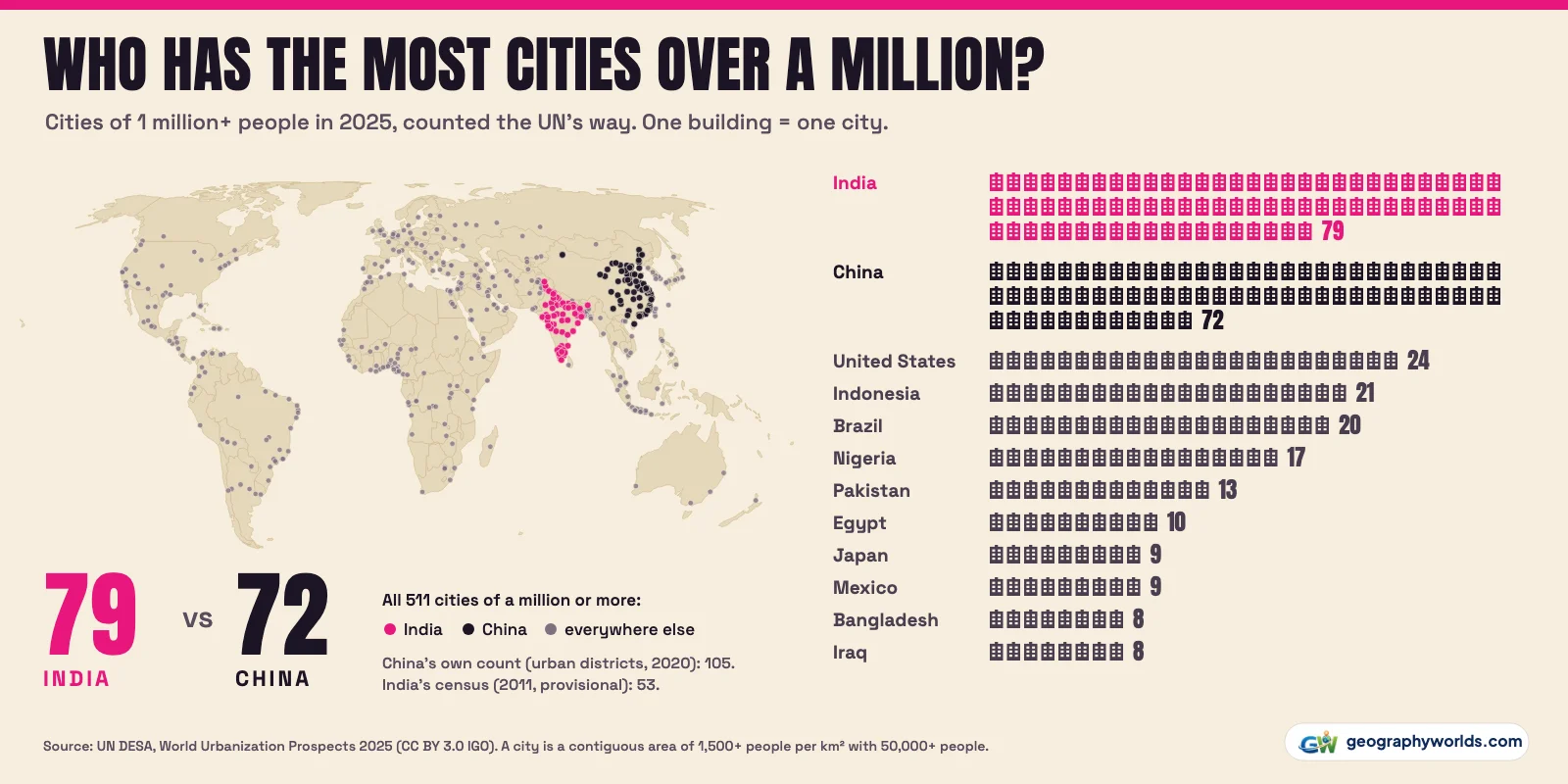
Measured the same way everywhere, India has more cities of over a million people than any other country: 79 in 2025, against China's 72. The United States is third with 24, then Indonesia (21), Brazil (20), Nigeria (17), Pakistan (13), Egypt (10), and Japan and Mexico (9 each). Those counts come from the UN's World Urbanization Prospects 2025, which draws every city on Earth with one density rule. China's own statistics, which count administrative cities, put China first with 105 in the 2020 census, and the reasons for that gap are most of this story.
The UN dataset, released in November 2025, maps 12,138 cities for 2025, and only 511 of them pass a million. India and China hold 151 of those, or 30%. Following the two giants from 1975 to the UN's 2050 projections shows a lead that swapped back and forth before India took it for good, a Chinese total that has stopped growing, and a gap that depends heavily on what counts as a city.
The scoreboard in 2025
The last column of the table is worth reading alongside the count. China's 72 million-plus cities hold 285.3 million people, slightly more than the 280.5 million in India's 79. China's are bigger: the median Chinese city on the list has 2.4 million people, the median Indian one 1.9 million. India wins on the number of cities; China still edges it on the number of people living in them.
| Rank | Country | 1975 | 2000 | 2025 | 2050 (projected) | People in them, 2025 |
|---|---|---|---|---|---|---|
| 1 | India | 18 | 53 | 79 | 93 | 280.5M |
| 2 | China | 21 | 54 | 72 | 69 | 285.3M |
| 3 | United States | 8 | 12 | 24 | 25 | 71.4M |
| 4 | Indonesia | 12 | 16 | 21 | 25 | 93.3M |
| 5 | Brazil | 6 | 13 | 20 | 19 | 65.2M |
| 6 | Nigeria | 1 | 7 | 17 | 26 | 48.9M |
| 7 | Pakistan | 3 | 9 | 13 | 25 | 65.9M |
| 8 | Egypt | 2 | 2 | 10 | 14 | 46.9M |
| 9 | Japan | 8 | 9 | 9 | 8 | 62.4M |
| 9 | Mexico | 3 | 7 | 9 | 10 | 34.6M |
| 11 | Bangladesh | 2 | 5 | 8 | 10 | 52.7M |
| 11 | Iraq | 1 | 1 | 8 | 14 | 16.2M |
| 13 | Iran | 2 | 6 | 7 | 8 | 24.0M |
| 13 | Russia | 8 | 9 | 7 | 7 | 25.1M |
| 13 | Turkey | 3 | 4 | 7 | 7 | 27.6M |
The UN lists Hong Kong, Macao and Taiwan separately from China. They add 2, 1 and 3 million-plus cities, which would make 78, still one short of India.
1975 to 2007: China's long lead
In 1975 the world had 165 cities of a million or more, spread over 60 countries. China led with 21, India had 18 and Indonesia 12, while Japan, the United States and Russia had 8 each. By 2025 the world total had reached 511 in 128 countries, and the rich countries on the 1975 list had barely moved: Japan has 9, Russia 7, the United Kingdom 5 and Germany 5.
China's count climbed steadily through the reform years, from 21 to 42 in 1990 and 54 in 2000. India kept pace almost exactly, reaching 37 in 1990 and 53 in 2000. The two lines touched and briefly crossed in the late 1990s, when India led from 1996 to 1998, and China went back in front until the mid-2000s. In 2007 India pulled ahead, and on the UN's figures it has had more million-plus cities every year since.
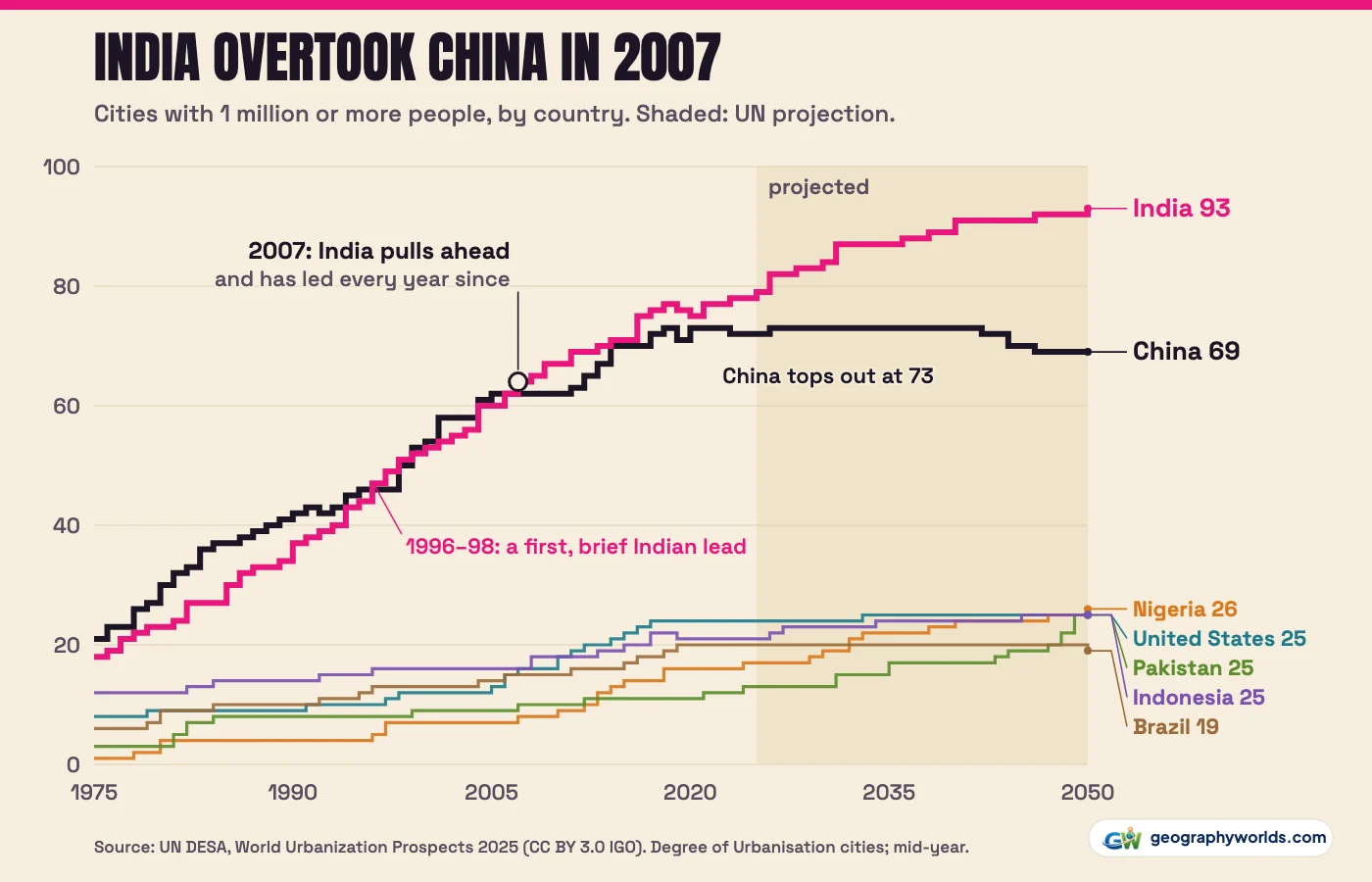
China's line then flattens. It first reached 73 million-plus cities in 2018, and the UN projects it hovering around that level until the early 2040s before slipping to 69 by 2050. India's count, 75 in 2020, keeps rising.
How India pulled ahead
India's lead is partly a story of cities that most people outside India have never heard of. The UN identifies cities from satellite-derived population grids: a city is a contiguous patch of square kilometres each holding at least 1,500 people, adding up to at least 50,000. That rule does not care whether a government calls the place a town or a village.
On the Gangetic plain of Bihar, rural population density is high enough for the rule to join villages into vast continuous clusters. The clearest example is Hajipur, across the Ganges from Patna. The 2011 census provisional totals recorded Hajipur as a town of 147,126 people. The UN's Hajipur, drawn around it across 3,092 km² of densely settled plain, had 6.6 million people in 2011 and has 9.9 million in 2025, at an average of 3,215 people per km². Patna, counted separately, has 3.3 million. The UN's own press release singles out Hajipur as a city expected to pass 10 million by 2050; the projection is 13.7 million.

Kerala, at the other end of the country, shows a similar effect. The UN counts 8 million-plus cities in this one small state: Kozhikode, Kochi, Kollam, Thiruvananthapuram, Ponnani, Thrissur, Kottayam and Thalassery. The census, using its own urban agglomerations, already found 7 Kerala agglomerations over a million in its 2011 provisional totals, so this is not purely an artefact of the UN method. Our guide to the largest cities in India covers the big metropolitan names. The UN rates the population estimates for its cities, and three of India's million-plus cities, Asansol, Srinagar and Surat, carry a low plausibility rating; none of China's do.
Beijing counts 105: the case for China
China's statistics describe a different country. According to the 2020 census county-level volume, as reported by the People's Daily Overseas Edition, 105 Chinese cities had more than a million residents in their urban districts: 7 with over 10 million, 14 with 5 to 10 million, 14 with 3 to 5 million and 70 with 1 to 3 million. For 2020 the UN counts 73.
The biggest reason is that the UN's rule merges administrative cities that have grown into each other. In the Pearl River Delta, Guangzhou and Foshan have fused into one built-up mass, and the UN's Guangzhou is a single city of 27.6 million covering 4,542 km². The file has no separate entry for Foshan or Dongguan, both of which the National Bureau of Statistics classed as megacities of 5 to 10 million urban residents in the 2020 census, according to The Paper. Shenzhen stays separate at 13.9 million. Further east along the Guangdong coast, Shantou has no entry of its own either, while the UN's Chaozhou counts 6.4 million. Our guide to the Pearl River Delta shows how that conurbation formed.

China also has the deeper pipeline on paper: 133 UN cities of between half a million and a million people in 2025, against India's 93. But those Chinese cities are not projected to grow into the million club. The UN expects 56 of China's 72 million-plus cities to be smaller in 2050 than in 2025. Between 2025 and 2050 China gains one million-plus city, Baoding, and loses four: Honghuagang, Kaifeng, Luohe and Zhangjiagang. For the giants themselves, see our guide to the largest cities in China.
Same cities, different rulers
India's census moves the other way. Its 2011 provisional table of urban agglomerations and cities lists 53 with a million or more people, up from 35 in 2001; the smallest of them, Chandigarh at 1,025,682, only just clears the line; the UN's figure for India in 2011 is 69. The census only counts places it classifies as urban, so a Hajipur-style belt of dense villages never enters its list.
The United States shows how much the ruler matters. The Census Bureau's estimates for 1 July 2025 give 12 incorporated cities over a million and 56 metropolitan areas, which are built from whole commuting counties. The UN's 24 sit in between. Jacksonville and Fort Worth pass a million inside their city limits but are not among the UN's 24, while Denver, Miami, Las Vegas and Seattle, all short of a million within their own boundaries, are.
The UN itself used to give the opposite answer. Its 2018 revision, which took each country's own city concept, listed 548 cities of a million or more, with China on 124, India on 61 and the United States on 45. Recounted on the 2025 method, 2018 had 483 such cities, with China on 73 and India on 77. The cities did not change between the two publications; the definition did.
The chasing pack: Nigeria, Pakistan and the United States
Below the two leaders, the most striking growth is in Africa and South Asia. Nigeria's count went from 1 in 1975 to 7 in 2000 and 17 in 2025. Pakistan went from 3 to 13, Egypt from 2 to 10, Iraq from 1 to 8 and DR Congo from 1 to 6. The United States tripled from 8 to 24, while Indonesia rose from 12 to 21 and Brazil from 6 to 20.
2050: India stretches the gap
The UN projects 611 million-plus cities by 2050. 109 cities cross the threshold after 2025 and 9 fall back below it. India adds the most, 14, led by Kotwali, Gaya, Darbhanga, Sitamarhi and Faizabad, reaching 93. Pakistan adds 12 and nearly doubles to 25; Nigeria adds 9, DR Congo 7 and Iraq 6.
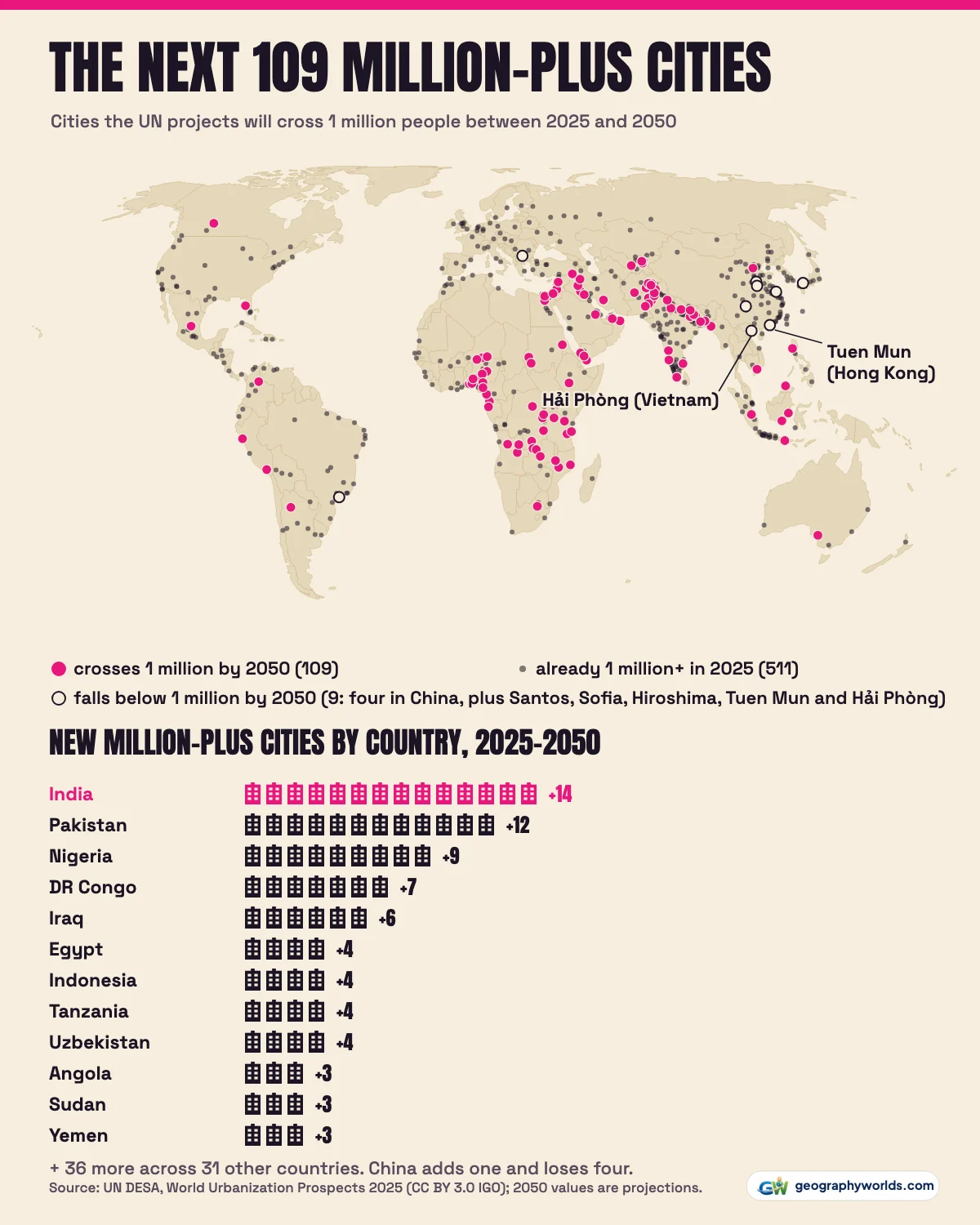
On those projections, the 2050 order is India 93, China 69, then Nigeria alone in third on 26, ahead of Indonesia, Pakistan and the United States on 25 each. Japan slips to 8. Projections that far ahead depend on fertility and migration assumptions, so the 2050 figures are best read as direction rather than destination.
How we counted
A city here is one of the UN's Degree of Urbanisation cities, counted when its 1 July population is 1,000,000 or more. Countries are the UN's locations, so Hong Kong, Macao and Taiwan appear on their own, and cities in Jammu and Kashmir are counted under India as the UN assigns them. 2026 to 2050 are projections. We cross-checked the totals against China's 2020 census, India's Census 2011 table, the Census Bureau's own files and the UN's 2018 annex, and where they disagree the text above gives both. The CSV holds 132 countries and areas with their counts for nine years from 1975 to 2050 and the population of their million-plus cities in 2025; download the data as a CSV. Paste it into Parity and you can chart any country's rise yourself. Sources:
- UN DESA Population Division, World Urbanization Prospects 2025 (cities database, Degree of Urbanisation): mid-year population of every city of 50,000+ in 1975–2050 (2026–2050 projected); released November 2025; CC BY 3.0 IGO
- UN DESA press release on WUP 2025, 18 November 2025
- UN DESA, The World's Cities in 2018 data booklet (WUP 2018), annex table of cities of 1 million or more
- Census of India 2011, Provisional Population Totals, Table 3: urban agglomerations and cities of 1 lakh and above (archived copy)
- People's Daily Overseas Edition via China News Service, 2 November 2022: 105 cities with over a million urban residents (2020 census county-level data)
- The Paper, 22 September 2021: China's 7 super-large and 14 megacities in the 2020 census (NBS chart in Qiushi)
- US Census Bureau, Vintage 2025 population estimates for metropolitan areas and incorporated places: public domain
- Natural Earth country outlines (via world-atlas): public domain
Counting cities shows how many places cross a line; to see how big the very largest have become, our ranking of the most populated cities in the world picks up where this count leaves off.