
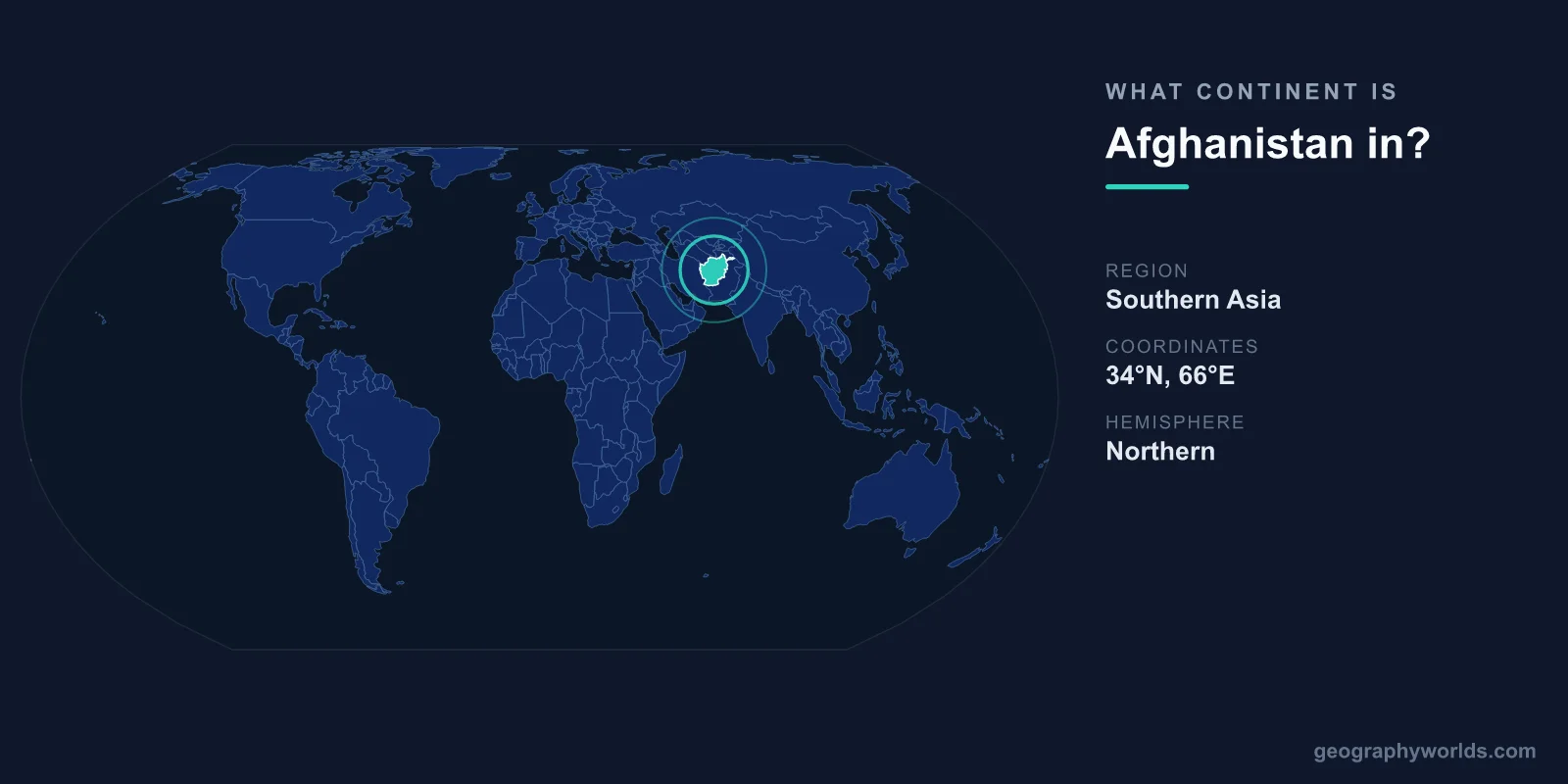
Afghanistan is located in Asia, sitting at the crossroads of Central Asia and South Asia. It is a landlocked, mountainous country that shares borders with six other Asian nations: Pakistan, Iran, Turkmenistan, Uzbekistan, Tajikistan, and China. Whether you classify it as Central Asian or South Asian, there is no doubt about the broader answer: Afghanistan belongs firmly to the continent of Asia.
Asia: The Continent and the Sub-Region Debate
Asia is the largest continent on Earth, and Afghanistan occupies a position deep within its interior. While the continental answer is straightforward, geographers and international organizations disagree on which sub-region best describes the country. The United Nations places Afghanistan in Southern Asia, grouping it with neighbours such as Pakistan, India, and Iran. Many other geographers and political analysts treat it as part of Central Asia, alongside the former Soviet republics of Turkmenistan, Uzbekistan, and Tajikistan to its north.
This dual identity is not a contradiction so much as a reflection of geography. Afghanistan straddles the natural boundary between the Indian subcontinent and the steppes of Central Asia. Its language, ethnic makeup, and trade ties pull it in both directions, which is exactly why it has so often been described as a bridge rather than a destination.
Where Exactly Afghanistan Sits
Afghanistan covers roughly 652,230 square kilometres, making it comparable in size to France or the U.S. state of Texas. Its capital, Kabul, lies in the eastern part of the country at a high elevation in the Hindu Kush foothills. Here are the essentials at a glance:
- Continent: Asia
- Region: Central Asia / South Asia (Southern Asia per the UN)
- Capital: Kabul
- Area: about 652,230 km²
- Coastline: none — completely landlocked
Being landlocked means Afghanistan has no direct access to the sea. All of its trade by water must pass through neighbouring countries, a fact that has shaped its economy and its strategic relationships for centuries.
The Six Asian Neighbours
Every country that borders Afghanistan is itself in Asia, which reinforces the continental answer from every direction. The borders break down like this:
- Pakistan — to the east and south, along the long and historically contested Durand Line.
- Iran — to the west, linking Afghanistan toward the Middle East.
- Turkmenistan, Uzbekistan, and Tajikistan — to the north, the gateway to the Central Asian steppe.
- China — to the far northeast, met only by a thin sliver of land.
That sliver is the Wakhan Corridor, a narrow finger of territory that stretches about 350 kilometres eastward and narrows to roughly 13 kilometres at its tightest point. It was created in the 19th century as a buffer zone between the British and Russian empires, and today it gives Afghanistan its short, remote frontier with China.
A Landscape Defined by Mountains
Afghanistan's place in Asia is dramatically shaped by the Hindu Kush, a towering mountain range that runs from the northeast to the southwest through the heart of the country. The Hindu Kush is an extension of the broader mountain systems that include the Himalayas and the Pamirs, tying Afghanistan physically to the high spine of Asia.
The country's highest point is Noshak, which rises to about 7,492 metres in the eastern Wakhan region — one of the tallest peaks outside the Himalayas proper. The terrain ranges from these alpine heights to arid plateaus and the southwestern deserts, while fertile northern valleys supply much of the nation's agriculture. The Amu Darya river forms part of the northern border, an ancient waterway known to the Greeks as the Oxus.
The Crossroads of Asia
Afghanistan's central position has earned it the enduring nickname "the crossroads of Asia." For thousands of years, traders, armies, and pilgrims passed through its mountain valleys. The ancient Silk Road threaded through Afghan cities such as Balkh and Herat, linking China and the Mediterranean world. Lapis lazuli, the prized deep-blue gemstone, has been mined in the country's Badakhshan province for more than 6,000 years and once travelled as far as the tombs of ancient Egypt.
This geography helps explain why so many empires — Persian, Greek, Mauryan, Mongol, and others — left their mark here. To learn more about its history, culture, and modern life, see our afghanistan country guide.
Frequently Asked Questions
Is Afghanistan in Asia or the Middle East?
Afghanistan is in Asia. It is sometimes loosely associated with the Middle East because of cultural and religious ties and its proximity to Iran, but geographers classify it as part of Central or South Asia, not the Middle East.
Is Afghanistan in Central Asia or South Asia?
It depends on the classification system. The United Nations lists Afghanistan under Southern Asia, while many other sources group it with Central Asia. Both are correct in their own framework, and either way it remains within Asia.
Does Afghanistan border any country outside Asia?
No. All six of Afghanistan's neighbours — Pakistan, Iran, Turkmenistan, Uzbekistan, Tajikistan, and China — are Asian countries.
Is Afghanistan landlocked?
Yes. Afghanistan has no coastline and no access to the open sea, making it one of Asia's landlocked nations. The nearest seas are reached only by crossing Pakistan or Iran.