

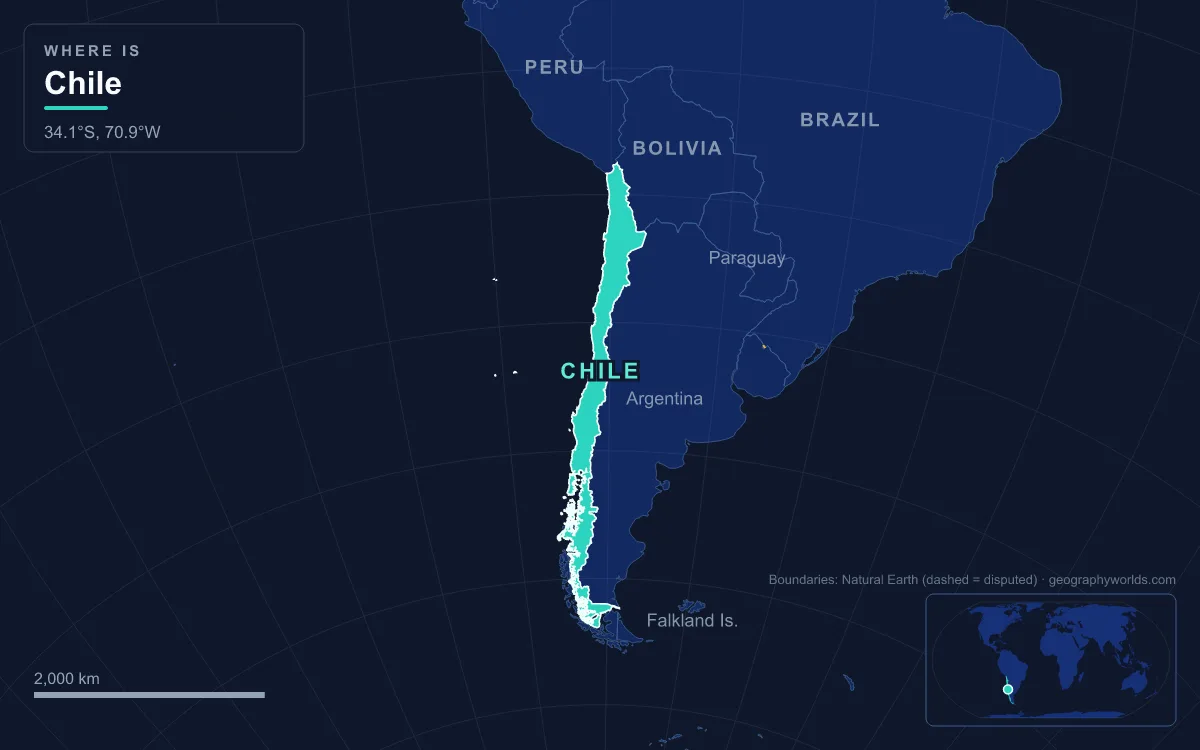
Chile's two Nobel poets, Gabriela Mistral (1945) and Pablo Neruda (1971), head any list of famous Chileans, alongside the independence leader Bernardo O'Higgins, the folk singer and artist Violeta Parra, President Salvador Allende, the novelist Isabel Allende, author of The House of the Spirits, and the footballer Alexis Sánchez, the national team's most capped player and record goalscorer. Others include Michelle Bachelet, the first woman elected president, the pianist Claudio Arrau, the novelist Roberto Bolaño and the actor Pedro Pascal. In a country that stretches over 4,300 km from north to south, where people come from says a lot about them, so this guide follows them home: from the Elqui Valley in the north to Punta Arenas on the Strait of Magellan.
Vicuña and the Elqui Valley: Where Gabriela Mistral Began
Gabriela Mistral (1889–1957) was born Lucila Godoy Alcayaga in Vicuña, a small town in the Elqui Valley of the Coquimbo Region, and grew up in Montegrande, a village further up the valley where her older sister Emelina ran the primary school. Her father left when she was three, and poverty marked her childhood. Her first poems appeared from 1904 in local newspapers such as La Voz de Elqui, under a string of pseudonyms before she settled on the one that stuck.
Teaching carried her the length of the country. In 1918 the education minister, and future president, Pedro Aguirre Cerda made her director of the Sara Braun girls' school in Punta Arenas, in the far south. In 1920 she moved to Temuco, and in 1921 to Santiago to run the capital's newest girls' school. Her first book, Desolación, was published in 1922 with help from the Hispanic Institute of New York. In 1945 she became the first Latin American author to receive the Nobel Prize in Literature, cited for lyric poetry that had made her name a symbol of Latin America's idealistic aspirations. She later served abroad as a consul, but the Elqui Valley is where Chileans place her.
Parral, Temuco and Isla Negra: Pablo Neruda and Marcelo Salas
Pablo Neruda (1904–1973) was born Ricardo Eliécer Neftalí Reyes Basoalto in Parral, in today's Maule Region, about 350 km south of Santiago. His mother, a schoolteacher, died two months after his birth, and his father, a railway worker, took the family south to Temuco, in the Araucanía Region. It was in Temuco that the teenage poet met Gabriela Mistral, who had come to run the local girls' school and who encouraged his writing when his father opposed it. He published his first essay in the town's newspaper La Mañana in 1917, at 13.

His Twenty Love Poems and a Song of Despair (1924) made his name at 20. A diplomatic career took him to Buenos Aires, Barcelona and Madrid, where he succeeded Mistral as consul. A 1943 visit to Machu Picchu in Peru inspired Alturas de Macchu Picchu, part of his epic Canto General (1950). He sat as a Communist senator, went into hiding when President Gabriel González Videla outlawed the party in 1948, and won the Nobel Prize in Literature in 1971. He died in September 1973, days after the coup; his seaside house at Isla Negra, on the coast of the Valparaíso Region, is now a museum.
Temuco also produced Marcelo Salas (born 1974), who played for the Deportes Temuco youth team before Universidad de Chile signed him. Nicknamed "El Matador", he went on to River Plate, Lazio and Juventus and scored 37 goals for Chile. Since 2013 he has been president of Deportes Temuco, the club where he started.
Chillán and the Ñuble Countryside: O'Higgins, Arrau, Violeta Parra and Víctor Jara
Ñuble, the farming region around the city of Chillán, about 400 km south of the capital, gave Chile an independence leader, a concert pianist and two of the founders of its folk-song revival.
Bernardo O'Higgins (1778–1842) was born in Chillán, the illegitimate son of Ambrosio O'Higgins, an Irish-born officer who became Governor of Chile and Viceroy of Peru. Educated partly in London, he joined the fight against Spanish rule, went into exile in Argentina after a royalist comeback, and in 1817 crossed the Andes with José de San Martín and the Army of the Andes. After their victory at Chacabuco he was proclaimed Supreme Director, heading the first fully independent Chilean state until 1823. He is counted among Chile's founding fathers.

Claudio Arrau (1903–1991), born in Chillán, was reading Beethoven sonatas at four and gave his first concert at five. At six he played for President Pedro Montt, who arranged for his education abroad; he trained at Berlin's Stern Conservatory under Martin Krause, a pupil of Liszt, and became one of the leading pianists of the 20th century, later settling in New York and taking American citizenship.
Violeta Parra (1917–1967) was born, according to her birth certificate, in San Carlos, a small town in Ñuble. She travelled Chile collecting folk songs and pioneered the Nueva Canción movement. In April 1964 she became the first Latin American artist to hold a solo exhibition at the Louvre's Museum of Decorative Arts, showing her arpilleras, oil paintings and wire sculptures. Her song "Gracias a la vida", written in 1964–65 and released in 1966, has become one of the most covered Latin American songs, and her birthday, 4 October, is Chilean Musicians' Day.
Víctor Jara (1932–1973) was born to tenant farmers in Ñuble, near Chillán Viejo, before the family moved to Lonquén near Santiago when he was five. A theatre director and singer, he became a leading voice of Nueva Canción. The day after the coup of 11 September 1973 he was detained with hundreds of others at the Technical University and taken to Estadio Chile in Santiago, where he was tortured and shot dead.
Santiago and Valparaíso: Presidents, Novelists and a Hollywood Actor
The capital region and its port have produced the largest share of Chile's political and cultural figures, and the country's modern history ran through both cities. More on the capital is in our guide to Santiago, capital of Chile.
Salvador Allende (1908–1973) was born in Santiago and trained as a doctor, but built his political base in Valparaíso, where he led the local doctors' union and in 1933 co-founded the city's section of the Socialist Party. After losing the presidential elections of 1952, 1958 and 1964, he won in 1970 as candidate of the Popular Unity coalition, described as the first Marxist elected president in a liberal democracy in Latin America. On 11 September 1973, as troops surrounded La Moneda Palace, he gave a last speech vowing not to resign and died by suicide in his office, although the exact circumstances are still disputed.
Augusto Pinochet (1915–2006), born in Valparaíso, was the army commander who led that coup and ruled as head of the military government from 1973 to 1990, a period of repression in which approximately 3,000 people were killed and more than 1,000 remain missing.
Michelle Bachelet (born 1951) was born in the La Cisterna district of Santiago. A physician who was detained and tortured under the military government and then went into exile, she was elected Chile's first woman president, serving from 2006 to 2010 and again from 2014 to 2018. She was the first head of UN Women and, from 2018 to 2022, UN High Commissioner for Human Rights.
Isabel Allende (born 1942) is a Chilean-American novelist who was in fact born in Lima, Peru, where her father, a first cousin of Salvador Allende, was a diplomat. After the coup she fled to Venezuela, where she wrote The House of the Spirits (1982). She has lived in California since 1989, became a US citizen in 1993 and received the Presidential Medal of Freedom in 2014.
Roberto Bolaño (1953–2003) was born in Santiago but grew up in Viña del Mar, Quilpué and Cauquenes before leaving for Mexico and Spain. The Savage Detectives won the Rómulo Gallegos Prize in 1999, and 2666 won the US National Book Critics Circle Award posthumously in 2008. The biologist Humberto Maturana (1928–2021), also born in Santiago, coined the term "autopoiesis" with Francisco Varela to describe how living systems produce and maintain themselves. And the actor Pedro Pascal (born 1975), born in Santiago and a great-nephew of Allende's sister Laura, is known for The Mandalorian and The Last of Us.
Tocopilla to Punta Arenas: Jodorowsky, Sánchez and Boric at Chile's Far Ends
Tocopilla, a port in the Antofagasta Region on the edge of the Atacama, the desert covered in our Atacama Desert geography guide, gave Chile two very different figures. Alejandro Jodorowsky (born 1929), the son of Ukrainian Jewish immigrants, lived there until he moved to Santiago at nine, and his dislike of the American mining bosses he saw there as a boy later fed the anti-imperialist streak in his films. A Chilean and French director and writer, he made the cult films El Topo (1970) and The Holy Mountain (1973).
Alexis Sánchez (born 1988), also from Tocopilla, came through the youth ranks of Cobreloa, in the mining city of Calama, and made his Chile debut at 18 in 2006. He moved to Barcelona in 2011 and Arsenal in 2014, and scored the winning penalty in the 2015 Copa América final, Chile's first major title, before leading the side to a second title at the 2016 Copa América Centenario, where he won the Golden Ball as the tournament's best player.
At the other end of the country, Gabriel Boric (born 1986) was born in Punta Arenas to a family of Croatian and Catalan descent. A student leader during the 2011–2013 protests, he won the 2021 presidential election with 55.9% of the second-round vote and, on taking office in March 2022, became the youngest president in Chilean history, serving until 2026.
From Vicuña to Punta Arenas, the birthplaces on this list trace almost the whole length of the country, a shape explained in our overview of Chile's geography.