

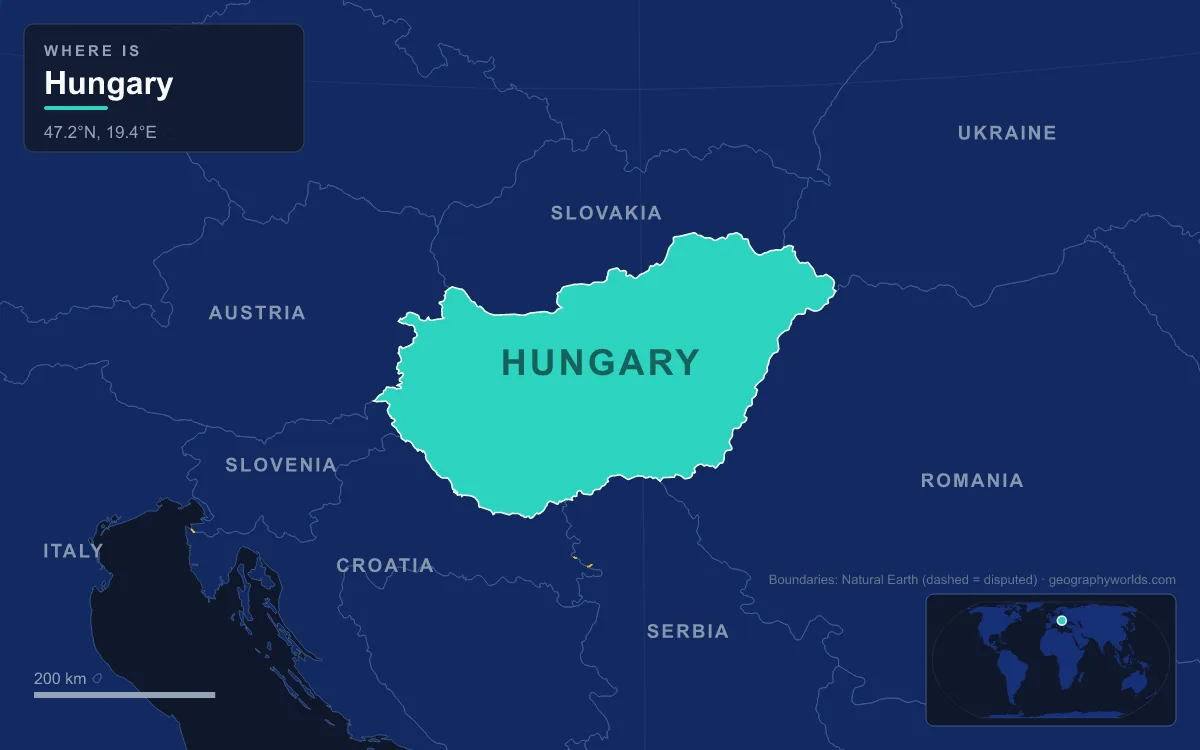
Hungary's most famous people start with the nation-makers: Saint Stephen, crowned the first king of Hungary around the year 1000; Lajos Kossuth, who led the 1848–49 war of independence; and the poet Sándor Petőfi, whose "National Song" opened that revolution. Beyond them stand the Hungarians who took the country's name abroad: the composers Franz Liszt and Béla Bartók, the mathematician John von Neumann, the footballer Ferenc Puskás, Ernő Rubik, inventor of the Rubik's Cube, and the biochemist Katalin Karikó, whose work on messenger RNA won the 2023 Nobel Prize in Physiology or Medicine. This guide begins with the founders and reformers, then follows the people who carried Hungary into concert halls, laboratories and stadiums around the world.
Saint Stephen and Matthias Corvinus: The Kingdom of 1000 and Its Renaissance King
The Hungarian state dates itself to one coronation. Stephen I (c. 975–1038), born in Esztergom and given the pagan name Vajk, succeeded his father, Grand Prince Géza, in 997. He defeated his pagan relative Koppány and was crowned on 25 December 1000 or 1 January 1001 with a crown sent by Pope Sylvester II, becoming the first king of Hungary. He spent his reign building a Christian church organisation and subduing semi-independent chieftains, and was canonised in 1083 together with his son Emeric. His feast day, 20 August, is Hungary's State Foundation Day, a national holiday.
Almost five centuries later Matthias Corvinus (1443–1490), son of the regent John Hunyadi, was proclaimed king at 14 on 24 January 1458. He built the Black Army, one of the earliest professional standing armies in medieval Europe, was elected King of Bohemia in 1469 and occupied Lower Austria between 1482 and 1487, riding into Vienna at the head of 8,000 veterans on 1 June 1485 after a five-month siege. His royal library, the Bibliotheca Corviniana, was one of the largest collections of books in Europe, and under his patronage Hungary became the first country to embrace the Renaissance from Italy. He survives in Hungarian and Slovak folk tales as Matthias the Just, a king who wandered among his subjects in disguise.
From the Chain Bridge to 1956: Széchenyi, Kossuth, Petőfi and Imre Nagy
Modern Hungary was shaped in the reform era before 1848 by a count and a lawyer who disagreed about almost everything. István Széchenyi (1791–1860), still called "the Greatest Hungarian", gave a full year's income from his estates, 60,000 forints, in 1825 to found the Hungarian Academy of Sciences. He championed the first permanent bridge across the Danube between Buda and Pest, the Chain Bridge, designed by the English engineer William Tierney Clark and opened in 1849; its 202-metre central span was a symbol of the two towns becoming one city.

Lajos Kossuth (1802–1894), born into the lesser nobility at Monok in northern Hungary, was a journalist and orator who became governor-president of the Hungarian state during the war of independence of 1848–49. After defeat by Austria and Russia he lived in exile, was received as a hero in Britain and the United States, and settled in Turin, where he died. On the morning of 15 March 1848 the 25-year-old poet Sándor Petőfi (1823–1849) marched through Pest reading his Nemzeti dal ("National Song") and the "12 Points" of the revolutionaries. He most likely died at the Battle of Segesvár in July 1849, and 15 March remains a national holiday.
A century later another uprising produced another national symbol. Imre Nagy (1896–1958), a communist who had been prime minister from 1953 to 1955, became leader of the Hungarian Revolution of 1956 against the Soviet-backed government. After Soviet troops crushed it he was tried for treason and executed on 16 June 1958 and buried in an unmarked grave. His rehabilitation and reburial with full honours in June 1989 helped bring down the communist regime.
Liszt, Bartók, Houdini and Kertész: Hungarian Names on the World's Stages
Franz Liszt (1811–1886) was born in Doborján in the Kingdom of Hungary, now Raiding in Austria, and studied with Carl Czerny and Antonio Salieri in Vienna. The tour of Europe he began in 1839 produced a public frenzy, first seen in Berlin in 1841, that Heinrich Heine named "Lisztomania", and he championed Berlioz, Chopin, Schumann and Wagner. His Hungarian Rhapsodies carried the country's music into every concert hall. Béla Bartók (1881–1945) was born in Nagyszentmiklós, now Sânnicolau Mare in Romania. His first major orchestral work, in 1903, was a symphonic poem called Kossuth. With his friend Zoltán Kodály (1882–1967), later creator of the Kodály method of music teaching, he recorded hundreds of phonograph cylinders of peasant songs, a study that made him a founder of ethnomusicology. Opposed to Hungary's drift towards Nazi Germany, he emigrated to New York in October 1940, where he wrote the Concerto for Orchestra, premiered by the Boston Symphony Orchestra in December 1944, a year before his death.
Harry Houdini (1874–1926) was born Erik Weisz in Budapest, the son of a rabbi. The family emigrated in 1878, when he was four, and settled in Appleton, Wisconsin, so Houdini's career as the world's best-known escape artist was an American one. The same is true of two other emigrants whose names became institutions. Joseph Pulitzer (1847–1911), born in Makó, about 200 km south-east of Budapest, built the St. Louis Post-Dispatch and the New York World, and his will endowed the Pulitzer Prizes, first awarded in 1917. Robert Capa (1913–1954), born Endre Friedmann in Budapest, left Hungary as a teenager, covered five wars as a photographer and was the only civilian photographer to land on Omaha Beach on D-Day. In literature, Imre Kertész (1929–2016), born in Budapest and deported as a teenager to Auschwitz and Buchenwald, turned that experience into Fatelessness and in 2002 became the first Hungarian to win the Nobel Prize in Literature. László Krasznahorkai (born 1954), from Gyula in eastern Hungary, followed in 2025; his novel Satantango (1985) was filmed by Béla Tarr.
Semmelweis to Karikó: Hungarian Science from Childbed Fever to mRNA
Ignaz Semmelweis (1818–1865), born in the Tabán district of Buda, worked at Vienna General Hospital, where the ward staffed by doctors had three times the maternal mortality of the midwives' ward. In 1847 he required staff to wash their hands in chlorinated lime solution, and deaths from childbed fever fell from 18% to under 2%. The medical establishment of his day rejected his findings, although his 1861 book set them out in full; he is now remembered as the "saviour of mothers".
John von Neumann (1903–1957), born in Budapest to a banking family, did foundational work in quantum mechanics and wrote Theory of Games and Economic Behavior (1944) with Oskar Morgenstern, launching game theory. His First Draft of a Report on the EDVAC described the stored-program design now called the von Neumann architecture, and during the Second World War he worked on the Manhattan Project. His fellow émigré Leo Szilard (1898–1964), raised in Pest, conceived the nuclear chain reaction in 1933 and in 1939 drafted the letter that Albert Einstein signed to President Roosevelt, the starting point of the Manhattan Project. Albert Szent-Györgyi (1893–1986), also Budapest-born, first isolated the compound he called hexuronic acid at Cambridge, showed at the University of Szeged with Joseph Svirbely that it was vitamin C, and won the 1937 Nobel Prize in Physiology or Medicine.
Katalin Karikó (born 1955) was born in Szolnok and grew up in Kisújszállás in a house without running water. She studied at Szeged, moved to the United States, and spent decades on messenger RNA with little funding before the work underpinned the mRNA vaccines of the COVID-19 pandemic; she shared the 2023 Nobel Prize with Drew Weissman. Ernő Rubik (born 1944 in Budapest), trained in sculpture and architecture, was teaching at the Budapest College of Applied Arts when he built a prototype cube of 27 wooden blocks in 1974; it took him a month to solve it after scrambling it. Hungary's state trading company began selling it in late 1977, and by 1980 it was on sale worldwide.
Puskás, Keleti and Polgár: Stadiums, Gyms and Chessboards
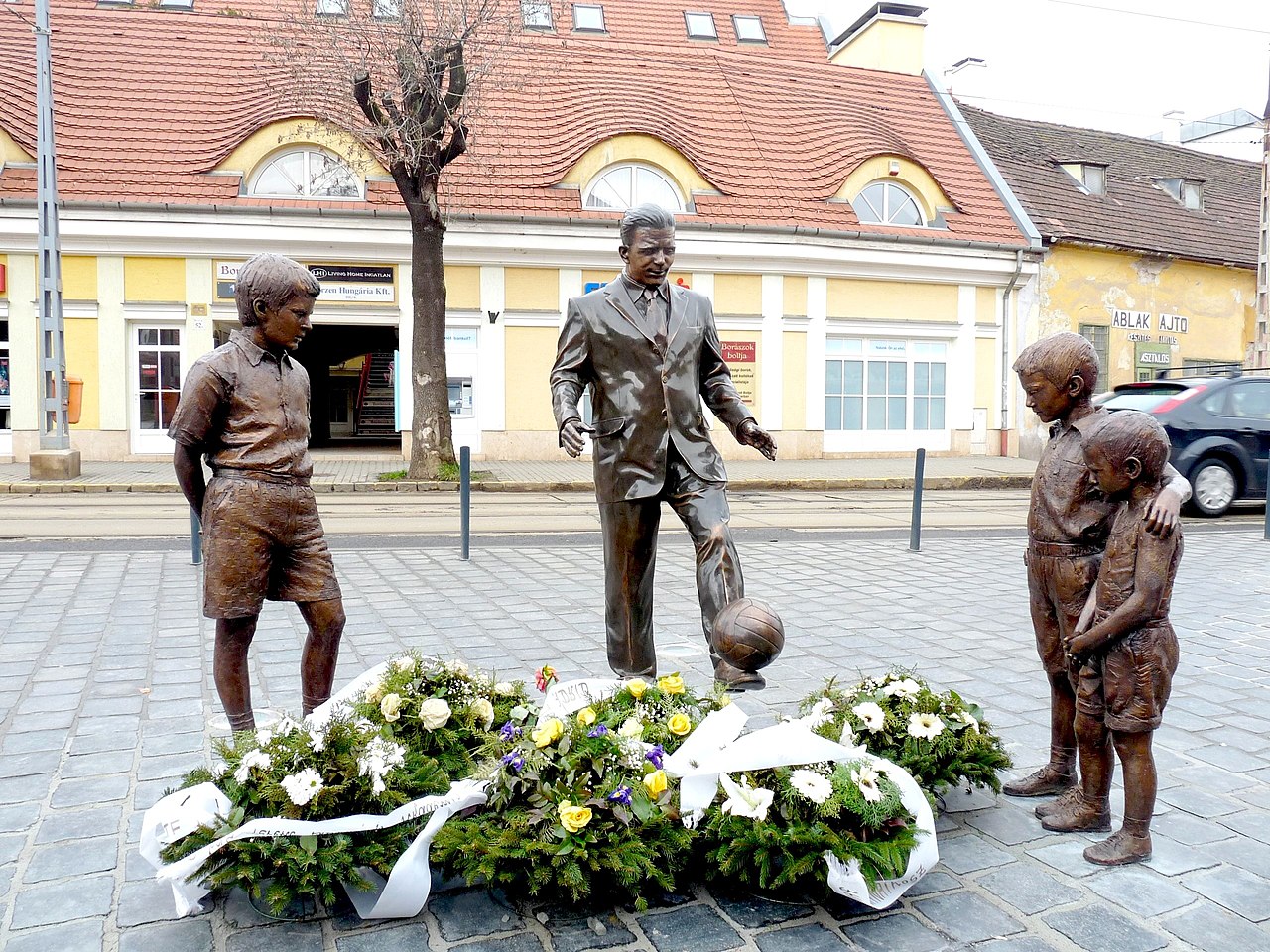
Ferenc Puskás (1927–2006), born in Budapest and brought up in the then-suburb of Kispest, scored 84 goals in 85 matches for Hungary, won Olympic gold in 1952 and led the national team to the 1954 World Cup final. His club, Budapest Honvéd, had just lost the away leg of a European Cup tie in Bilbao when the 1956 revolution erupted; the players refused to go back, staged the return leg in Brussels, and Puskás stayed in the West; after a two-year UEFA ban he joined Real Madrid in 1958 at 31, winning three European Cups and four Pichichi trophies as La Liga's top scorer. He did not return to Hungary until 1981. Budapest's national stadium was renamed after him in 2002.
Ágnes Keleti (1921–2025), a Budapest-born gymnast who survived the Holocaust, won ten Olympic medals, five of them gold, and was the most successful athlete of the 1956 Melbourne Games. She moved to Israel in 1957 and returned to Hungary in 2015. Judit Polgár (born 1976) became a grandmaster in 1991 at 15 years and 4 months, then the youngest ever, and is the only woman to have reached the world top ten; she was the top-rated woman on every list from January 1989 to March 2015, a record 26 consecutive years, and retired in 2014.
The Chain Bridge that Széchenyi championed is covered in our guide to the Chain Bridge in Budapest, and the language that Petőfi wrote in and Rubik still teaches in, unrelated to its neighbours, is explained in the language spoken in Hungary.