

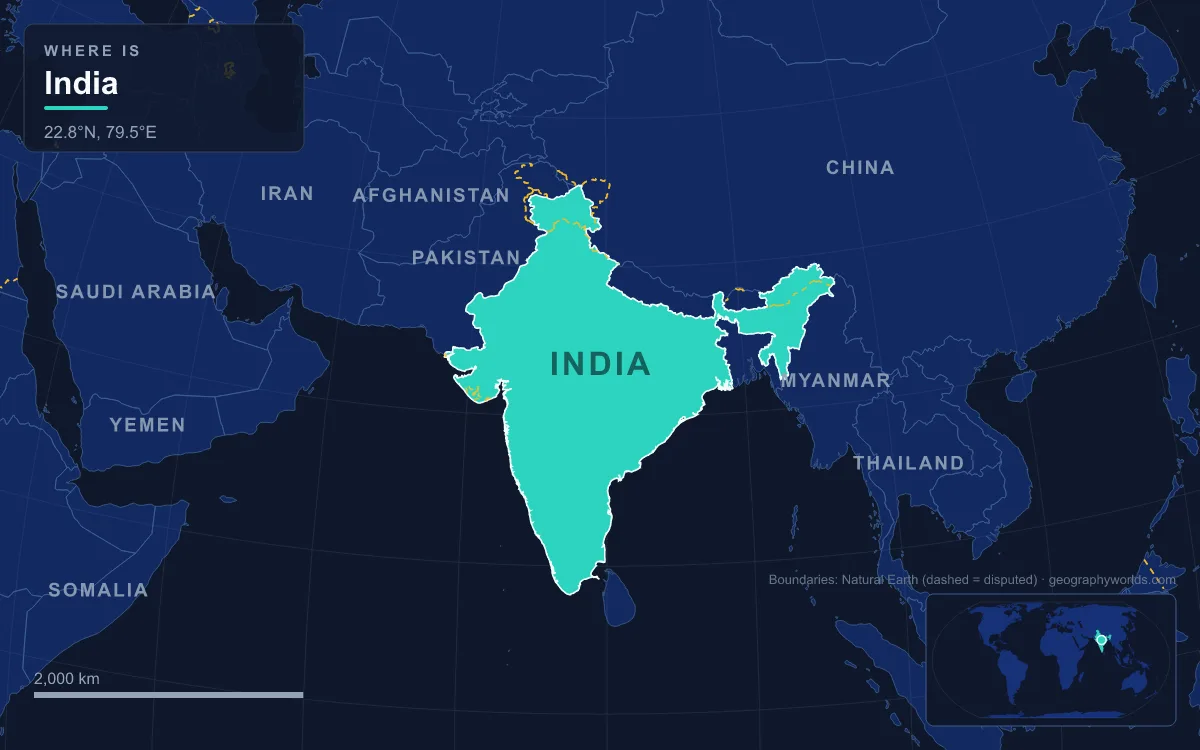
Mahatma Gandhi, who led India’s nonviolent campaign for independence; Rabindranath Tagore, the poet who won the 1913 Nobel Prize in Literature; Srinivasa Ramanujan, the self-taught mathematician; Lata Mangeshkar, the playback singer whose recording career lasted eight decades; Satyajit Ray, director of Pather Panchali; and Sachin Tendulkar, the only batsman with 100 international centuries, are among the most famous people from India. The list below is arranged by field, from politics and science to books, music, film and sport, and each heading names the people who lead that field, with their birthplaces, dates and the achievement each is best known for.
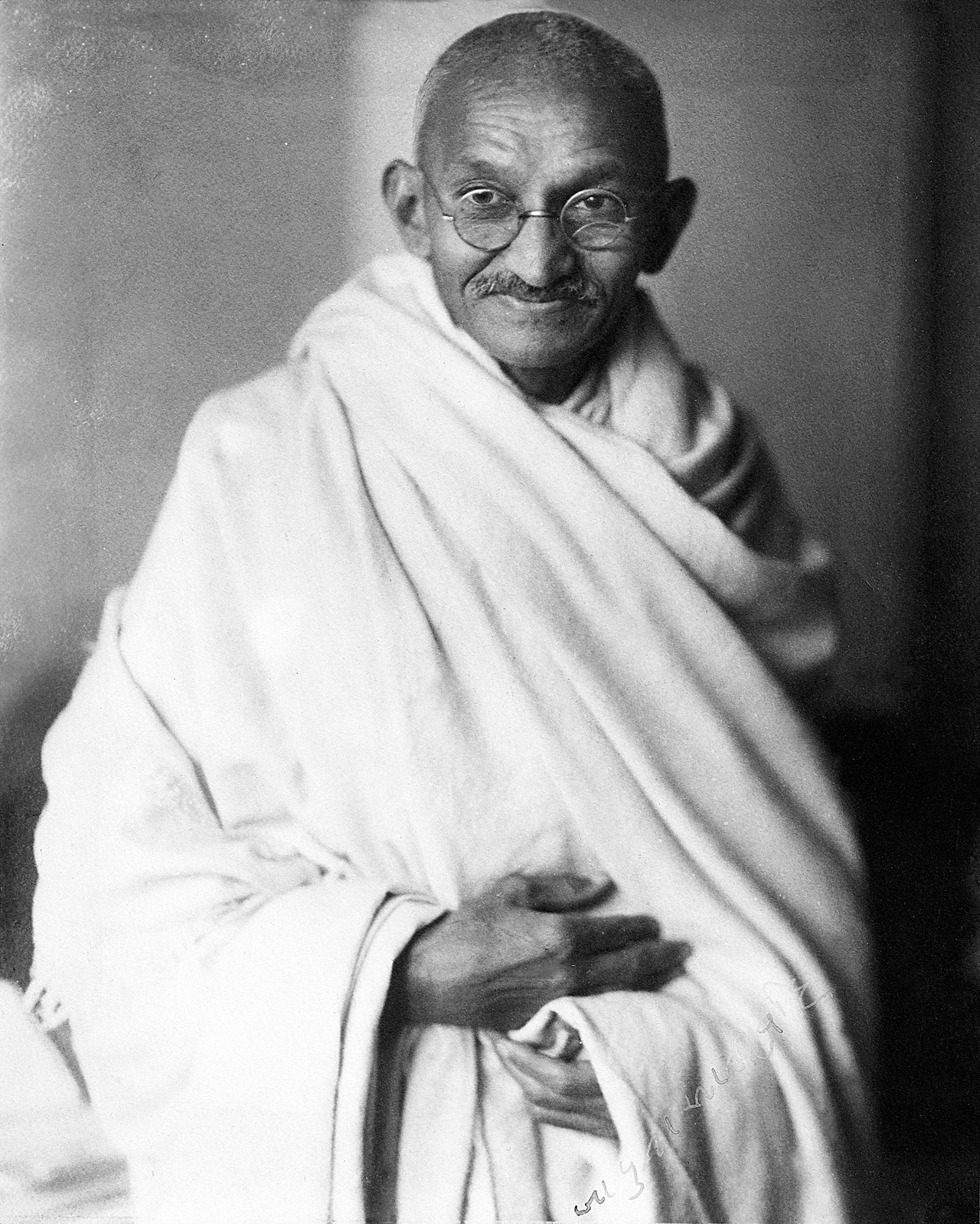
Mahatma Gandhi, Jawaharlal Nehru and Indira Gandhi in Politics
Mohandas Karamchand Gandhi (1869–1948) was born in Porbandar, a coastal town on the Kathiawar Peninsula of Gujarat. He trained as a lawyer at the Inner Temple in London and spent 21 years in South Africa, where he first developed his method of mass nonviolent resistance. Back in India he led the campaign against British rule. His best-remembered protest was the Salt March of 12 March to 6 April 1930, when he and his volunteers walked 388 km from Ahmedabad to the coast at Dandi to make salt in defiance of the British salt tax. In 1942 he called on the British to “quit India”. He was assassinated in Delhi on 30 January 1948, five months after independence.
Jawaharlal Nehru (1889–1964), born in Allahabad (now Prayagraj), became the first prime minister on 15 August 1947 and gave the “Tryst with Destiny” speech on the eve of independence. He held office for almost 17 years, until his death in 1964, promoting parliamentary democracy and keeping India out of both Cold War blocs. His daughter Indira Gandhi (1917–1984), also born in Allahabad, was prime minister from 1966 to 1977 and again from 1980 until her assassination in 1984. She remains India’s only female prime minister, and her combined tenure of almost 16 years is second only to her father’s. The seat of all three careers was New Delhi, described in our guide to New Delhi, India’s capital.
B. R. Ambedkar and Sarojini Naidu, Reformers of the Republic
Bhimrao Ramji Ambedkar (1891–1956) was born in the army cantonment of Mhow, now officially called Dr Ambedkar Nagar, in Madhya Pradesh, into a family of the Mahar caste, then treated as untouchable. He earned doctorates from Columbia University and the London School of Economics, and chaired the committee that drafted the Constitution of India. The Constituent Assembly adopted the constitution on 26 November 1949, and it came into force on 26 January 1950, the date India now celebrates as Republic Day. Ambedkar served as the first law minister, and in 1956 he converted to Buddhism, beginning a mass movement of conversions among Dalits.
Sarojini Naidu (1879–1949), born in Hyderabad and educated in Madras, London and Cambridge, published her first collection of poems, The Golden Threshold, in London in 1905. Gandhi called her the “Nightingale of India”. In 1925 she became the first Indian woman to be president of the Indian National Congress, and after independence she was the first woman appointed governor of an Indian state, the United Provinces.
Srinivasa Ramanujan and C. V. Raman: Mathematics and Physics from Tamil Nadu
Srinivasa Ramanujan (1887–1920) was born in Erode and grew up in Kumbakonam, in what is now Tamil Nadu. Largely self-taught, he wrote to the English mathematician G. H. Hardy at Cambridge in 1913, and Hardy arranged for him to come to England. In a short life Ramanujan compiled nearly 3,900 results, mostly identities and equations, in number theory, infinite series and continued fractions. In May 1918 he was elected a Fellow of the Royal Society, only the second Indian admitted, and he was the first Indian elected a Fellow of Trinity College, Cambridge. The number 1729 is still called the Hardy–Ramanujan number after a remark he made about Hardy’s taxi.

Chandrasekhara Venkata Raman (1888–1970), born in Tiruchirappalli in Tamil Nadu, began his research in his spare time while working for the Indian Finance Service in Calcutta, at the Indian Association for the Cultivation of Science. With his student K. S. Krishnan he found that light passing through a transparent material is scattered with a change in wavelength, the effect now named after him. He received the 1930 Nobel Prize in Physics, the first Asian to win the physics prize.
Homi Bhabha, Vikram Sarabhai, A. P. J. Abdul Kalam and Kalpana Chawla: Atoms, Rockets and Space
India’s nuclear and space programmes grew from the work of a few individuals. Homi J. Bhabha (1909–1966), a physicist from a wealthy Parsi family, founded the Tata Institute of Fundamental Research in 1945 and then the Atomic Energy Establishment at Trombay, renamed the Bhabha Atomic Research Centre after he died in the crash of Air India Flight 101 in 1966. Vikram Sarabhai (1919–1971) founded the Physical Research Laboratory in Ahmedabad in 1947 and is regarded as the founder of the Indian Space Research Organisation (ISRO). The rocket centre at Thiruvananthapuram in Kerala carries his name.
A. P. J. Abdul Kalam (1931–2015), born into a Muslim family in the temple town of Rameswaram, led ISRO’s first satellite launch vehicle, which put the Rohini satellite into orbit in July 1980, and played a central role in the Pokhran-II nuclear tests of May 1998. He then served as President of India from 2002 to 2007. Kalpana Chawla (1962–2003) was born in Karnal, Haryana, moved to the United States for graduate study and became an American citizen. In 1997 she flew on the Space Shuttle mission STS-87, becoming the first woman of Indian heritage in space. She died with six crewmates when Columbia broke up on re-entry on 1 February 2003.
Rabindranath Tagore, R. K. Narayan and Arundhati Roy on the Page
Rabindranath Tagore (1861–1941), from Calcutta, wrote poems, novels, plays and some two thousand songs in Bengali. In 1913 he became the first non-European to win the Nobel Prize in Literature, for the poems of Gitanjali. He founded a school at Santiniketan in 1901 that grew into Visva-Bharati University, and his songs became the national anthems of two countries: India’s “Jana Gana Mana” and Bangladesh’s “Amar Sonar Bangla”.
R. K. Narayan (1906–2001), from Madras, set most of his fiction in Malgudi, an invented South Indian town. His first novel, Swami and Friends, reached print in 1935 after Graham Greene read the manuscript and recommended it. Arundhati Roy (born 1961 in Shillong, in present-day Meghalaya) grew up in Kerala, the setting of The God of Small Things, which won the Booker Prize in 1997 and became the biggest-selling book by a non-expatriate Indian author.
Ravi Shankar, Lata Mangeshkar, A. R. Rahman, Satyajit Ray and Amitabh Bachchan: Music and Film
Ravi Shankar (1920–2012), born in Benares (now Varanasi), brought the sitar to Western audiences in the 1960s through concerts, teaching and his friendships with the violinist Yehudi Menuhin and the Beatles guitarist George Harrison. He won four Grammy Awards, including Album of the Year for The Concert for Bangladesh, and received the Bharat Ratna, India’s highest civilian honour, in 1999. Lata Mangeshkar (1929–2022), born in Indore, recorded songs in more than 36 languages over eight decades and received the Bharat Ratna in 2001. A. R. Rahman (born 1967 in Madras, now Chennai) began his film career with the Tamil film Roja in the early 1990s and won two Academy Awards, for Best Original Score and for the song “Jai Ho”, for Slumdog Millionaire (2008).
The director Satyajit Ray (1921–1992), born in Calcutta, made 36 films. His first, Pather Panchali (1955), opened the Apu Trilogy and won a prize at the 1956 Cannes Film Festival. In 1992 he received both an honorary Academy Award and the Bharat Ratna. The actor Amitabh Bachchan (born 1942 in Allahabad) became Hindi cinema’s leading star after Zanjeer (1973) and Sholay (1975). He has appeared in more than 200 films and hosted Kaun Banega Crorepati, India’s version of Who Wants to Be a Millionaire?.
Sachin Tendulkar, Mary Kom and Neeraj Chopra: Cricket, Boxing and Javelin
Sachin Tendulkar (born 1973) made his Test debut for India at 16, against Pakistan in Karachi in November 1989, and played for 24 years. He is the leading run-scorer in both Test cricket (15,921 runs) and one-day internationals (18,426), and won the World Cup with India in 2011. In 2014 he became the first sportsperson to receive the Bharat Ratna.
Mary Kom (born 1982 in Kagathei village, in the Churachandpur district of Manipur) is the only woman to have won the World Amateur Boxing Championship six times, and she took flyweight bronze at the London 2012 Olympics. She went on to become the first Indian woman boxer to win gold at the Asian Games, at Incheon in 2014, and at the Commonwealth Games, in 2018, and later sat in the Rajya Sabha, the upper house of Parliament. Neeraj Chopra (born 1997 in Khandra village, Panipat district, Haryana) won javelin gold at the Tokyo Olympics on 7 August 2021 with 87.58 m, India’s first Olympic gold in athletics, and added silver in Paris in 2024 with 89.45 m. In between, at the 2023 World Championships in Budapest, he became the first Asian to win the world javelin title. Gujarat, Tamil Nadu, Manipur and Haryana all appear in these stories; our guide to how many states India has shows where each one lies.