

The most famous people from Japan include the novelist Murasaki Shikibu, author of The Tale of Genji; the warlord Tokugawa Ieyasu, whose shogunate ruled from 1603 to 1868; the woodblock artist Katsushika Hokusai, who made The Great Wave off Kanagawa; the film director Akira Kurosawa, whose Rashomon won the Golden Lion at Venice in 1951; the animator Hayao Miyazaki, who has won two Academy Awards; and the baseball player Shohei Ohtani, a four-time Most Valuable Player in Major League Baseball. Read in order, their lives trace Japan’s history from the imperial court at Kyoto to the global stage, so this guide moves era by era, naming the people who defined each one.
Heian Kyoto, 794–1185: Murasaki Shikibu and Sei Shōnagon
The oldest names on any list of famous Japanese people belong to two women of the imperial court at Heian-kyō, today’s Kyoto. Murasaki Shikibu (c. 973 – c. 1014 or 1025) was a lady-in-waiting who wrote The Tale of Genji between about 1000 and 1012. Its 54 chapters follow the romances and political fortunes of Hikaru Genji, the son of an emperor, and then his descendants. The book is widely considered one of the world’s first novels. Her real name is unknown; “Murasaki” comes from a character in the book and “Shikibu” from her father’s post at the Ministry of Ceremonial.
Unusually for a woman of her time, Murasaki learned classical Chinese, the written language of government, in her father’s household, where it was being taught to her younger brother as preparation for an official career. Court women were expected to write in kana, the Japanese syllabic script, and it was in kana that both she and her contemporary produced the great prose of the age.

That contemporary was Sei Shōnagon (c. 966 – 1017 or 1025), who served Empress Teishi around the year 1000. Her Pillow Book is a collection of lists, anecdotes and sharp opinions about court life, including headings such as “hateful things” and “things of beauty”; the book contains 164 such lists. Between them the two women gave Japanese literature its first classics, a thousand years before most of the people below were born.
The Three Unifiers, 1560–1616: Nobunaga, Hideyoshi and Ieyasu
By the sixteenth century imperial power was largely ceremonial and Japan was split among warring lords, or daimyo. Three men reunited it in succession. Oda Nobunaga (1534–1582), born in Nagoya in Owari Province, began the conquest in the 1560s and built Azuchi Castle near Lake Biwa, in what is now Shiga Prefecture. In 1582 his retainer Akechi Mitsuhide trapped him at the temple of Honnō-ji in Kyoto, and Nobunaga died there.
Toyotomi Hideyoshi (1537–1598) came from a peasant background yet rose to become Kampaku, or Imperial Regent, the first commoner to hold the title. He completed the unification, then launched invasions of Korea in 1592 that ended in stalemate by the time of his death in 1598. The third unifier, Tokugawa Ieyasu (1543–1616), had spent part of his childhood as a hostage. He built his base at the fishing village of Edo, won the Battle of Sekigahara in what is now Gifu Prefecture on 21 October 1600, and became shogun in 1603. His family governed Japan from Edo, now Tokyo, until the Meiji Restoration of 1868.
Edo’s Poets and Printmakers: Bashō and Hokusai
Two and a half centuries of Tokugawa peace produced a new urban culture of theatre, poetry and colour woodblock prints. Matsuo Bashō (1644–1694), born near Ueno in Iga Province (now western Mie Prefecture), turned the short opening verse of linked poetry into the form now called haiku. In May 1689 he left Edo with his student Kawai Sora on a long walk through northern Honshū, the journey he later wrote up as Oku no Hosomichi, The Narrow Road to the Deep North.
Katsushika Hokusai (c. 1760–1849) was the printmaker who took ukiyo-e beyond actors and courtesans into landscape. His series Thirty-six Views of Mount Fuji opens with The Great Wave off Kanagawa, created in late 1831, in which three boats struggle beneath a curling wave with Fuji small in the distance. The series used imported Prussian blue pigment, and its prints influenced Vincent van Gogh and Claude Monet during the craze for Japanese art in late nineteenth-century Europe.
Meiji Japan, 1868–1912: An Emperor, a Teacher and Two Faces on Banknotes
Emperor Meiji (1852–1912), personal name Mutsuhito, came to the throne in 1867. The Meiji Restoration of 1868 ended the shogunate and restored power in his name. During his reign Japan issued the Charter Oath of 1868 and the Meiji Constitution of 1889, built railways and a conscript army, and turned from a feudal state of about 270 domains into an industrial power.
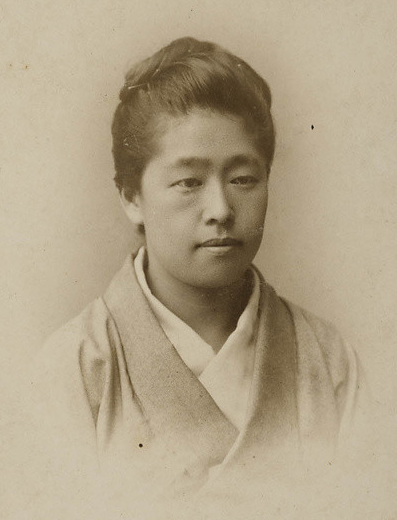
Several people of the Meiji generation are so closely tied to modern Japan that they appear on its money. Fukuzawa Yukichi (1835–1901) sailed with Japan’s first mission to the United States in 1860, founded the school that became Keio University, and argued that Japan should adopt Western institutions as well as Western machines. His portrait was on the 10,000-yen note from 1984 to 2024. Tsuda Umeko (1864–1929) was sent to the United States at the age of seven, on the same ship as the Iwakura Mission of 1871, as Japan’s first female exchange student. Back home she founded Joshi Eigaku Juku in 1900, now Tsuda University in Kodaira, Tokyo, and in 2024 her portrait went onto the new 5,000-yen note.
The bacteriologist Hideyo Noguchi (1876–1928) worked at the Rockefeller Institute in New York, where he became known for his work on syphilis. He was nominated for the Nobel Prize in medicine several times between 1913 and 1927. Some of his later claims, including his yellow fever research, were overturned after his death, and he died of yellow fever in Accra, in what was then the Gold Coast, while studying the disease. He appeared on the 1,000-yen note from 2004. The novelist Natsume Sōseki (1867–1916), who had occupied the same note from 1984 to 2004, studied in London from 1900 and then wrote I Am a Cat (1905), Botchan (1906) and Kokoro (1914), novels about the strain of rapid Westernisation on ordinary lives. To see how these portraits fit into the yen’s design, read our guide to the currency of Japan.
Recovery and Recognition, 1945–1989: Yukawa, Kurosawa, Honda, Morita and Tezuka
After defeat in the Second World War, Japanese scientists, artists and manufacturers won the country a new kind of reputation abroad. The physicist Hideki Yukawa (1907–1981) became the first Japanese Nobel laureate in 1949, for predicting the existence of the meson from his theoretical work on nuclear forces. Two years later Akira Kurosawa (1910–1998) surprised the film world when Rashomon won the Golden Lion at Venice on 10 September 1951. He directed 30 feature films in all, including Seven Samurai (1954), made 16 films with the actor Toshirō Mifune, and received an honorary Academy Award in 1990. The novelist Yasunari Kawabata (1899–1972), author of Snow Country, became the first Japanese writer to win the Nobel Prize in Literature, in 1968.
Industry produced its own household names. Soichiro Honda (1906–1991) established Honda Motor Co. in 1948, starting by fitting small engines to bicycles; the company has been the world’s largest motorcycle manufacturer since 1959. Akio Morita (1921–1999) co-founded the company that became Sony with Masaru Ibuka in 1946 and oversaw the launch of the Walkman cassette player in July 1979. In publishing, Osamu Tezuka (1928–1989), a medical graduate from Osaka, created Astro Boy, who first appeared in 1951, and later Black Jack, Phoenix and Buddha. His output earned him the title “the God of Manga”.
Heisei and Reiwa Japan, 1989 Onwards: Miyazaki to Ohtani
The people who carry Japan’s name abroad today work in animation, fiction, art, science, games and sport. Hayao Miyazaki (born 1941 in Tokyo) co-founded Studio Ghibli. Spirited Away (2001) became Japan’s highest-grossing film, a record it held for 19 years until Demon Slayer: Mugen Train overtook it in 2020, and won the Academy Award for Best Animated Feature, and The Boy and the Heron (2023) won the same award two decades later. Haruki Murakami (born 1949), who grew up in Ashiya near Kobe and ran a jazz bar for seven years before publishing Hear the Wind Sing in 1979, has had his novels, among them Norwegian Wood (1987) and Kafka on the Shore (2002), translated into 50 languages.
The artist Yayoi Kusama (1929–2026), raised in Matsumoto in Nagano Prefecture, moved to New York in 1958 and became part of the city’s avant-garde before returning to Japan; her polka-dot installations and mirrored infinity rooms made her one of the world’s top-selling female artists. She died in Tokyo in August 2026 at the age of 97. The stem-cell researcher Shinya Yamanaka (born 1962) of Kyoto University shared the 2012 Nobel Prize in Physiology or Medicine with John Gurdon for showing that mature cells can be reprogrammed into stem cells. Shigeru Miyamoto (born 1952 in Sonobe, Kyoto Prefecture) joined Nintendo in 1977 and designed Donkey Kong (1981) and Super Mario Bros. (1985); games in the franchises he created have sold more than a billion copies.

In sport, Shohei Ohtani (born 1994) plays as both hitter and pitcher. He won the American League MVP award with the Los Angeles Angels in 2021 and 2023, then the National League award with the Los Angeles Dodgers in 2024, when he became the first player to hit 50 home runs and steal 50 bases in one season, and again in 2025. Naomi Osaka (born 1997 in Osaka, to a Haitian-American father and a Japanese mother) has lived and trained in the United States since she was three but represents Japan. She won the US Open in 2018 and 2020 and the Australian Open in 2019 and 2021, the first Japanese player to win a major singles title, and in 2019 became the first Asian player ranked world No. 1 in singles. For how these careers compare with those of Japan’s nearest neighbour, see our Japan vs South Korea comparison.