
Few national emblems carry the weight of an exile's dream quite like the flag of Cuba. It was not born on the island it represents, but sketched far away in New York City by men plotting a revolution they might never live to see succeed. With its bold red triangle, lone white star, and crisp alternating stripes of blue and white, the banner has flown over a republic, a colony's final years of resistance, and decades of political transformation. Today it is instantly recognizable, fluttering above Havana's seafront, painted on murals, and waved by Cubans across the world. Understanding its layout and its origins is the surest way to grasp how Cuba came to imagine itself as a free and independent nation.
A Banner Sewn From Exile and Ambition
The Cuban flag is one of the oldest surviving designs in Latin America, and its story begins in the mid-nineteenth century among independence activists who had fled Spanish-controlled Cuba. Working in the United States, these revolutionaries needed a symbol to rally support for their cause. The design that emerged was the handiwork of the poet Miguel Teurbe Tolón, who helped translate the political ambitions of the movement into a piece of cloth. Conceived in New York, the flag traveled back toward the island as a banner of insurrection long before it was ever a flag of state.
For decades it remained the emblem of rebels and exiles rather than an official standard. Only after Cuba finally secured its independence did the design ascend to its formal role, becoming the national flag in 1902 when the Republic of Cuba was established. That gap between creation and adoption is part of what makes the flag so meaningful: it was a promise stitched into fabric, kept alive across generations until the moment it could be raised legitimately.
How the Flag Is Arranged
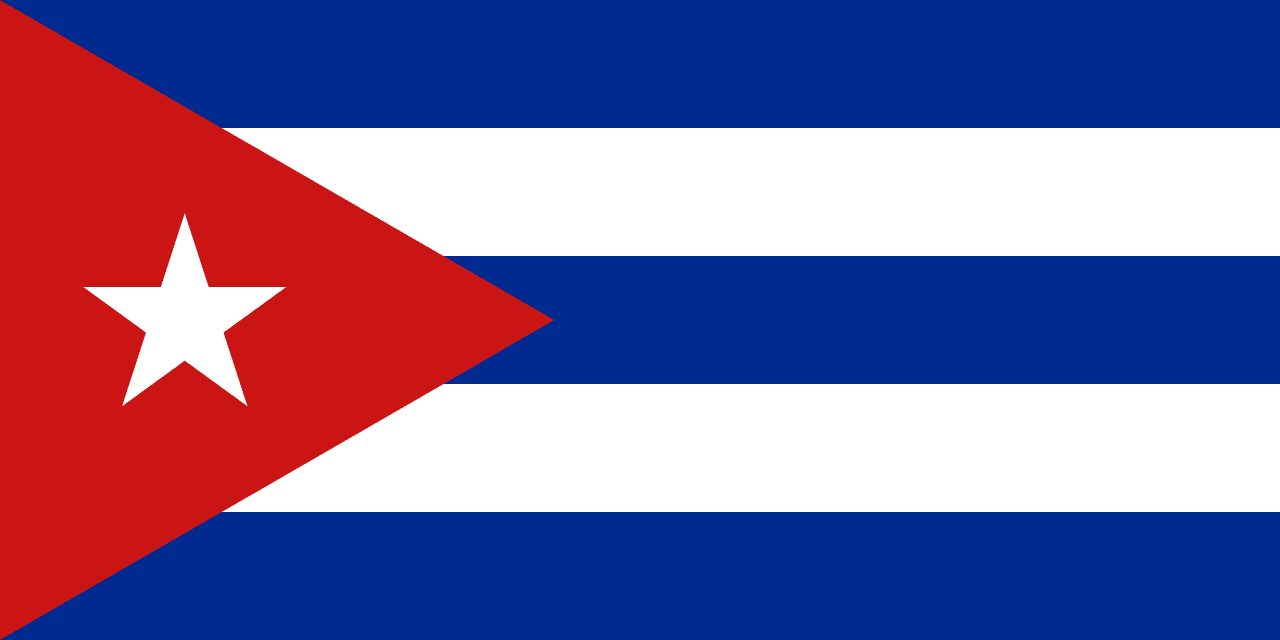
The composition is deceptively simple but carefully balanced. The field consists of five horizontal stripes that alternate between blue and white, with three blue stripes and two white ones woven among them. Layered over the stripes at the hoist, on the left side, is a red equilateral triangle that points toward the center of the flag. Inside that triangle sits a single white five-pointed star, centered so that it commands attention against the red background.
This pairing of striped field and triangular charge gives the flag a sense of motion. The eye is drawn from the calm rhythm of the horizontal bands toward the sharp, energetic wedge of red and its solitary star. It is a layout that reads clearly whether printed small on a lapel pin or flown enormous over a public square, which is one reason the design has endured without revision for well over a century.
What the Colors and Star Stand For
Every element of the flag was chosen to tell a story. The three blue stripes represent the three original divisions, or provinces, into which Cuba was historically separated, anchoring the banner in the geography of the island itself. The two white stripes speak to the purity and strength of the patriotic cause, the ideals that motivated those fighting for self-determination.
The red triangle evokes the blood shed in the struggle for liberty and the equality the revolutionaries hoped to establish, its shape a nod to ideals of fraternity. At its heart, the white star—often called la estrella solitaria, the lone star—stands for freedom and the independence of a single, unified nation. Together these symbols compress a whole political philosophy into a handful of colors and geometric forms.
Look-Alikes and Shared Roots
Anyone scanning a wall of world flags will notice that Cuba's banner has a close cousin. The flag of Puerto Rico uses nearly the same vocabulary: five horizontal stripes, a triangle at the hoist, and a single white star. The resemblance is no accident, since both designs emerged from the same revolutionary milieu of Caribbean independence movements in the nineteenth century. The crucial difference is the color scheme. Cuba places blue stripes against a red triangle, while Puerto Rico inverts the palette, setting red stripes against a blue triangle.
The broader red-white-and-blue family also includes flags inspired by the United States and the French republican tradition, palettes that revolutionaries across the Americas borrowed to signal their commitment to liberty. What distinguishes Cuba's version is the specific geometry of three blue stripes, the equilateral red triangle, and the lone star reading together as a single coherent message. Once you learn to spot the blue-and-red contrast, the Cuban flag is impossible to confuse with its relatives. For more on the island's geography and culture, see our cuba country guide.
A Symbol Woven Into National Identity
For Cubans, the flag is far more than an administrative marker. It is bound up with the long fight for sovereignty and with poets, soldiers, and ordinary citizens who treated it as sacred. Because it was carried by independence fighters before it ever belonged to a government, the banner has always held an emotional charge that transcends any single regime. It appears in patriotic songs, in classroom rituals, and in the iconography of national heroes.
The lone star in particular has become shorthand for Cuban identity. You will find it stamped on everything from cigar labels to athletic jerseys, a compact emblem that signals "Cuba" without a single word. That portability has made the flag a unifying image for Cubans both on the island and in the large diaspora scattered across the Americas, where waving it is an act of memory and belonging.
The Flag in Everyday Modern Life
In contemporary Cuba, the flag is woven into the routines of civic and cultural life. It is raised at government buildings, schools, and ceremonies marking national holidays, and it features prominently during commemorations of the independence struggle. On the international stage, Cuban athletes carry it into stadiums at events like the Olympics and Pan-American Games, where the lone star travels far beyond the Caribbean.
Beyond officialdom, the design lives in popular culture. It decorates baseball caps in a country famously obsessed with the sport, appears in street art and music videos, and serves as a backdrop for celebrations in Cuban communities worldwide. Whether draped over a balcony or printed on a T-shirt, the flag remains a living symbol rather than a museum piece, continually reinterpreted by each generation.
Quick Facts Worth Knowing
- The flag was designed in New York City by exiled revolutionaries, not on Cuban soil.
- Its creator was the poet Miguel Teurbe Tolón, who lent an artist's eye to the independence cause.
- The single white star earned the flag the nickname la estrella solitaria, the lone star.
- Cuba sits in the Caribbean, part of the North American continent's island chain.
- The design became the official national flag in 1902, with the founding of the Republic of Cuba.
- It shares its basic structure with the flag of Puerto Rico, distinguished mainly by reversed colors.
Frequently Asked Questions
When was the Cuban flag adopted?
The flag was officially adopted as the national standard in 1902, when the Republic of Cuba came into being. The design itself, however, is considerably older, having been created decades earlier by independence activists working in exile in the United States.
What do the colors of the Cuban flag mean?
The three blue stripes represent Cuba's original provinces, and the white stripes symbolize the purity and strength of the patriotic cause. The red triangle evokes the blood shed for liberty and the ideal of equality, while the lone white star stands for freedom and national independence.
Who designed the flag of Cuba?
The design is credited to the poet Miguel Teurbe Tolón, who helped craft it for the Cuban independence movement. Notably, the work was done in New York City, where many Cuban revolutionaries had taken refuge from Spanish rule.
What continent is Cuba on, and how does its flag compare to similar ones?
Cuba is an island nation in the Caribbean, geographically associated with North America. Its flag closely resembles that of Puerto Rico—both feature five stripes, a triangle, and a single star—but Cuba uses blue stripes with a red triangle, the reverse of Puerto Rico's red stripes and blue triangle.