
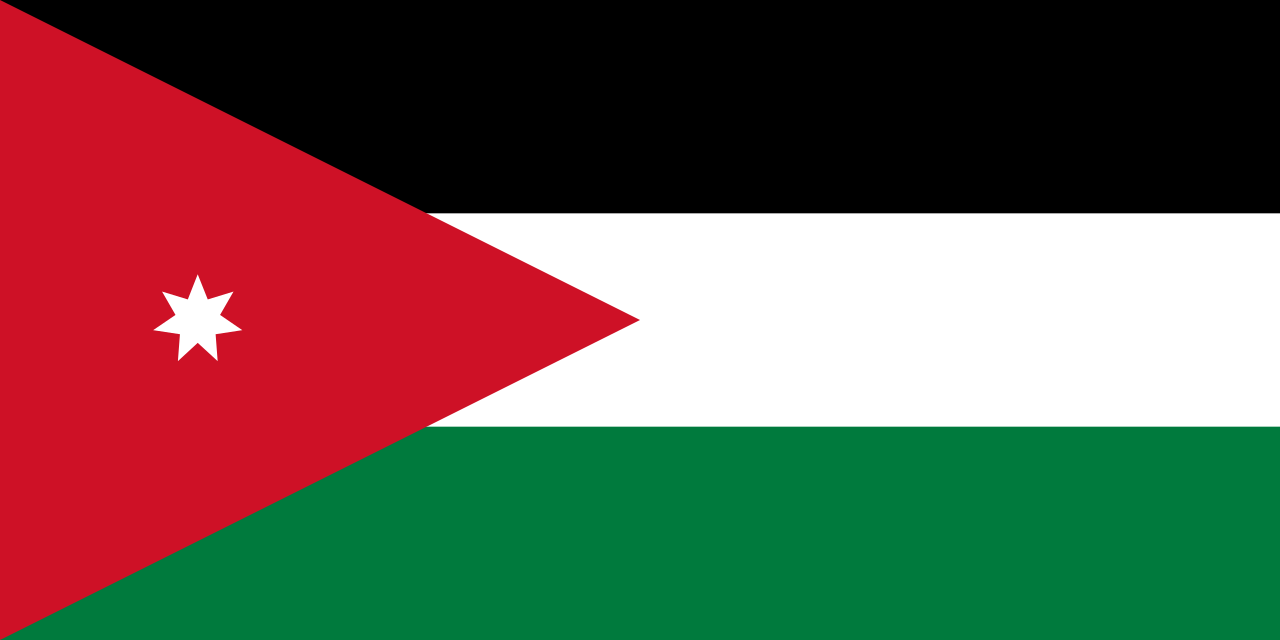
The flag of Jordan features three horizontal bands — black on top, white in the center, and green on the bottom — with a red chevron (triangle) on the hoist side bearing a small white seven-pointed star. The colors represent the Abbasid (black), Umayyad (white), and Fatimid (green) caliphates, while the red triangle symbolizes the Hashemite dynasty and the Arab Revolt. The seven-pointed star represents the seven verses of Al-Fatiha, the opening chapter of the Quran.
Jordan's flag is a powerful expression of Arab identity and Hashemite heritage. Every element — from the Pan-Arab colors to the unique seven-pointed star — connects Jordan to the broader story of Arab nationalism, Islamic history, and the quest for self-determination in the modern Middle East.

Design and Colors
Jordan's flag consists of three horizontal bands of equal width: black on top, white in the middle, and green on the bottom. A red isosceles triangle extends from the hoist side, covering the left portion of the flag. Within this red triangle sits a small white seven-pointed star. The flag's proportions are 1:2.
The overall layout closely resembles the flag of Palestine, which uses the same four Pan-Arab colors in a similar arrangement but without the star. The star is the key distinguishing feature that marks the flag as uniquely Jordanian.
The Pan-Arab Colors
Jordan's flag uses the four Pan-Arab colors, each historically associated with a great Islamic dynasty:
- Black: Represents the Abbasid Caliphate (750-1258), which was based in Baghdad and oversaw the Islamic Golden Age.
- White: Represents the Umayyad Caliphate (661-750), the first great Islamic dynasty after the Rashidun, based in Damascus.
- Green: Represents the Fatimid Caliphate (909-1171), which ruled North Africa and parts of the Middle East from Cairo.
- Red: Represents the Hashemite dynasty, descendants of the Prophet Muhammad who led the Arab Revolt and now rule Jordan.
The Arab Revolt and Flag Origins
Jordan's flag traces directly to the flag of the Arab Revolt of 1916-1918, when Sharif Hussein bin Ali of Mecca, with British support, led an uprising against Ottoman Turkish rule. The Revolt flag featured the same black, green, and white horizontal stripes with a red triangle. T.E. Lawrence ("Lawrence of Arabia") fought alongside Arab forces under this banner during the famous desert campaigns.
After World War I, the territory that would become Jordan was established as the Emirate of Transjordan under Hashemite rule. The Arab Revolt flag was adopted as the national flag. When Jordan gained full independence in 1946, the seven-pointed star was added to distinguish Jordan's flag from other Arab states using similar Pan-Arab designs.
The Seven-Pointed Star
The white seven-pointed star within the red triangle is unique to Jordan's flag and carries multiple layers of meaning. The seven points represent the seven verses (ayat) of Al-Fatiha, the opening surah of the Quran, which is recited in every Muslim prayer. The seven points also symbolize faith in one God, humanity, national spirit, humility, social justice, virtue, and aspirations — the seven qualities that the Jordanian nation strives to embody.
Additionally, the star is sometimes said to represent the unity of Arab peoples and the seven hills upon which Amman, Jordan's capital, was originally built — echoing the seven hills of Rome.
Jordan vs Palestine vs Sudan: Related Flags
Jordan's flag is part of a family of Pan-Arab flags that share the same four colors. The Palestinian flag uses identical black, white, and green horizontal stripes with a red triangle, but omits the star. Sudan's flag features the same colors but in horizontal stripes with a green triangle. The flags of the short-lived Arab Federation (1958) and various other proposed Arab states have also drawn from this same color palette. Jordan's seven-pointed star remains its unique identifier within this family.
Flag Protocol
Jordanian law mandates respect for the national flag. The flag is flown on all government buildings and at official events. It must not touch the ground, be used as decoration or covering, or be displayed in a damaged state. The King's personal standard features the flag's design with a white band bearing the Hashemite crown. Jordan celebrates Independence Day on May 25, when the flag is displayed prominently across the kingdom.
The Hashemite Legacy
The red triangle on Jordan's flag specifically represents the Hashemite dynasty — the ruling family descended from Hashim ibn Abd Manaf, the great-grandfather of the Prophet Muhammad. The Hashemites have ruled Jordan since its creation as a state, from King Abdullah I (who was assassinated in 1951) through King Hussein (who ruled for 46 years) to the current King Abdullah II. The flag's red triangle is thus both a historical reference to the Arab Revolt and a contemporary symbol of the monarchy.
Fun Facts About Jordan's Flag
- Seven-pointed star: Jordan is the only country in the world whose flag features a seven-pointed star (heptagram).
- Lawrence of Arabia: The Arab Revolt flag that inspired Jordan's flag was made famous in the West through T.E. Lawrence's accounts and the 1962 David Lean film.
- Tallest flagpole: The Raghadan Flagpole in Amman, at 126.8 meters, was once one of the tallest free-standing flagpoles in the world when erected in 2003.
- Constitutional protection: Jordan's flag design is specified in Article 4 of the Jordanian Constitution, giving it the highest level of legal protection.
- Color order: A popular Jordanian mnemonic for the flag's colors is that black represents the past (dark days of oppression), white the present (bright future), and green the prosperity to come.
Final Thoughts
Jordan's flag weaves together 1,400 years of Islamic history, the drama of the Arab Revolt, and the ongoing story of the Hashemite Kingdom. The Pan-Arab colors connect Jordan to the broader Arab world, while the seven-pointed star marks it as a unique nation with its own identity and aspirations. From the desert of Wadi Rum to the ancient city of Petra, the Jordanian flag flies as a symbol of heritage, faith, and national pride.
Test Your Knowledge!
Think you know your world geography? Try our interactive quiz!
Play Geography Games →