
The flag of Oman is one of the most instantly recognizable banners in the Arabian Peninsula, set apart by a single striking detail: the white national emblem of crossed swords and a curved khanjar dagger riding high in its upper corner. While many of its neighbors fly variations on the pan-Arab palette, Oman built something distinct, marrying horizontal bands of red, white, and green with a bold vertical bar and an emblem rooted in the sultanate's own heritage. The result is a flag that tells you, at a glance, that this is a nation proud of its swords, its faith, and its fertile land.
A First Look at the Banner
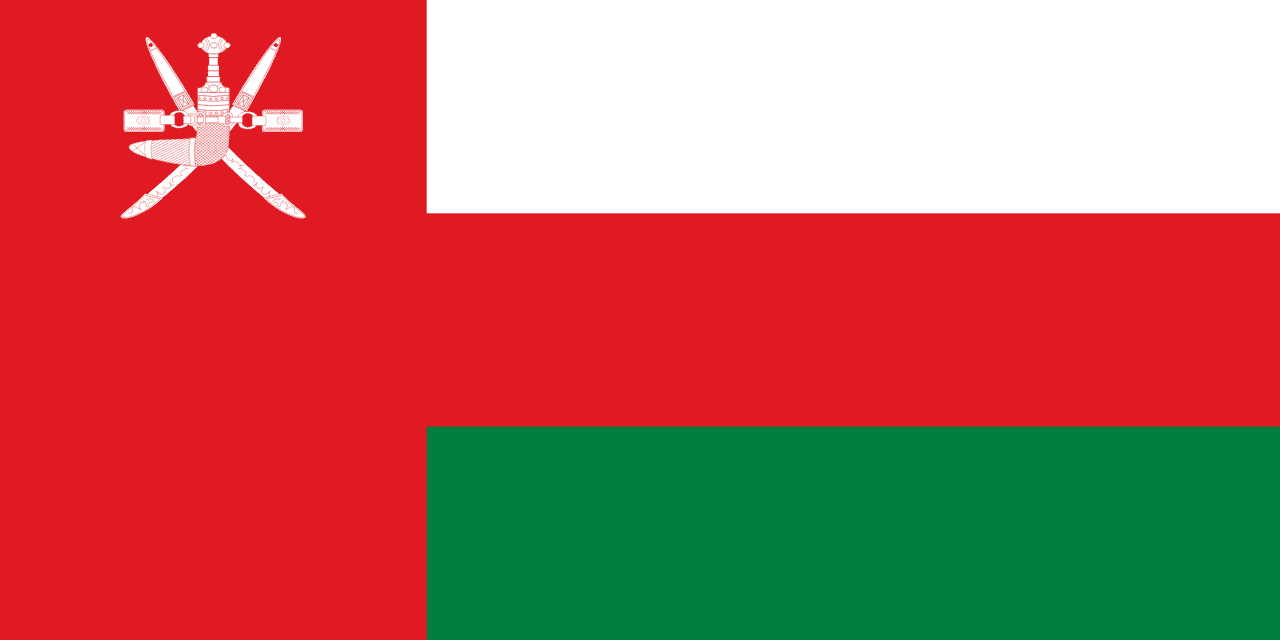
At its core, the Omani flag is a field divided into three horizontal stripes: red across the top, white in the middle, and green along the bottom. Running down the hoist side, where the flag attaches to the pole, is a thick vertical red bar. Centered within that red bar near the top sits the national emblem in white. The combination of a vertical band crossing horizontal stripes gives the design a layered, almost architectural quality that few other national flags share. It reads as ordered and deliberate rather than purely decorative, which suits a country that has long valued tradition and measured change.
What the Colors Stand For
Each color on the flag carries its own meaning, and together they sketch a portrait of the nation. Red is the dominant color of the hoist bar and the top stripe, and it represents the battles Oman has fought through its history, recalling the struggles and sacrifices that secured the sultanate's independence and unity. White, the central stripe, is associated with the Imam, a reference to the religious and spiritual leadership that has shaped Omani society for centuries, and it carries connotations of peace and prosperity. Green, along the bottom, stands for fertility, evoking the green mountains of the interior, the date palm groves, and the agricultural life that has sustained communities across the country. Crowning the design, the white emblem represents the national identity itself, tying the colors together under one unmistakable symbol.
The Emblem and Its Details
The emblem is the heart of the Omani flag and the feature most people remember. It depicts two crossed swords laid over a khanjar, the traditional curved dagger that is a cornerstone of Omani dress and culture. The khanjar is more than a weapon; it is a badge of honor worn on ceremonial occasions, a fixture of formal attire, and a craft passed down through generations of silversmiths. By placing this dagger at the center of the flag, alongside the swords, the design elevates an everyday object of national pride to the highest civic level. The motif speaks to defense, dignity, and heritage all at once, and rendered in white against the red bar, it stands out crisply from any distance.
How the Flag Came to Be
The current design is a modified version of a traditional Omani banner. For much of its earlier history, Oman flew a plain field that emphasized the color red, a hue long associated with the region's flags. As the sultanate modernized in the second half of the twentieth century, the flag was reworked to add the white and green stripes and to incorporate the national emblem prominently, producing a banner that could carry layered meaning while still honoring the older red tradition. The version flown today was settled in 1995, refining the proportions and arrangement into the form recognized around the world now. This evolution mirrors Oman's broader story: a country that has carefully balanced its deep-rooted customs with the demands of a changing era, updating its symbols without discarding their origins.
Standing Apart From Its Neighbors
The Arabian Peninsula is home to several flags that share a family resemblance, often drawing on red, white, green, and black in the pan-Arab tradition. Bahrain and Qatar, for instance, lean heavily on red and white with serrated dividing lines, while several Gulf states use horizontal tricolor arrangements. What distinguishes Oman is the unusual pairing of horizontal stripes with a full vertical hoist bar, a combination that immediately breaks from the simpler tricolor templates. Even more decisive is the emblem: no other national flag features the crossed-swords-and-khanjar motif, making Oman impossible to confuse with any look-alike. Where some regional flags rely on geometry alone, Oman's banner is identified by a culturally specific symbol that belongs to it and nothing else. If you would like more context on the country behind the flag, the oman country guide offers a fuller picture of its geography and culture.
The Flag in National Life
Within Oman, the flag is woven into the rhythm of public life. It appears on government buildings, schools, and embassies, and it is flown enthusiastically during National Day celebrations, when streets, vehicles, and storefronts bloom with red, white, and green. The colors of the flag often spill into national branding, sporting events, and civic decorations, with the emblem reproduced on everything from official documents to commemorative items. For Omanis at home and abroad, the banner is a shorthand for belonging, a visual reminder of the swords that defended the land, the faith that guided it, and the green valleys that fed it. Internationally, the flag represents Oman at sporting competitions and diplomatic gatherings, carrying the sultanate's distinctive identity onto a global stage.
Quick Facts Worth Knowing
- The national emblem includes two crossed swords and a khanjar dagger, a motif unique to Oman among the world's flags.
- The flag combines three horizontal stripes with a vertical red bar at the hoist, an unusual layout among national banners.
- Its three colors carry distinct meanings: red for battles, white for the Imam, and green for fertility.
- The current form of the flag dates to 1995, the most recent refinement of a design rooted in older traditions.
- Oman sits in southwestern Asia, on the southeastern coast of the Arabian Peninsula.
- The khanjar at the flag's center is also a beloved item of traditional dress, not merely a heraldic symbol.
Frequently Asked Questions
When was the flag of Oman adopted?
The flag in its present form was adopted in 1995. It is a modified version of an earlier traditional Omani design, with the proportions and layout refined over time before settling into the banner used today.
What do the colors of the Omani flag mean?
Red represents the battles Oman has fought through its history, white is associated with the Imam and connotes peace, and green symbolizes fertility and the land's agricultural richness. The white emblem at the hoist stands for the nation's identity.
What is the symbol on the flag of Oman?
The white emblem in the upper hoist features two crossed swords laid over a khanjar, the traditional curved dagger of Oman. Together they represent defense, dignity, and the country's cultural heritage. No other national flag uses this motif.
What continent is Oman on, and how does its flag compare to its neighbors?
Oman is located in Asia, on the southeastern edge of the Arabian Peninsula. While many neighboring Gulf flags use red, white, and green in pan-Arab arrangements, Oman stands apart through its mix of horizontal stripes with a vertical hoist bar and, above all, its unmistakable crossed-swords-and-khanjar emblem.