
Troy, the legendary city immortalized in Homer's Iliad, is identified with the archaeological mound of Hisarlik in the Troad region of northwestern Turkey. Overlooking the Dardanelles strait, this strategic site contains nine major layers of habitation spanning from approximately 3000 BCE to 500 CE, making it one of the longest continuously occupied sites in the ancient Mediterranean world.
Introduction
The identification of Hisarlik with Homer's Troy was championed by German businessman and amateur archaeologist Heinrich Schliemann, who began excavations in 1870. His dramatic and often destructive methods caused significant damage to the site, but subsequent work by Wilhelm Dörpfeld, Carl Blegen, and Manfred Korfmann has built a detailed picture of a prosperous Bronze Age trading city at a geographic crossroads between Europe and Asia.
Geographic Setting
- Location: Çanakkale Province, northwestern Turkey
- Elevation: Approximately 25 meters above sea level
- Distance to Coast: 6 km from the Aegean Sea (was closer in antiquity)
- Strategic Position: Controls access to the Dardanelles strait
Troy's location was dictated by geography. The site sits on a low ridge at the western end of a broad plain where the Scamander (Karamenderes) and Simoeis (Dümrek) rivers flow toward the Dardanelles. In the Bronze Age, the coastline was significantly closer — a shallow bay extended inland nearly to the base of the citadel mound, providing harbor access that made Troy a natural waypoint for maritime trade between the Aegean and the Black Sea.
The Dardanelles strait, only 1.2 kilometers wide at its narrowest point, is one of the most important maritime chokepoints in the world. Any city controlling this passage could levy tolls on shipping and exert influence over trade between the Mediterranean and the grain-rich Black Sea region. This geographic advantage explains Troy's wealth and the strategic interest of rival powers throughout antiquity.
Architecture & Engineering
- Layers: 9 major settlement phases (Troy I–IX)
- Troy II: Megaron buildings, Schliemann's "Treasure of Priam"
- Troy VI/VIIa: Most likely candidates for Homer's Troy
- Troy IX: Roman Ilium, with temple of Athena
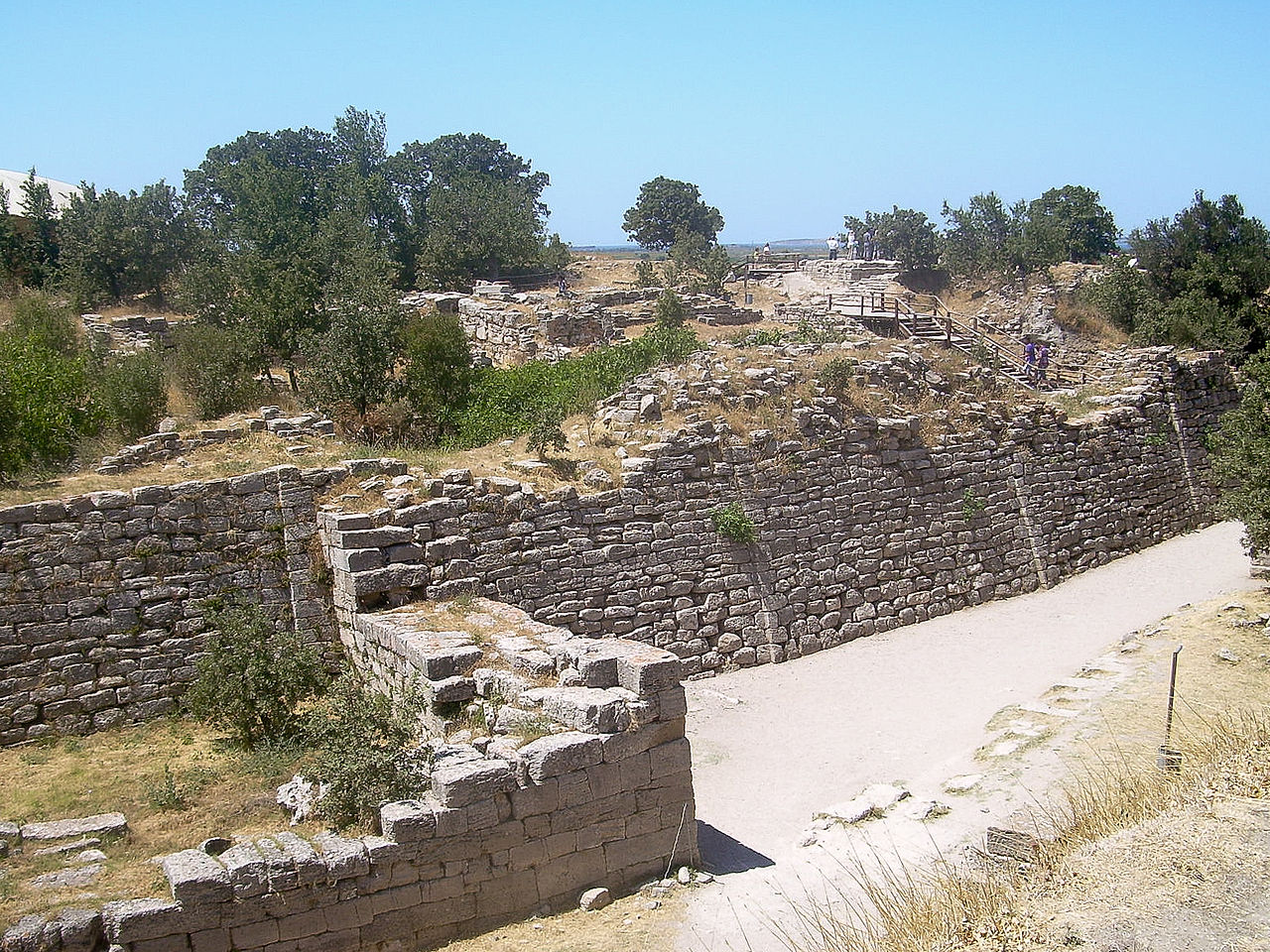
The archaeological mound of Hisarlik rises about 20 meters above the surrounding plain, built up by successive layers of construction and destruction over 3,500 years. Troy II (c. 2550–2300 BCE) was a prosperous Early Bronze Age citadel with megaron-style buildings and impressive fortification walls. Schliemann mistakenly identified this layer as Homer's Troy and removed the famous "Treasure of Priam" from it, actually a collection predating the Trojan War by over 1,000 years.
Troy VI (c. 1700–1250 BCE) and Troy VIIa (c. 1250–1180 BCE) are the layers most associated with the period of the Trojan War. Troy VI featured massive limestone walls, towers up to 9 meters tall, and large freestanding buildings suggesting a wealthy and powerful citadel. Troy VIIa shows evidence of destruction by fire and hasty repairs, possibly correlating with a siege event around 1180 BCE.
Historical Significance
- First Settlement: c. 3000 BCE (Troy I)
- Trojan War Period: c. 1250–1180 BCE (Troy VI/VIIa)
- Roman Period: Rebuilt as Ilium, visited by Alexander the Great
- UNESCO Status: World Heritage Site since 1998
Troy's historical significance extends far beyond its archaeology. Homer's Iliad, composed around 750 BCE, describes a Greek coalition besieging Troy for ten years to recover Helen, wife of King Menelaus. Whether the Iliad preserves a memory of actual events remains debated, but the archaeological evidence of destruction at Troy VIIa around 1180 BCE roughly aligns with the traditional date of the Trojan War.
In the historical period, the site was revered as the location of the Homeric epic. Alexander the Great visited in 334 BCE and made sacrifices at the Temple of Athena before launching his invasion of Persia. The Romans rebuilt the city as Ilium and claimed Trojan ancestry through the mythical hero Aeneas. Julius Caesar and Augustus both patronized the site, and Emperor Constantine briefly considered it as the capital of the Eastern Roman Empire before choosing Byzantium.
Conservation & Tourism
- Annual Visitors: ~600,000
- Iconic Feature: Wooden horse replica at entrance
- Threats: Erosion, earlier excavation damage, tourism wear
- Access: 30 km south of Çanakkale city
Troy was inscribed as a UNESCO World Heritage Site in 1998 in recognition of its exceptional cultural significance. A modern museum, the Troy Museum, opened in 2018 near the site and houses artifacts from all nine settlement layers, including pottery, weapons, jewelry, and architectural fragments. The museum won the European Museum of the Year Special Commendation in 2020.
Conservation at Troy is complicated by the damage inflicted by Schliemann's 19th-century excavations, which cut a massive trench through the center of the mound, destroying significant portions of later layers to reach earlier ones. Modern archaeological work focuses on non-invasive techniques like geomagnetic surveys and careful stratigraphic excavation. The site trails guide visitors through the visible remains of fortification walls, ramps, and building foundations from multiple periods.
Key Facts
- Troy (Hisarlik) contains 9 settlement layers spanning approximately 3000 BCE to 500 CE.
- The site controls access to the Dardanelles strait, one of the world's most strategic waterways.
- Troy VIIa shows evidence of destruction by fire around 1180 BCE, close to the traditional date of the Trojan War.
- Alexander the Great and Julius Caesar both visited and honored the site.
- Troy was designated a UNESCO World Heritage Site in 1998.
Fun Facts
- Schliemann's "Treasure of Priam" was actually from Troy II, about 1,000 years before the Trojan War.
- The coastline has retreated roughly 6 kilometers since the Bronze Age due to alluvial deposits from the Scamander River.
- Emperor Constantine considered Troy as the site for his new capital before choosing Byzantium (Istanbul).
Final Thoughts
Troy is where myth and archaeology intersect at one of the most geographically strategic locations in the ancient world. Its nine layers of settlement, its command of the Dardanelles strait, and its place in the literary imagination through Homer's Iliad make it one of the most significant and evocative archaeological sites on Earth.
Test Your Knowledge!
Think you know the world's ancient ruins and archaeological sites? Try our geography quiz games!
Play Geography Games →