
The Florida Keys are an archipelago of approximately 1,700 islands curving in a gentle arc from the southeastern tip of the Florida peninsula southwestward for 290 kilometers to Key West, the southernmost city in the continental United States. Only about 43 of these islands are connected by the Overseas Highway (US Route 1), which runs 182 kilometers across 42 bridges — including the famous Seven Mile Bridge — from Key Largo to Key West.
Introduction
The Keys are unique in American geography. They are the only extensive coral reef island chain in the continental United States, built on the skeletal remains of ancient coral reefs that grew during higher sea levels over 100,000 years ago. The Florida Keys National Marine Sanctuary protects 9,800 square kilometers of ocean surrounding the islands, including the only living coral barrier reef in North America — the third-largest barrier reef system in the world after Australia's Great Barrier Reef and Belize's.
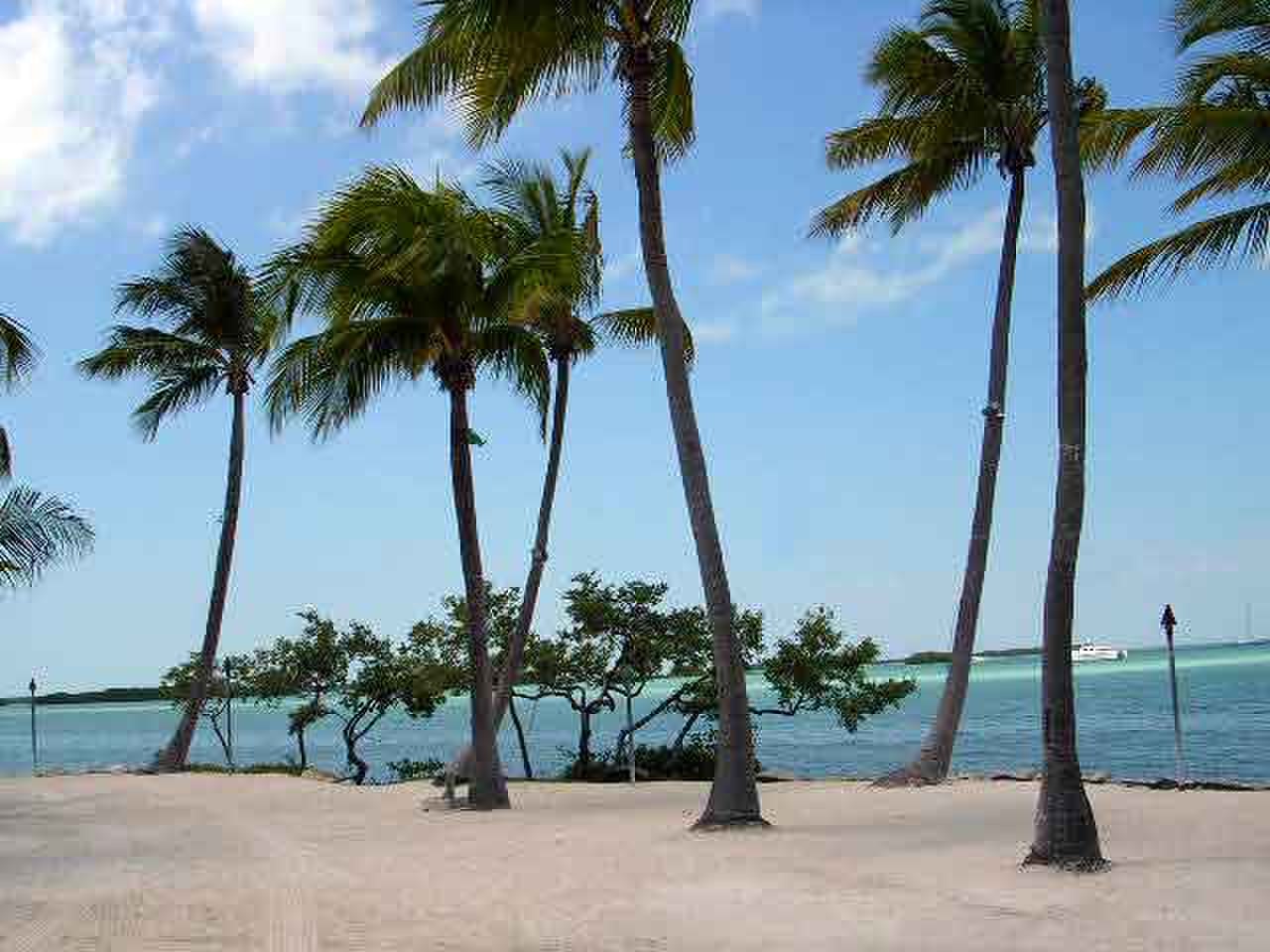
Geography & Geology
- Length: 290 km arc from mainland to Key West
- Islands: ~1,700 (43 connected by highway)
- Highest Elevation: 5.5 m (Windley Key)
- Reef Type: Ancient coral limestone (Key Largo Limestone)
The Florida Keys are divided into two geological zones. The Upper Keys, from Key Largo to Big Pine Key, are composed of Key Largo Limestone — the fossilized remains of an ancient coral reef that grew along the edge of the Florida Platform during the Sangamonian Interglacial period roughly 125,000 years ago, when sea levels were 6 to 9 meters higher than today. The Lower Keys, from Big Pine Key to Key West, are composed of Miami Oolite — small, round grains of calcium carbonate formed in shallow tropical waters.
The entire archipelago is extremely low-lying. The highest natural point in the Keys is just 5.5 meters above sea level on Windley Key, and most islands average only 1 to 2 meters of elevation. This makes the Keys extraordinarily vulnerable to sea level rise and storm surge. The island chain is separated from the mainland by Florida Bay to the north and from the open Atlantic by the coral reef tract to the south and east.
Marine Ecology
- Reef Length: ~270 km (3rd largest barrier reef system)
- Coral Species: Over 50 species
- Fish Species: Over 500 in reef waters
- Key Deer: Endangered subspecies, ~1,000 remaining on Big Pine Key
The Florida Keys reef tract is the only living coral barrier reef in the continental United States and the third-largest in the world. Stretching approximately 270 kilometers parallel to the island chain, it supports over 50 species of coral, more than 500 species of fish, and thousands of invertebrate species. The reef provides critical storm protection to the islands, reduces wave energy by up to 97 percent, and supports a marine ecosystem valued at billions of dollars annually.
The Keys also support extensive seagrass meadows, mangrove forests, and tidal flats that serve as nursery habitat for commercially important species including spiny lobster, stone crab, pink shrimp, and numerous reef fish. The endangered Key deer, a miniature subspecies of the white-tailed deer standing just 75 centimeters at the shoulder, survives only in the Lower Keys, with a population of roughly 1,000 animals concentrated on Big Pine Key and No Name Key.
Culture & Tourism
- Annual Visitors: ~5 million
- Key West: Hemingway, Truman, drag shows, Duval Street
- Fishing: World-class sportfishing (tarpon, bonefish, permit)
- Diving: John Pennekamp: first underwater park in US (1963)
The Florida Keys attract approximately 5 million visitors annually, generating over $3 billion in tourism revenue. Key West, the cultural heart of the archipelago, is famous for its eclectic personality: Ernest Hemingway wrote some of his greatest works there in the 1930s, Harry Truman used the "Little White House" as a presidential retreat, and the city has long been a haven for artists, writers, and the LGBTQ+ community. Sunset celebrations at Mallory Square and the bar-hopping scene along Duval Street are iconic.
The Keys offer some of the best diving and snorkeling in North America. John Pennekamp Coral Reef State Park, established in 1963 as the first undersea park in the US, protects 70 nautical square miles of coral reefs off Key Largo. Sportfishing is legendary — the warm waters of the Gulf Stream pass close to the Keys, bringing game fish including tarpon, bonefish, permit, sailfish, and marlin. The "backcountry" flats of Florida Bay are considered the best shallow-water fishing destination in the world.
Hurricanes & Climate
- Climate: Tropical savanna (Aw), frost-free
- Hurricane Risk: Extreme — direct path of Atlantic hurricanes
- Hurricane Irma (2017): Devastated Lower Keys, 25% of homes destroyed
- 1935 Labor Day Hurricane: Category 5, killed 408 in the Keys
The Florida Keys have a tropical climate — the only frost-free region in the continental US — with average winter lows around 18°C and summer highs around 32°C. The trade winds provide natural cooling, and the surrounding ocean moderates temperature extremes. However, this tropical paradise sits directly in the path of Atlantic hurricanes, making it one of the most hurricane-vulnerable places in the United States.
The 1935 Labor Day Hurricane, a Category 5 storm with sustained winds of 295 km/h, remains the strongest hurricane to make landfall in the US. It killed 408 people in the Keys, many of them World War I veterans working on the Overseas Highway. Hurricane Irma in 2017 devastated the Lower Keys, destroying 25 percent of all homes and damaging 65 percent. Evacuation is extremely difficult because US Route 1 is the only road out, creating potentially lethal traffic jams when storms approach.
Challenges & Future
- Sea Level Rise: Keys could lose 50–70% of dry land by 2100
- Coral Bleaching: Reef has lost ~50% of coral cover since 1970s
- Stony Coral Tissue Loss Disease: Devastating outbreak since 2014
- Affordable Housing: Extreme costs push out working residents
The Florida Keys face existential threats from climate change. Sea level rise projections suggest the Keys could lose 50 to 70 percent of their dry land area by 2100 under moderate warming scenarios. With most land just 1 to 2 meters above sea level, even modest rises in sea level will increase flooding frequency dramatically. Tidal flooding, once rare, is already occurring multiple times per year during king tides and full moons.
The coral reef is in crisis. The Keys reef has lost approximately 50 percent of its living coral cover since the 1970s due to bleaching events, disease, pollution, and physical damage. Stony Coral Tissue Loss Disease, first detected in 2014, has spread across the entire reef tract and is killing over 20 species of coral. Scientists at Mote Marine Laboratory and NOAA are attempting to restore reefs by growing heat-resistant coral in nurseries and transplanting them — but the scale of the challenge is enormous.
Key Facts
- The Florida Keys comprise ~1,700 islands stretching 290 km from mainland Florida to Key West.
- The Keys reef is the only living coral barrier reef in the continental US and the 3rd largest in the world.
- Key West is the southernmost city in the continental United States.
- The highest point in the Keys is just 5.5 meters above sea level.
- The Keys could lose 50–70% of dry land by 2100 due to sea level rise.
Fun Facts
- The Seven Mile Bridge in the Keys is actually 6.79 miles (10.93 km) long — the name was rounded up.
- Key West is closer to Havana, Cuba (170 km) than to Miami (209 km).
- The endangered Key deer is the smallest subspecies of white-tailed deer, standing just 75 cm at the shoulder.
- Ernest Hemingway's house in Key West is still home to approximately 60 polydactyl (six-toed) cats, descendants of his original cat.
Final Thoughts
The Florida Keys are a fragile paradise — a unique coral island chain whose existence depends on the health of the surrounding reef and the pace of sea level rise. Their beauty, biodiversity, and cultural character make them irreplaceable, but their survival in the coming century will require unprecedented investment in coral restoration, climate adaptation, and coastal engineering.
Test Your Knowledge!
Think you know American geography? Try our interactive geography quiz!
Play Geography Games →