
Introduction
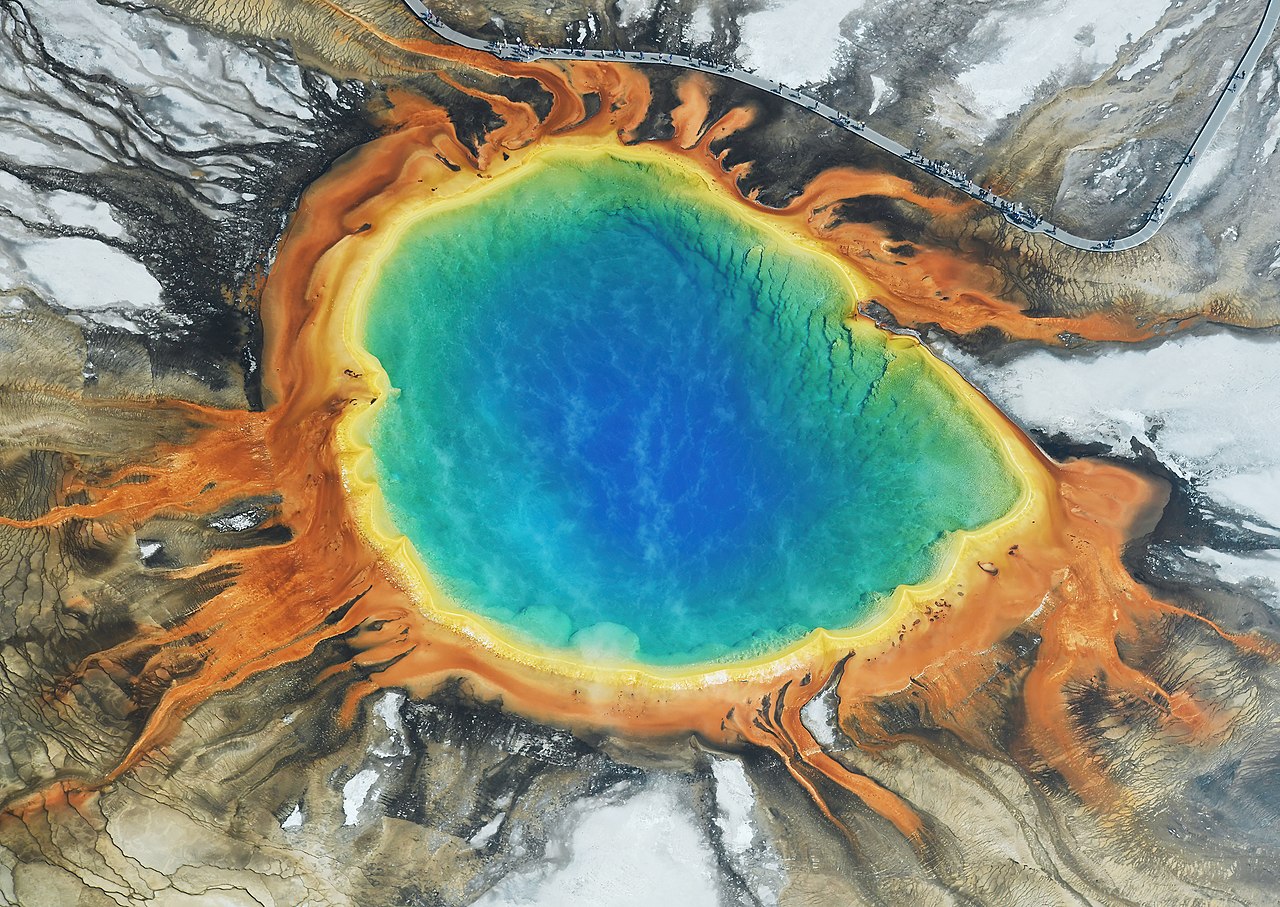
Grand Prismatic Spring is Yellowstone's most photographed thermal feature and arguably the most visually spectacular hot spring on Earth. Spanning roughly 110 meters in diameter, this immense pool displays concentric bands of vivid color ranging from deep blue at the center to orange and rust-red at the margins.
The spring's rainbow-like color palette is created not by minerals but by billions of thermophilic (heat-loving) microorganisms that thrive in different temperature zones. The scalding blue center is too hot for life, while progressively cooler water at the edges supports communities of pigmented bacteria and algae that produce the stunning chromatic display.
Geology & Geothermal Activity
- Diameter: ~110 m (370 ft)
- Depth: ~50 m (160 ft)
- Water Discharge: ~2,120 liters per minute
- Rank: 3rd largest hot spring in the world
Grand Prismatic Spring sits in Yellowstone's Midway Geyser Basin, fed by a powerful geothermal system driven by the Yellowstone hotspot. Superheated water rises from deep underground through fissures in the rhyolite bedrock, reaching the surface at near-boiling temperatures.
The spring discharges roughly 2,120 liters of water per minute, which flows outward from the center in a thin sheet across broad, gently sloping terraces before draining into the Firehole River. This constant outflow prevents the spring from erupting as a geyser and creates the broad, shallow margins where microbial communities flourish.
Water Chemistry & Temperature
- Center Temperature: ~87°C (189°F)
- Edge Temperature: ~55-70°C (131-158°F)
- pH: ~8.1 (alkaline)
- Dissolved Minerals: Silica, arsenic, chloride
The deep blue center of Grand Prismatic Spring is essentially sterile due to its extreme temperature. The intense blue color is caused by the scattering of light by water molecules, the same Rayleigh scattering phenomenon that makes the sky blue, enhanced by the spring's exceptional clarity and depth.
As water flows outward and cools, distinct temperature zones develop, each hosting different species of thermophilic organisms. The brilliant orange and yellow bands are produced by carotenoid pigments in cyanobacteria and other microbes that use these pigments to protect themselves from ultraviolet radiation and to harvest light energy.
Surrounding Landscape
- Location: Midway Geyser Basin, Yellowstone NP
- Elevation: ~2,250 m (7,382 ft)
- Nearby Features: Excelsior Geyser Crater, Turquoise Pool
- Basin Size: Midway is one of Yellowstone's smaller geyser basins
The Midway Geyser Basin is compact but powerful, containing several of Yellowstone's most impressive thermal features within a small area. Grand Prismatic Spring sits alongside Excelsior Geyser Crater, a massive hot spring that was once the world's most powerful geyser before it ceased erupting in the 1890s.
Steam rising from Grand Prismatic Spring is visible from kilometers away. The Fairy Falls Trail overlook, accessible via a short hike, provides an elevated vantage point from which the spring's full color spectrum is dramatically visible. From ground level, the spring often appears as a wall of steam.
Cultural & Historical Significance
- First Recorded: 1839 by fur trappers
- Named: 1871 by the Hayden Geological Survey
- Scientific Importance: Pioneered study of thermophilic organisms
- Taq Polymerase: Thermus aquaticus discovered in Yellowstone springs
Fur trappers in 1839 were likely the first Euro-Americans to describe Grand Prismatic Spring, calling it a "boiling lake." Ferdinand Hayden's 1871 geological survey gave it the name "Prismatic" for its rainbow-like colors, and the accompanying paintings by Thomas Moran helped convince Congress to protect Yellowstone.
Yellowstone's hot springs, including Grand Prismatic, revolutionized microbiology. In 1966, Thomas Brock discovered Thermus aquaticus in a nearby hot spring. An enzyme from this bacterium, Taq polymerase, became the foundation of PCR (polymerase chain reaction) technology, which transformed genetics, forensics, and medical diagnostics worldwide.
Visitor Experience
- Viewing: Boardwalk at spring level + overlook trail
- Overlook Trail: ~2.4 km round trip to elevated viewpoint
- Best Time: Late morning (less steam obscuring colors)
- Photography: Aerial/elevated views show colors best
A boardwalk extends across the Midway Geyser Basin, bringing visitors within meters of Grand Prismatic Spring's edge. At ground level, the massive clouds of steam can obscure the colors, making the elevated overlook on the Fairy Falls Trail essential for seeing the full chromatic display.
The spring's colors change seasonally. In summer, microbial mats produce the most vivid oranges and reds. In winter, some organisms shift their pigment ratios, and the cooler temperatures produce more greens and darker tones. The contrast between the vivid hot spring and a snow-covered landscape makes winter visits particularly dramatic.
Key Facts
- Grand Prismatic Spring is 110 meters across, the largest hot spring in the United States.
- Its vivid colors are produced by billions of thermophilic microorganisms, not minerals.
- The deep blue center is too hot for life at ~87°C; color bands mark temperature zones.
- An enzyme discovered in Yellowstone hot springs enabled PCR technology, revolutionizing genetics.
- The spring discharges over 2,120 liters per minute into the Firehole River.
Fun Facts
- Grand Prismatic Spring's colors can be seen clearly from satellite imagery and aerial photographs.
- The Taq polymerase enzyme from Yellowstone thermophiles earned Kary Mullis the 1993 Nobel Prize in Chemistry for developing PCR.
- In winter, the spring's microbial mats shift color, producing more green tones than the vivid summer oranges.
- Grand Prismatic Spring produces enough heat energy to warm about 800 homes continuously.
Final Thoughts
Grand Prismatic Spring is a convergence of geology, chemistry, and biology that produces one of the most visually stunning natural features on Earth. Its rainbow bands of living color, created by extremophile microorganisms thriving in scalding water, make it a masterpiece of geothermal geography and a reminder that life can flourish in the most extreme conditions.
