
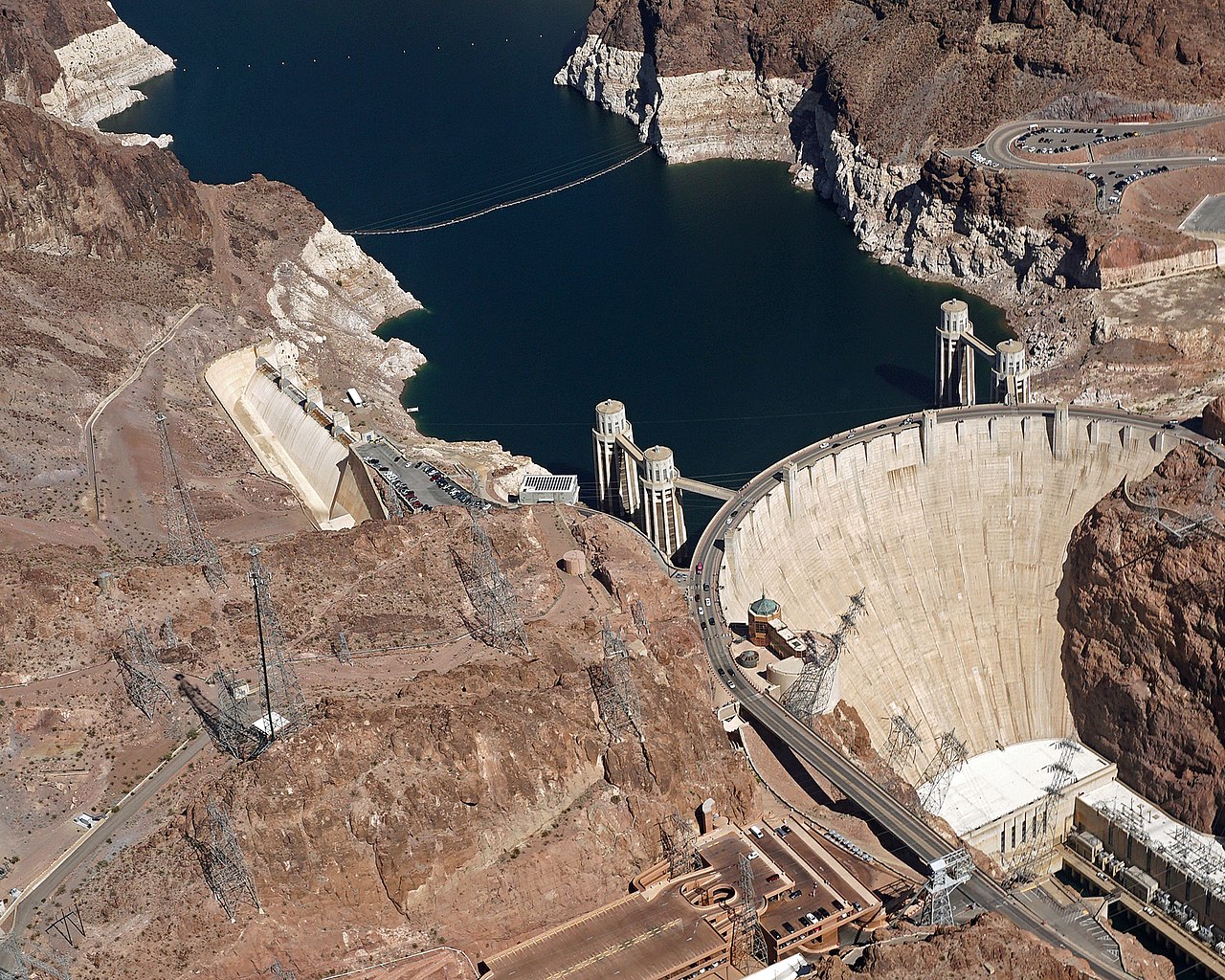
**Hoover Dam** on the Colorado River at the Arizona-Nevada border is one of the most iconic engineering landmarks in the world. Completed in **1936** during the Great Depression, the **221-meter** concrete arch-gravity dam was the tallest in the world at the time and created **Lake Mead**, which remains the largest reservoir in the United States by total capacity at **36.7 km³**.
Introduction
The dam was a defining achievement of the early 20th century, built by over 21,000 workers in one of the most inhospitable environments in North America — the scorching Black Canyon of the Colorado River. It transformed the American Southwest by providing flood control, irrigation water, and hydroelectric power to the rapidly growing cities of Las Vegas, Los Angeles, and Phoenix.

Engineering & Structure
- Type: Concrete arch-gravity dam
- Height: 221 meters
- Crest Length: 379 meters
- Concrete Volume: 2.48 million m³
Hoover Dam is a concrete arch-gravity dam, combining the curvature of an arch dam with the massive weight of a gravity dam. It contains 2.48 million cubic meters of concrete — enough to pave a two-lane highway from San Francisco to New York. The dam's Art Deco ornamentation, designed by architect Gordon Kaufmann, makes it one of the most aesthetically distinctive dams ever built.
Construction required the diversion of the Colorado River through four 17-meter-diameter tunnels bored through the canyon walls. Workers operated in temperatures exceeding 49°C (120°F) in the confined canyon, and 96 workers died during construction. The dam was completed two years ahead of schedule, a remarkable achievement given the engineering challenges.
Geographic Setting
- River: Colorado River
- Location: Black Canyon, Arizona-Nevada border, United States
- Coordinates: 36.02°N, 114.74°W
- Lake Mead Capacity: 36.7 km³ (maximum)
The dam sits in Black Canyon, a narrow gorge of dark volcanic rock carved by the Colorado River as it flows through the Mojave Desert. The surrounding landscape is stark and arid, with less than 150 millimeters of rainfall annually. Summer temperatures regularly exceed 45°C, making this one of the hottest environments for any major dam worldwide.
Lake Mead extends approximately 180 kilometers upstream into the desert, with a surface area of up to 640 square kilometers at full capacity. The reservoir spans the Arizona-Nevada border and reaches into the Grand Canyon National Recreation Area. However, a 23-year megadrought exacerbated by climate change reduced Lake Mead to just 25 percent of capacity by 2022, exposing a dramatic white "bathtub ring" on the canyon walls.
Hydroelectric Power
- Installed Capacity: 2,080 MW
- Annual Output: ~4 TWh (varies with water level)
- Turbines: 17 Francis turbines
- Customers: Nevada, Arizona, California
Hoover Dam's 17 Francis turbines can generate up to 2,080 MW, though actual output depends heavily on Lake Mead's water level. At full capacity, the dam generates roughly 4 terawatt-hours per year, but declining water levels have reduced output significantly. The electricity is divided among Nevada (23.4%), Arizona (18.9%), and California (57.7%).
The dam was the largest hydroelectric power plant in the world from 1939 to 1949. Its electricity powered the wartime industries of Southern California and enabled the explosive growth of Las Vegas, which was a small railroad town when the dam was built. Today, the dam's power represents a small fraction of the Southwest's total energy supply, but it remains symbolically and operationally important.
Environmental & Social Impact
- Workers Killed: 96 during construction
- Colorado River Ecology: Dramatically altered downstream
- Water Crisis: Lake Mead at historic lows due to drought
Hoover Dam fundamentally altered the Colorado River's ecology. The river, which once carried enormous seasonal floods of warm, sediment-laden water to the Gulf of California, now runs cold, clear, and regulated below the dam. Native fish species adapted to warm, turbid water have been devastated, with several species now endangered or extinct in the wild.
The ongoing water crisis in the Colorado River basin is the dam's most pressing challenge. Lake Mead's level has dropped so low that it has exposed long-submerged intake pipes, human remains, and a World War II-era boat. The seven US states and Mexico that depend on the Colorado have been forced into emergency water-sharing agreements, highlighting the limits of the dam's capacity to manage water in an era of climate change and growing demand.
Key Facts
- Hoover Dam was the tallest dam in the world at 221 meters when completed in 1936.
- Lake Mead is the largest reservoir in the United States by total capacity.
- The dam's Art Deco design was created by architect Gordon Kaufmann.
- 96 workers died during the dam's construction in the extreme desert heat.
- Lake Mead dropped to just 25% of capacity during the 2020s megadrought.
Fun Facts
- The concrete in Hoover Dam is still curing — engineers estimate it will take another 100 years for the interior to fully harden.
- Time zones change at the dam: the Nevada side observes Pacific Time while the Arizona side observes Mountain Time (but Arizona does not observe daylight saving time).
- During construction, workers who died from carbon monoxide poisoning in the diversion tunnels were sometimes listed as dying from "pneumonia" to avoid liability claims.
Final Thoughts
Hoover Dam is simultaneously a monument to American engineering ambition and a warning about the limits of controlling nature. As Lake Mead shrinks and the Colorado River basin faces its worst drought in 1,200 years, the dam stands at the center of the American West's existential water crisis.
Test Your Knowledge!
Think you know the world's great dams and reservoirs? Try our geography quiz games!
Play Geography Games →