

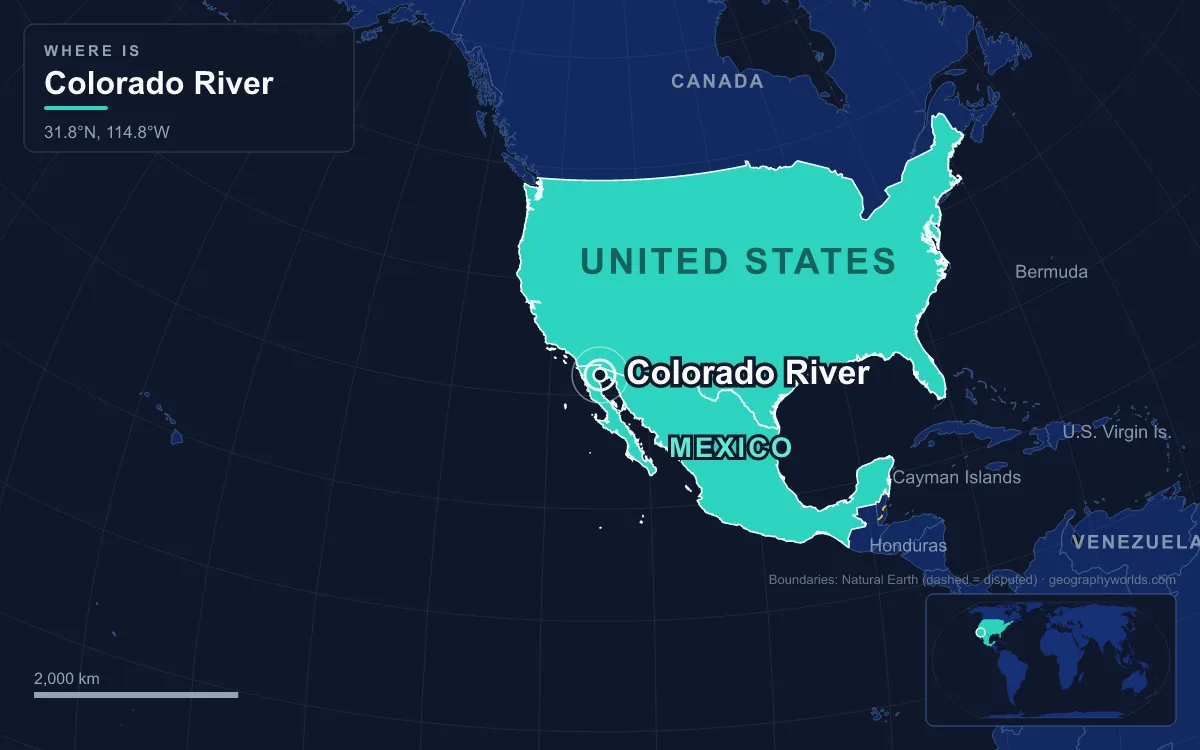
The Colorado River runs about 2,330 km (1,450 miles) from the Rocky Mountains of Colorado across the Colorado Plateau and through the Grand Canyon to the Gulf of California in Mexico, draining a basin of about 640,000 km² (246,000 sq mi) in seven US states, Wyoming, Colorado, Utah, New Mexico, Arizona, Nevada and California, plus small parts of Baja California and Sonora. It supplies water to about 40 million people and irrigates much of the Southwest, and its dams, including Glen Canyon and Hoover, divert or store almost its entire flow, so that the lower river has rarely reached the sea since the 1960s. That engineering has reshaped the river’s wildlife more than anything else. The Colorado basin was once home to 49 native fish species, 42 of them found nowhere else, and its delta was the largest desert estuary in North America. The species that survive, and the places where they hang on, are the best way to understand the river today.
Four Big-River Fish, from Black Rocks to the Little Colorado
The Colorado evolved as a warm, silty, violent river, and its native fish are built for it. Four large species unique to the system, the Colorado pikeminnow, humpback chub, bonytail and razorback sucker, are now the most at risk. The tally for the basin is stark: of the 49 native species, four are extinct and 40 have suffered severe declines, while about 40 introduced species, notably brown trout, now share the water.
The Colorado pikeminnow is a predator. It is among the largest minnows in the world, with historical reports of fish up to 1.8 m long and over 45 kg, though most adults today weigh 1.8–4.1 kg. Adults migrate 100 km or more to spawn around the summer solstice, and the larvae drift downstream from whitewater canyons into quiet backwaters. It was among the first species listed as endangered under the Endangered Species Act of 1973, after dams wiped it out of the lower basin; remnant populations now live only upstream, in the Green, Gunnison, White, San Juan and Yampa rivers.
The humpback chub takes its name from the hump behind its head, which is thought to help it hold position in fast currents; it reaches at most 38 cm. It now survives in six population centres: the Colorado and Little Colorado rivers in the Grand Canyon, Cataract Canyon in Utah, Black Rocks in Colorado, Westwater Canyon in Utah, the Green River’s Desolation and Gray Canyons, and the Green and Yampa rivers in Dinosaur National Monument. The Grand Canyon population, which uses the Little Colorado River as a nursery for its young, was estimated at 6,000–10,000 fish in 2008, a 50% rise on the 2001 estimate.
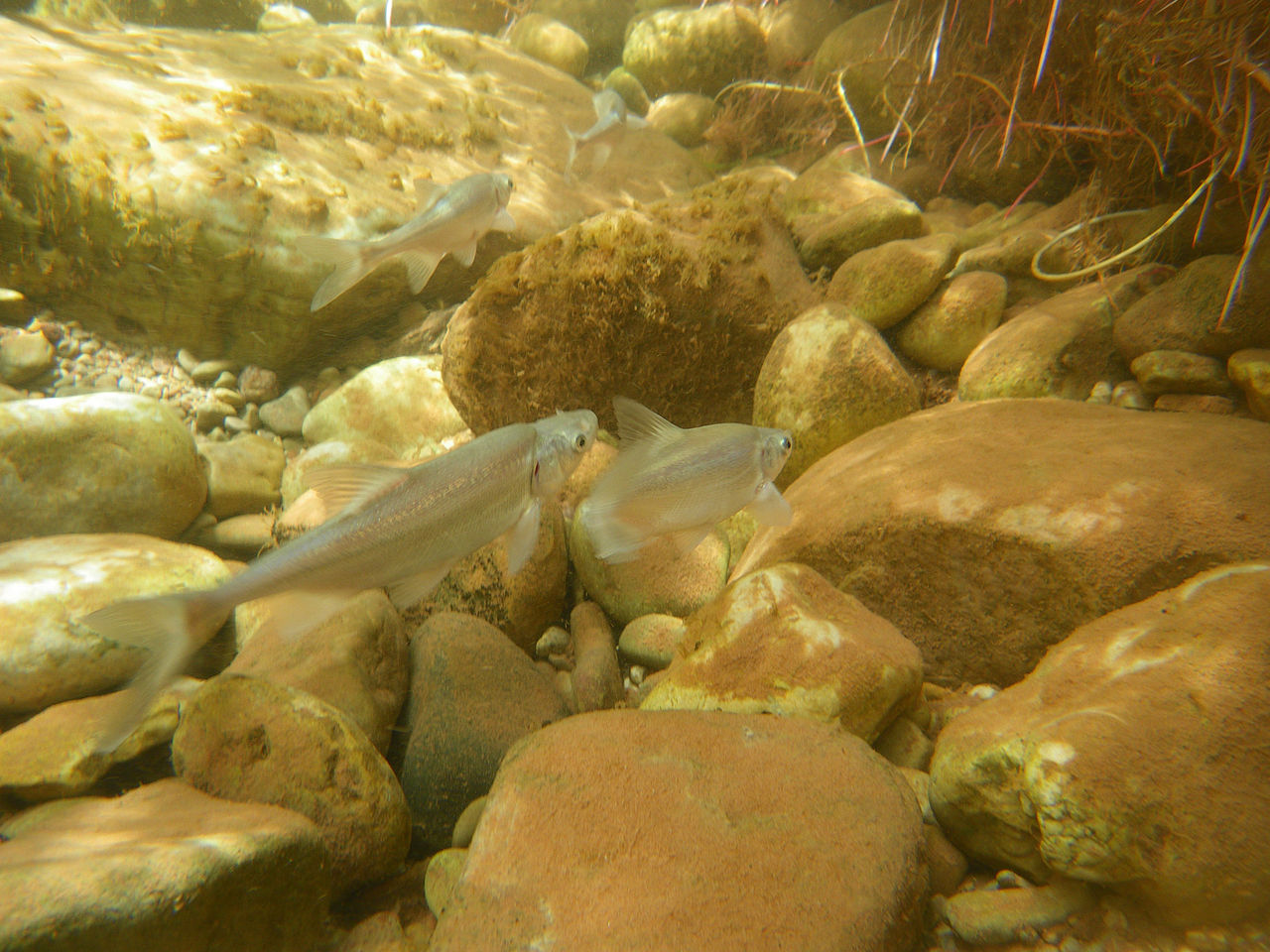
The razorback sucker, up to 91 cm long with a sharp keel behind its head, has been federally protected since 1991 and is rated Critically Endangered by the IUCN. It is now restricted to the river above the Grand Canyon and to Lakes Mead, Mohave, Havasu and Powell; as of 2021 the only self-sustaining population was in Lake Mead, and wild razorbacks were found again in the lower Grand Canyon in 2012 and 2013, the first records in the national park since the 1990s. The bonytail is in the worst shape of all. It was one of the first fish to show the effects of Hoover Dam, vanishing from the lower basin between 1926 and 1950, was listed as endangered in 1980, and has no self-sustaining wild population left; it survives through hatchery releases.
Below Glen Canyon Dam: 8 °C Water, Rainbow Trout and the 1996 Flood Experiment
The reach through the Grand Canyon shows most clearly how a dam rewrites a habitat. Before Glen Canyon Dam closed in 1963, the Colorado ran from around 29 °C at the height of summer to near freezing in winter, carried huge loads of red silt, and at its mouth often exceeded 2,800 m³/s in the spring melt. Glen Canyon Dam draws water from deep in Lake Powell, so the river below it now runs at a near-constant 8 °C all year, clear and cold. The humpback chub spawns from April to June in water of 19–21 °C, temperatures the main stem below the dam rarely reaches. Nikolai Ramsey of the Grand Canyon Trust called the colder, clearer river a “death zone for native fish”.
The same water suits fish that were never meant to be there. Rainbow trout, stocked below the dam after it was built, thrive in the cold tailwater, and the stretch down to Lees Ferry is now an excellent trout fishery; removing these non-native predators has become part of the humpback chub’s recovery programme. The dam also traps about 100 million US tons of sediment a year, so the sandbars and beaches that shelter young native fish in backwaters are slowly eroding, while the absence of scouring floods has let riverside vegetation spread over campsites and banks.
On 26 March 1996, the penstocks and two bypass tubes at Glen Canyon Dam were opened to full capacity, sending a flood of about 1,300 m³/s down the canyon, the first of the “high-flow experiments” meant to mimic the old spring floods. The early results looked good, but within six months much of the buried vegetation had grown back and the rebuilt sandbars proved unstable. Later releases, in 2004, 2008, 2012 and 2014, were timed to follow summer monsoon storms so the flood could spread sediment brought in by the Paria and Little Colorado rivers. Experimental flooding, together with warmer water during the drought of the 2000s, is credited with helping the humpback chub’s Grand Canyon numbers recover after 2001.
California Condors over Vermilion Cliffs and the Grand Canyon Since 1996
Above the river, the canyon country now holds one of the rarest birds in North America. The California condor, the continent’s largest land bird, once ranged across the Southwest; condor remains have been found in Arizona, Nevada, New Mexico and Texas. By 1987 the species was extinct in the wild, after the last free bird, AC-9, was captured on Easter Sunday that year, leaving a total population of 27 condors, all in captivity.
Releases began in California in 1991. In 1996 captive-bred condors were released at the Vermilion Cliffs release site in northern Arizona, near the Grand Canyon. To reassure ranchers, the US Fish and Wildlife Service classed the Arizona birds as an experimental, nonessential population. By October 2010 there were 73 wild condors in Arizona, and the birds now range over northern Arizona and southern Utah, including the Grand Canyon and Zion National Park.

The flock remains fragile. Among juvenile and adult condors, the main cause of death is lead poisoning from eating carcasses containing lead shot. In 2023 highly pathogenic avian influenza struck the Utah–Arizona flock and killed 21 condors, including 13 birds from eight breeding pairs. A vaccine trial followed, and by 2 February 2024, 94 condors had received at least the first of two doses.
The Colorado River Delta: 358 Bird Species, Desert Pupfish and the Last Vaquitas
Where the river ends, in eastern Mexicali Municipality in Baja California, at the head of the Gulf of California, the change has been greatest. The delta once spread over about 7,800 km² of freshwater, brackish and tidal wetlands, built from the 77–91 million tonnes of sediment the river carried to the Gulf each year. Early travellers reported jaguars, beavers, deer and vast numbers of waterfowl, and the Cucapá people harvested wild Palmer’s saltgrass on its floodplain. Since the dams, the wetlands have shrunk to about 5% of their original extent, and native cottonwood and willow forest has largely given way to non-native tamarisk.
Even so, the delta remains the principal freshwater marsh of the region, and 358 bird species have been recorded in it and the upper Gulf of California. Some have gone: the southwestern willow flycatcher, the fulvous whistling duck and the sandhill crane are among species that no longer breed or winter here. Others hold on in the Ciénega de Santa Clara, a wetland that supports the largest remaining population of the endangered desert pupfish anywhere, as well as the Yuma rail, a subspecies of Ridgway’s rail listed as endangered in the United States.
In November 2012 the US and Mexico signed Minute 319, which made water available to the delta. The first “pulse flow” began on 21 March 2014: an eight-week release of about 130 million m³ (105,000 acre-feet), aimed at reviving 950 hectares of wetland. It reached the sea on 16 May 2014, the first time in 16 years that Colorado River water had flowed into the ocean.
Just offshore lives the delta’s most endangered neighbour. The vaquita, the world’s smallest cetacean at up to 150 cm, lives only in the shallow, murky waters of the northern Gulf of California. The shrinking of the delta has been listed among the threats to it, but the direct cause of its collapse is drowning in gillnets, especially those set illegally for the totoaba fish. The first full survey, in 1997, estimated 567 animals; by 2007 there were about 150, and by 2018 fewer than 19. A 2024 survey saw a minimum of six to eight, and monitoring in 2025 identified seven to ten individuals and new calves.
For the full story of the wetlands at the river’s mouth, see our guide to the Colorado River Delta; for the dam that set the Grand Canyon’s water at 8 °C, read about Glen Canyon Dam, and for the vaquita’s home, our article on the Gulf of California.