
Most caves form through the dissolution of limestone and other soluble rocks by slightly acidic groundwater. Rainwater absorbs carbon dioxide from the atmosphere and soil, forming weak carbonic acid that slowly dissolves calcium carbonate in limestone, creating cracks, passages, and eventually vast underground chambers over hundreds of thousands of years.
Introduction
Caves are found on every continent and come in remarkable variety, from massive limestone caverns decorated with stalactites and stalagmites to lava tubes formed by flowing magma, sea caves carved by ocean waves, and ice caves sculpted within glaciers. They provide unique habitats for specialized organisms and preserve invaluable records of past climates and human history.
The Short Answer
- Primary Process: Chemical dissolution of soluble rock
- Main Rock Type: Limestone (calcium carbonate)
- Timeframe: Thousands to millions of years for solution caves
The most common caves on Earth are solution caves, formed when acidic water dissolves soluble rock. The process begins when rainwater absorbs carbon dioxide from the atmosphere and soil to form carbonic acid. This weak acid seeps through cracks in limestone, gradually widening them into passages. Over time, these passages grow into tunnels, chambers, and complex cave systems.
The chemical reaction is straightforward: carbonic acid reacts with calcium carbonate in limestone to produce calcium bicarbonate, which is soluble in water and is carried away. This process is slow but relentless, dissolving millimeters of rock per century and eventually hollowing out enormous underground spaces.
The Science Behind It
- Chemical Equation: CaCO₃ + H₂O + CO₂ → Ca(HCO₃)₂
- Water Table Role: Most dissolution occurs at or near the water table
- Speleothem Growth: Stalactites grow roughly 0.1-3 mm per year
Cave formation occurs in distinct phases. Initially, water seeps through tiny fractures and bedding planes in the limestone, dissolving rock and enlarging the openings. Once passages become large enough for turbulent water flow, dissolution accelerates dramatically. Many large caves formed during periods of high water flow, such as when glaciers melted and flooded underground river systems.
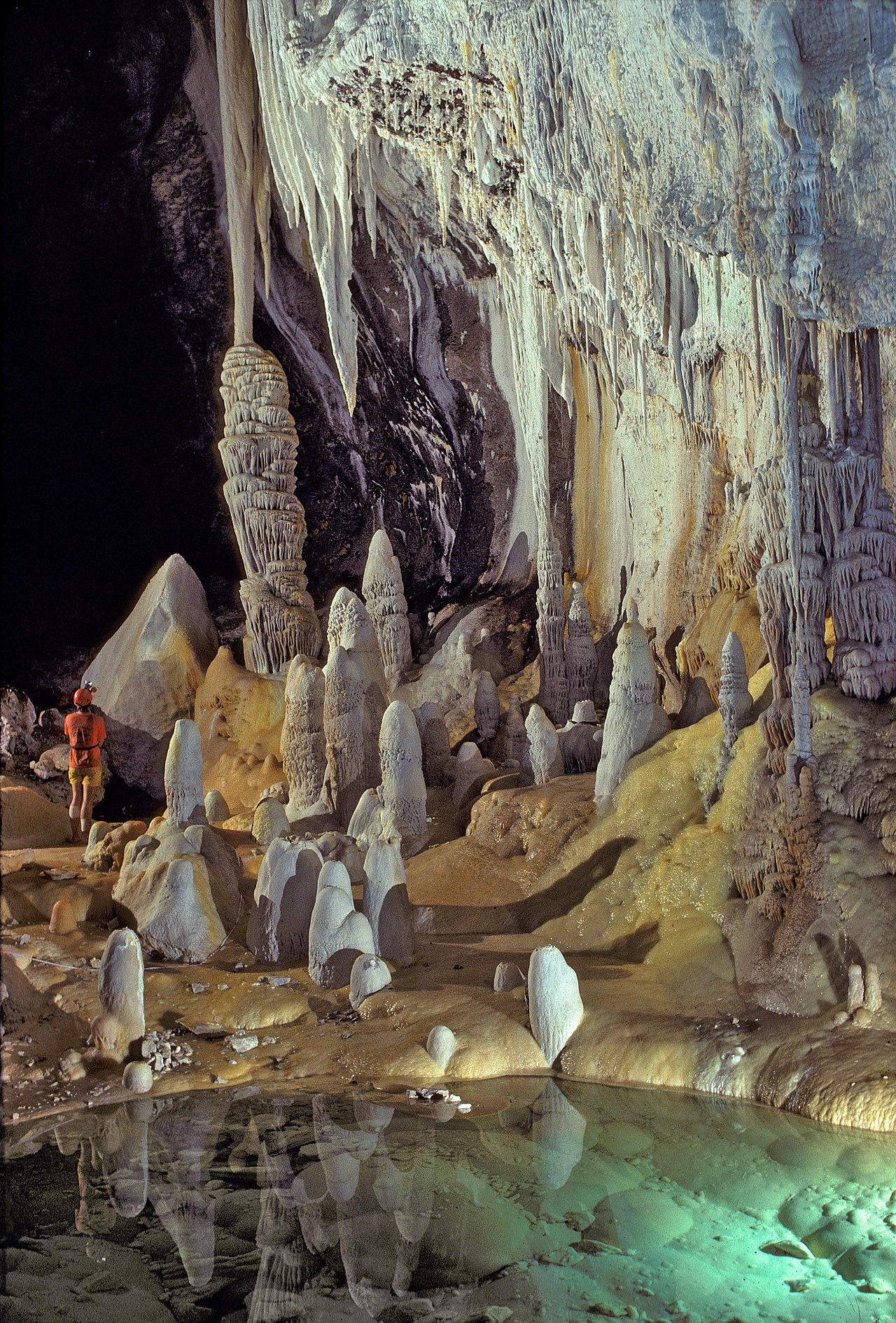
After the water table drops (due to river downcutting or tectonic uplift), cave passages drain and air fills the chambers. This is when speleothems, the mineral formations that decorate caves, begin to grow. Water seeping through the cave ceiling loses carbon dioxide to the cave atmosphere, causing dissolved calcium carbonate to precipitate as calcite, forming stalactites hanging from the ceiling and stalagmites growing up from the floor.
Types & Variations
- Solution Caves: Dissolved in limestone or dolomite (most common)
- Lava Tubes: Formed by flowing lava with a cooled surface crust
- Sea Caves: Eroded by ocean waves into coastal cliffs
- Ice Caves: Melted within glaciers or permanently cold rock caves
Lava tubes form during volcanic eruptions when the surface of a lava flow cools and hardens while molten lava continues flowing beneath. When the eruption stops, the lava drains out, leaving a tube-shaped cave. Kazumura Cave in Hawaii is the world's longest lava tube at over 65 kilometers. These caves can form in days, unlike solution caves that take millennia.
Sea caves are carved by the relentless pounding of ocean waves against coastal cliffs, particularly where the rock contains weak zones or fractures. The Painted Cave on Santa Cruz Island in California extends nearly 400 meters and is one of the world's largest sea caves. Glacier caves form when meltwater carves tunnels through ice, creating ethereal blue-walled passages.
Famous Examples
- Mammoth Cave: World's longest cave system at 680+ km (Kentucky, USA)
- Son Doong: World's largest cave passage (Vietnam)
- Carlsbad Caverns: Massive chambers with spectacular formations (New Mexico)
- Lascaux: Prehistoric cave paintings dating to 17,000 years ago (France)
Mammoth Cave in Kentucky holds the record as the world's longest known cave system, with over 680 kilometers of surveyed passages, and new sections continue to be discovered. The cave formed in limestone deposited in a shallow sea 325 million years ago, and its passages represent several distinct levels corresponding to ancient water table positions.
Son Doong in Vietnam, discovered in 2009, contains the world's largest known cave passage, a chamber over 200 meters high and 150 meters wide that could fit a 40-story skyscraper inside. The cave has its own weather system, with clouds forming inside the enormous passage, and supports a jungle ecosystem where sunlight penetrates through collapsed ceiling sections called dolines.
Why It Matters
- Water Supply: Karst aquifers supply drinking water for ~25% of the global population
- Climate Record: Speleothems preserve detailed records of past climates
- Biodiversity: Caves harbor unique species found nowhere else
Caves are far more than geological curiosities. Karst landscapes, the terrain formed by limestone dissolution, underlie about 15 percent of Earth's land surface, and karst aquifers supply drinking water to roughly a quarter of the world's population. Understanding how caves form is essential for protecting these vital water resources from contamination.
Caves preserve remarkable records of the past. Speleothems can be precisely dated using uranium-thorium methods and contain chemical signatures of temperature, rainfall, and vegetation changes going back hundreds of thousands of years. Caves have also preserved some of humanity's earliest art, such as the 40,000-year-old paintings in Indonesia's Sulawesi caves and the famous Lascaux paintings in France.
Key Facts
- Mammoth Cave in Kentucky is the world's longest cave system at over 680 km.
- Most caves form in limestone through chemical dissolution by carbonic acid.
- Karst aquifers supply drinking water to about 25% of the world's population.
- Stalactites typically grow at a rate of about 0.1 to 3 mm per year.
- Son Doong Cave in Vietnam is large enough to fit a 40-story building inside.
Fun Facts
- Some cave-dwelling species like the olm salamander can survive up to 10 years without food.
- The deepest known cave is Veryovkina Cave in Georgia at 2,212 meters deep.
- Cave pearls are smooth, round formations that grow in shallow cave pools from dripping water.
- The air inside deep caves remains at a nearly constant temperature year-round, matching the local average surface temperature.
Final Thoughts
Cave formation is a testament to the power of water as a geological agent. The slow, patient work of acidic water dissolving limestone grain by grain has created some of the most spectacular underground landscapes on Earth. From the vast chambers of Son Doong to the intricate formations of Carlsbad Caverns, caves reveal the hidden architecture beneath our feet and provide invaluable resources, from drinking water to climate records to the earliest evidence of human artistic expression.
Test Your Knowledge!
Curious about geography? Test what you've learned!
Play Geography Games →