
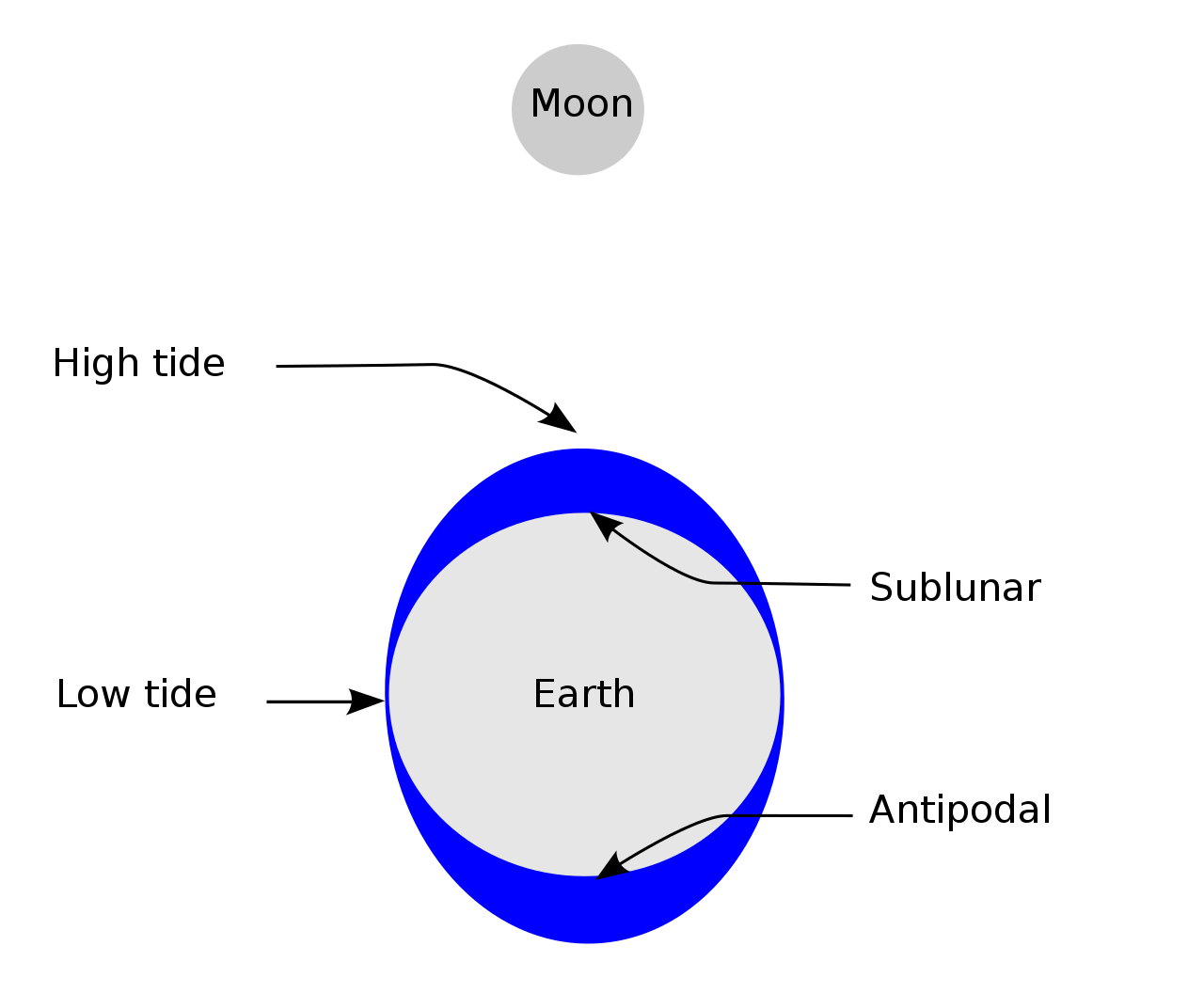
Tides are the regular rise and fall of ocean levels caused primarily by the gravitational attraction of the Moon, with a secondary contribution from the Sun. The Moon's gravity pulls on the near side of the Earth more strongly than on the far side, creating two bulges of water on opposite sides of the planet. As the Earth rotates beneath these bulges, coastal locations experience two high tides and two low tides roughly every 24 hours and 50 minutes.
Introduction
Tides affect every coastline on Earth and have profoundly influenced human activities from navigation and fishing to the siting of ports and the design of coastal infrastructure. They also play critical roles in marine ecosystems, creating intertidal zones that support extraordinary biodiversity and driving nutrient circulation in estuaries and coastal waters.

The Short Answer
- Primary Cause: Moon's gravitational pull on Earth's oceans
- Secondary Cause: Sun's gravitational pull (about 46% as strong)
- Cycle: Most locations experience 2 high and 2 low tides per day
The Moon's gravity pulls on the oceans, creating a bulge of water on the side of the Earth facing the Moon. On the opposite side, a second bulge forms because the Moon's gravitational pull is weakest there, and centrifugal force from the Earth-Moon system pushes water outward. These two bulges are the high tides.
As the Earth rotates on its axis, each point on the coast passes through both bulges, experiencing two high tides and two low tides approximately every 24 hours and 50 minutes. The extra 50 minutes accounts for the Moon's movement in its orbit: as the Earth completes one rotation, the Moon has moved slightly further along, so the Earth must rotate an extra 50 minutes to realign.
The Science Behind It
- Tidal Force: Differential gravity across Earth's diameter
- Spring Tides: Sun and Moon aligned, largest tidal range (full and new moon)
- Neap Tides: Sun and Moon at right angles, smallest tidal range (quarter moons)
- Amphidromic Points: Locations with essentially zero tidal range
Spring tides occur twice per month during full moon and new moon, when the Sun, Moon, and Earth are aligned. The gravitational pulls of the Sun and Moon combine, producing the highest high tides and lowest low tides. Despite the name, spring tides have nothing to do with the season; the term comes from the Middle English "springan," meaning to leap.
Neap tides occur during quarter moons when the Sun and Moon are at right angles relative to Earth. Their gravitational pulls partially cancel each other, producing the smallest tidal range. The difference between spring and neap tidal ranges can be substantial: the Bay of Fundy in Canada has spring tides of up to 16 meters but neap tides of "only" about 8 meters.
Types & Variations
- Semidiurnal: Two roughly equal high and low tides per day (most of Atlantic)
- Diurnal: One high and one low tide per day (parts of Gulf of Mexico)
- Mixed: Two unequal high and low tides per day (Pacific coast of Americas)
- Macro-tidal: Tidal range > 4 meters (Bay of Fundy, Bristol Channel)
The shape of ocean basins, coastlines, and the seafloor dramatically affects local tides. The Bay of Fundy between Nova Scotia and New Brunswick has the world's highest tidal range, up to 16 meters, because its funnel-shaped geometry and resonant length amplify the tidal wave. The Mediterranean Sea, by contrast, has very small tides because the narrow Strait of Gibraltar restricts water flow.
Tidal bores are another fascinating phenomenon. In funnel-shaped estuaries, the incoming tide can form a wave that travels upstream against the river current. The Qiantang River bore in China can reach 9 meters high, while the Severn Bore in England and the Pororoca on the Amazon are surfed by adventurous wave riders.
Famous Examples
- Bay of Fundy: World's highest tides at up to 16 meters (Canada)
- Mont Saint-Michel: Dramatic tidal changes transform island access (France)
- Bristol Channel: Second-highest tides globally, up to 15 meters (UK)
- Qiantang River: Spectacular tidal bore reaching 9 meters (China)
The Bay of Fundy experiences such extreme tides that the coastline can transform completely between low and high tide. At low tide, kilometers of ocean floor are exposed, revealing marine life and ancient fossils. At high tide, the same area is covered by up to 16 meters of water, roughly the height of a four-story building. Approximately 160 billion tons of water flow in and out of the bay with each tide cycle.
Mont Saint-Michel in Normandy, France is a tidal island that has captivated visitors for centuries. At low tide, the abbey sits surrounded by exposed sand flats. At high tide, the surrounding flats can flood rapidly as the tide races in, historically trapping pilgrims. The tidal range here can exceed 14 meters during spring tides, one of the highest in Europe.
Why It Matters
- Tidal Energy: Harnessing tides for renewable electricity generation
- Navigation: Tidal knowledge essential for shipping and port operations
- Ecosystems: Intertidal zones are among the richest marine habitats
Tidal energy is an emerging source of renewable electricity. The predictability of tides makes them more reliable than solar or wind power. Tidal barrages like the Rance Tidal Power Station in France (240 MW) capture energy from the tidal range, while tidal stream generators work like underwater wind turbines in areas of strong tidal currents. The potential global capacity is estimated at 150 gigawatts.
Intertidal zones, the areas alternately submerged and exposed by tides, are among the most productive ecosystems on Earth. They serve as nurseries for fish and shellfish, feeding grounds for migratory birds, and natural water filtration systems. The health of intertidal ecosystems is closely linked to tidal patterns, and any changes to tidal dynamics from coastal development or sea level rise can have cascading ecological effects.
Key Facts
- The Moon's gravitational pull is the primary cause of tides, with the Sun contributing about 46%.
- The Bay of Fundy in Canada has the world's highest tidal range at up to 16 meters.
- Spring tides occur during full and new moons when Sun and Moon are aligned.
- Most coastal locations experience two high and two low tides every 24 hours and 50 minutes.
- About 160 billion tons of water flow in and out of the Bay of Fundy each tidal cycle.
Fun Facts
- The word "tide" comes from the Old English "tid" meaning time or season.
- Tides slow Earth's rotation by about 2.3 milliseconds per century, making days gradually longer.
- The Moon is slowly moving away from Earth at 3.8 cm per year, which will eventually reduce tidal ranges.
- Some lakes experience tiny tides, but they are typically only a few centimeters.
Final Thoughts
Tides are the ocean's heartbeat, a rhythmic pulse driven by the gravitational dance of the Moon and Sun with our planet. From the spectacular 16-meter tides of the Bay of Fundy to the subtle oscillations of inland seas, tides shape coastlines, drive ecosystems, and influence human activities from shipping to energy production. Understanding how tides work connects us to the fundamental forces of gravity and celestial mechanics that govern our world.
Test Your Knowledge!
Curious about geography? Test what you've learned!
Play Geography Games →