
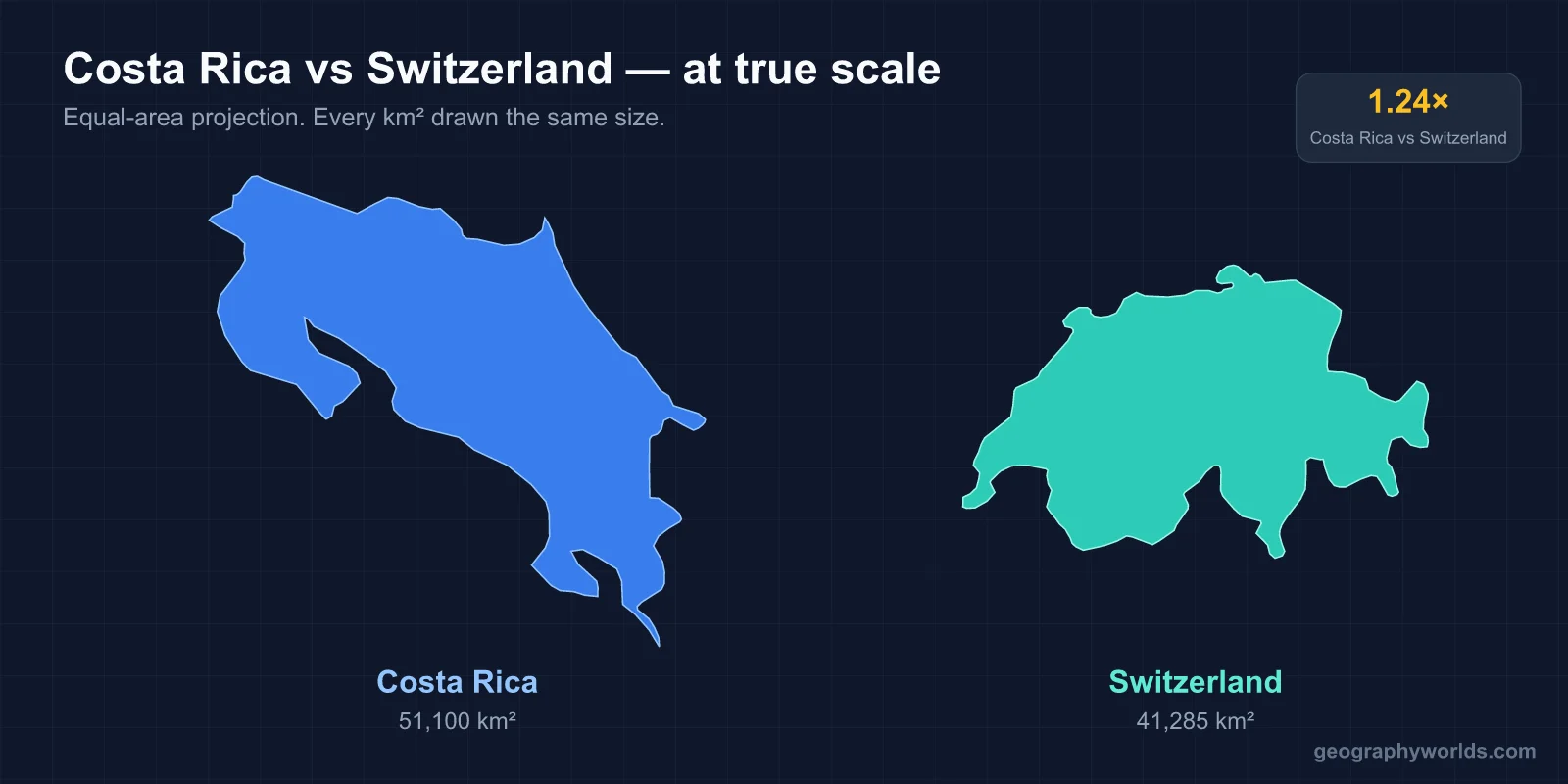
Yes. Costa Rica is larger than Switzerland. Costa Rica covers 51,100 km², while Switzerland covers 41,285 km². Costa Rica is about 1.24 times the size of Switzerland — larger by 9,815 km², which is about the size of Connecticut or Kosovo. But Switzerland has about 1.7× more people than Costa Rica.
The Short Answer
Costa Rica and Switzerland are two small but globally recognized countries — Costa Rica for its biodiversity and eco-tourism, Switzerland for its mountains, neutrality, banking, and chocolate. Both punch above their weight in global cultural recognition despite their modest sizes.
Costa Rica is bigger by area, but Switzerland is denser, wealthier, and more developed. The two countries share characteristics like high quality of life, strong tourism industries, and political stability, but they're in very different parts of the world (Central America vs Central Europe).

The Real Numbers
- Costa Rica total area: 51,100 km² (19,730 sq mi)
- Switzerland total area: 41,285 km² (15,940 sq mi)
- Difference: 9,815 km² — about the size of Connecticut, Kosovo, or Lebanon
- Ratio: Costa Rica is about 1.24× the size of Switzerland
Globally, Costa Rica ranks 128th by area; Switzerland ranks 137th. Both are mid-sized countries by world standards — much larger than tiny European nations like Luxembourg or Andorra, but much smaller than France, Germany, or Spain.
Population
Switzerland has more people:
- Switzerland population: ~8,800,000
- Costa Rica population: ~5,200,000
- Switzerland density: ~213 people per km²
- Costa Rica density: ~102 people per km²
Switzerland has about 69% more people than Costa Rica, packed into less land. Switzerland's population density is more than 2× Costa Rica's. Switzerland is densely settled with urban areas distributed across the country, while Costa Rica's population is concentrated in the Central Valley around San José.
Geography
Costa Rica has remarkable geographic variety for a small country:
- Central Valley: High plateau where most Costa Ricans live, including San José
- Volcanic mountain ranges: Cordillera Central, Cordillera de Talamanca
- Pacific coast: ~1,160 km of beaches and dry tropical forest
- Caribbean coast: ~210 km of beaches and rainforest
- Active volcanoes: Including Arenal, Poás, Irazú, Turrialba
- Tropical rainforests: Major national parks like Corcovado and Tortuguero
Switzerland is dominated by the Alps:
- The Alps: Cover about 60% of Switzerland
- The Mittelland (Central Plateau): Where most people live
- The Jura Mountains: Lower mountain range in the northwest
- Major lakes: Lake Geneva, Lake Constance, Lake Maggiore, Lake Lucerne
- Rhine, Rhône, Inn, and Ticino rivers
- Highest peak: Dufourspitze (4,634 m)
Biodiversity
This is where Costa Rica dramatically outshines Switzerland. Costa Rica is one of the most biodiverse countries on Earth — despite covering just 0.03% of Earth's surface, it contains about 5% of all known species. The country has over 500,000 species (many still undocumented), including 850 bird species, 250 mammal species, 200 reptile species, and 130 amphibian species. Costa Rica is famous for its sloths, monkeys, toucans, jaguars, sea turtles, and incredible variety of insects.
Switzerland has rich Alpine biodiversity but much less species variety. The country has about 50,000 species, including various Alpine mammals (chamois, ibex, marmot), birds (golden eagle, alpine swift), and many endemic alpine plants. But Switzerland's temperate-alpine environment supports a fraction of Costa Rica's tropical biodiversity.
Climate
Costa Rica has tropical climate. The Pacific side is hot and dry in summer (December-April) and wet in winter. The Caribbean side is warm and wet year-round. Mountain areas have cooler temperatures — San José (1,170 m elevation) averages 22°C year-round. The country has a true equatorial climate with little seasonal temperature variation.
Switzerland has temperate continental and alpine climate. Lowland areas (Geneva, Zurich) have mild summers (18-23°C) and cool winters (0-5°C). Mountain areas have alpine climate with significant snow. The country experiences all four seasons distinctly.
Economy
Switzerland has a much larger economy:
- Switzerland GDP: ~$885 billion
- Costa Rica GDP: ~$68 billion
- Switzerland per capita GDP: ~$101,000 (one of the world's highest)
- Costa Rica per capita GDP: ~$13,000
Switzerland's economy is about 13× larger than Costa Rica's. Per capita, Switzerland is about 8× richer on average. Switzerland is one of the world's wealthiest countries, with strengths in banking and finance, pharmaceuticals (Nestlé, Roche, Novartis), watches, chocolate, machinery, and chemicals.
Costa Rica is a middle-income economy with significant strengths in eco-tourism, technology (Intel had a major presence), medical devices, and agriculture (coffee, bananas, pineapple). Costa Rica abolished its military in 1948 and reinvested the savings in education and healthcare — a famously successful policy choice.
Politics and Society
Switzerland is famous for its direct democracy and political neutrality. The country has been militarily neutral since 1815 and stayed out of both World Wars. Swiss citizens vote on dozens of referendums each year. The country is divided into 26 cantons with significant autonomy. Four official languages: German, French, Italian, and Romansh.
Costa Rica is one of Latin America's most stable democracies. The country has held continuous democratic elections since 1949 and abolished its military in 1948 — money saved is invested in education and healthcare. Costa Rica has been praised as the "Switzerland of Central America" for its peace, prosperity, and high quality of life relative to its regional neighbors. Costa Rica's official language is Spanish.
Tourism
Both are major tourism destinations. Costa Rica receives about 3 million tourists annually, primarily for eco-tourism, beaches, and adventure activities (zip-lining, surfing, wildlife watching). Costa Rica has positioned itself as one of the world's premier eco-tourism destinations and aims to become the world's first carbon-neutral country.
Switzerland receives about 12 million tourists annually. Major attractions include the Alps (skiing, hiking), Lake Geneva, Lake Lucerne, the Matterhorn, Bern, Zurich, Geneva, Lausanne, Interlaken, and many mountain villages. Switzerland is famous for its luxury tourism and high-quality service.
Key Facts
- Costa Rica is about 1.24× the size of Switzerland.
- Switzerland has 69% more people than Costa Rica.
- Switzerland's economy is 13× larger than Costa Rica's.
- Costa Rica has 10× more biodiversity than Switzerland.
- Costa Rica abolished its military in 1948; Switzerland has been militarily neutral since 1815.
Fun Facts
- Switzerland produces about 1.7 million tons of chocolate annually — one of the largest producers in the world per capita.
- Costa Rica produces about 100,000 tons of coffee annually, including some of the world's most prestigious specialty beans.
- Both countries have been praised as among the world's happiest — Costa Rica often tops "happiness" rankings in Latin America.
- Switzerland is home to FIFA, UEFA, and the IOC (Olympic Committee) — making it the unofficial capital of international sport.
- Costa Rica's name means "rich coast" — given by Spanish colonizers who hoped (mistakenly) to find gold.
- Switzerland's name comes from the canton of Schwyz, one of the original three founding cantons in 1291.
- Costa Rica has been called the "Switzerland of Central America" — but Costa Rica is geographically larger and biologically far more diverse.
- Switzerland has 16 official national parks and protected areas; Costa Rica has 28 national parks plus numerous biological reserves.
- Both countries have remarkably high life expectancy — Costa Rica around 81 years, Switzerland around 84 years.
Education and Innovation
Switzerland has one of the world's best-developed education systems, including ETH Zurich and EPFL (federal institutes of technology), the University of Zurich, and excellent vocational training programs. The country produces high numbers of patents per capita and is consistently ranked as the world's most innovative country by the WIPO Global Innovation Index.
Costa Rica has invested heavily in education since abolishing its military in 1948. The country has high literacy rates (97%+) and one of the highest education rates in Latin America. The University of Costa Rica and the Tecnológico de Costa Rica are leading regional institutions. Costa Rica has attracted significant foreign investment in technology (especially semiconductor manufacturing by Intel and medical device companies) due to its educated workforce and stable political environment.
The Bottom Line
Costa Rica is bigger than Switzerland by area (24% larger), but Switzerland has more people and a much larger economy. Costa Rica has dramatically more biodiversity due to its tropical location. Both countries punch well above their weight in global recognition and have built reputations for stability, peace, and natural beauty. They're very different places — tropical Central America vs. alpine Central Europe — but share characteristics like high quality of life and successful small-country development. The comparison reminds us that geographic size doesn't determine global influence — both Costa Rica and Switzerland are far more prominent than many countries 10× their size. Both also offer lessons for how smaller countries can punch above their weight through smart policy choices, education investment, and tourism development.
Quiz Small Countries!
Test your knowledge of Costa Rica, Switzerland, and beyond.
Play Geography Games →