
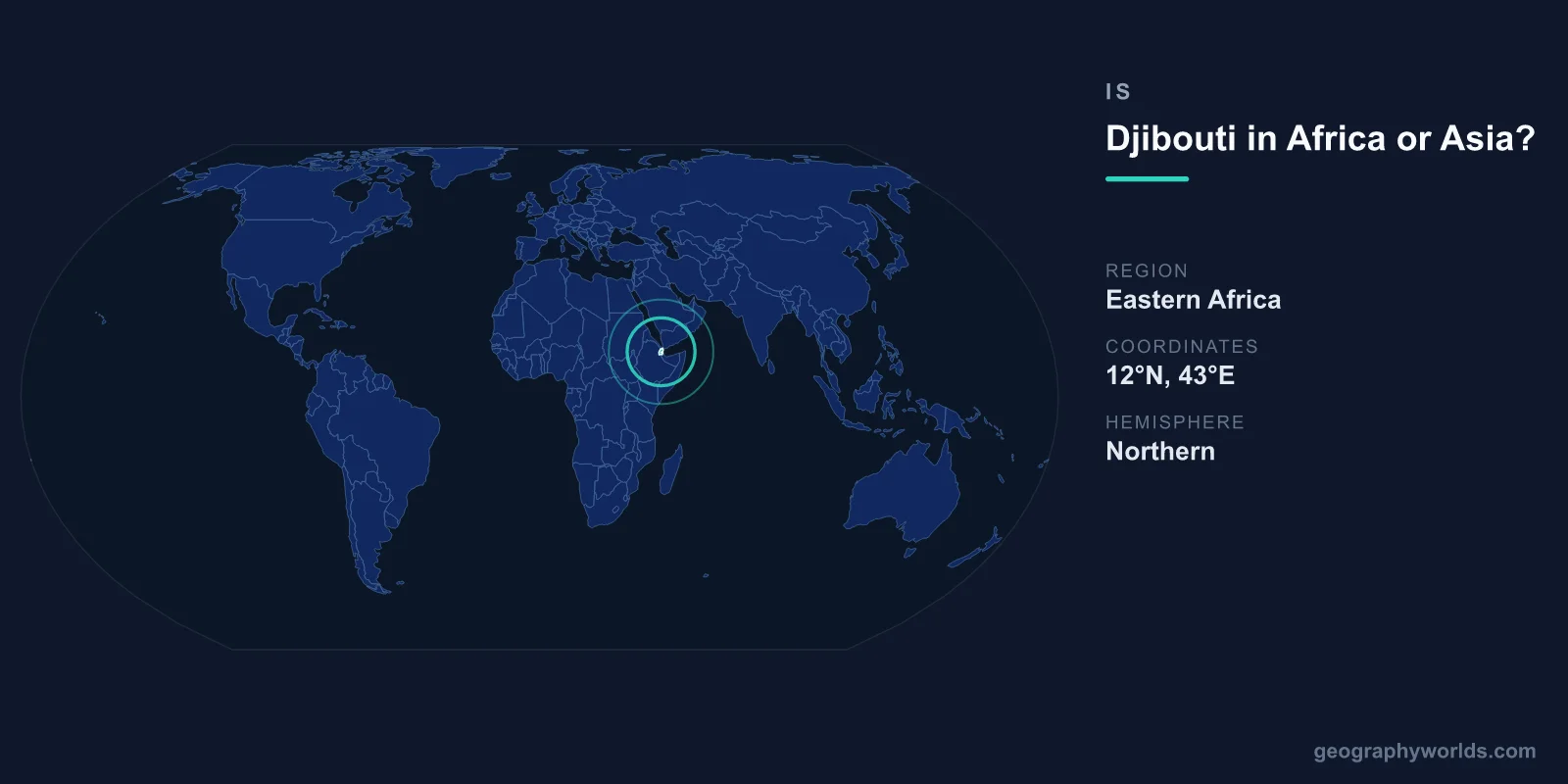
Djibouti is in Africa, not Asia. It is a small nation in the Horn of Africa, perched on the northeast coast of the continent where the Red Sea narrows into the Gulf of Aden. Although it sits only a short distance across the water from the Arabian Peninsula and shares deep cultural ties with the Arab world, Djibouti is firmly and unambiguously an African country.
Where Exactly Is Djibouti?
Djibouti occupies a strategic pocket of the Horn of Africa, the easternmost projection of the African continent. It is bordered by Eritrea to the north, Ethiopia to the west and south, and Somalia (the Somaliland region) to the southeast. To the east lies the coastline along the Gulf of Aden and the Red Sea. Covering roughly 23,200 km², it is one of the smallest countries in Africa, with a population of approximately one million people. Its capital, Djibouti City, hugs the coast and serves as the country's economic and political heart.
The defining geographic feature is the Bab-el-Mandeb Strait, the narrow channel where the African and Arabian landmasses come closest together. At its tightest, only about 30 km of water separate Djibouti from Yemen on the Arabian Peninsula. This proximity to Asia is precisely what sparks the question of which continent Djibouti belongs to — but the strait is the boundary, and Djibouti sits squarely on the African side of it.
Why People Confuse Djibouti's Continent
The confusion is understandable. Djibouti is a member of the Arab League, Arabic is one of its two official languages alongside French, and the vast majority of its population is Muslim. Culturally and diplomatically, the country leans toward the Middle East as much as toward sub-Saharan Africa. Many people associate Arabic-speaking, predominantly Muslim societies with Asia, so Djibouti's identity can feel ambiguous at first glance.
Geography, however, is decided by physical landmass, and Djibouti's territory lies entirely on the African continent. The Bab-el-Mandeb Strait is the recognized dividing line between Africa and Asia in this region. Everything west of that water — including all of Djibouti — is Africa. Yemen, just across the strait, is the Asian neighbor. So while Djibouti acts as a bridge between two worlds, it is anchored to one of them: Africa.
A Land of Extremes
Djibouti's landscape is dramatic and often harsh. Much of the country is arid plain, volcanic rock, and shimmering salt flats. Its most remarkable feature is Lake Assal, which sits at about 155 metres below sea level — the lowest point in all of Africa and one of the lowest dry-land points anywhere on Earth. It is also among the saltiest bodies of water in the world, with crystalline white salt deposits ringing turquoise water in a starkly beautiful scene.
The climate is one of the hottest on the planet, with summer temperatures regularly soaring above 40°C. Despite this unforgiving environment, the country's volcanic origins have produced striking terrain, including the otherworldly Lake Abbe with its towering limestone chimneys, a landscape so alien it has stood in for other planets in film.
Strategic Importance at the Crossroads
Djibouti's location at the mouth of the Red Sea gives it influence far beyond its modest size. The Bab-el-Mandeb Strait is one of the busiest and most strategically vital shipping lanes in the world, and a large share of global maritime trade — vessels moving between Europe, Asia, and the Gulf via the Suez Canal — funnels past Djibouti's shores.
This has turned the tiny nation into a magnet for foreign military presence. The United States, France, China, Japan, and Italy all maintain bases there, making Djibouti home to more foreign military installations per square kilometre than almost any other country. Its ports also serve as the main maritime gateway for landlocked Ethiopia, handling a major portion of that much larger nation's imports and exports. In effect, Djibouti punches well above its weight on the world stage precisely because of where Africa meets the sea route to Asia. For a deeper look at the country, see our djibouti country guide.
Quick Facts About Djibouti
- Continent: Africa (Horn of Africa)
- Capital: Djibouti City
- Area: approximately 23,200 km²
- Population: around 1 million
- Official languages: French and Arabic
- Lowest point: Lake Assal, about 155 m below sea level
Frequently Asked Questions
Is Djibouti part of the Middle East?
Geographically, no — Djibouti is in Africa. However, because it is an Arab League member with Arabic as an official language and a majority-Muslim population, it is often grouped with the broader Middle East and North Africa (MENA) region in cultural and political contexts.
What continent is Djibouti on?
Djibouti is on the continent of Africa, specifically in the Horn of Africa region in the northeast of the continent, along the Red Sea and Gulf of Aden.
How close is Djibouti to Asia?
Djibouti is very close to Asia. Only about 30 km of water at the Bab-el-Mandeb Strait separate it from Yemen on the Arabian Peninsula, which is part of Asia. That narrow strait is the boundary between the two continents.
What countries border Djibouti?
Djibouti shares land borders with three African nations: Eritrea to the north, Ethiopia to the west and south, and Somalia to the southeast. Its eastern edge is coastline along the Gulf of Aden and Red Sea.
