
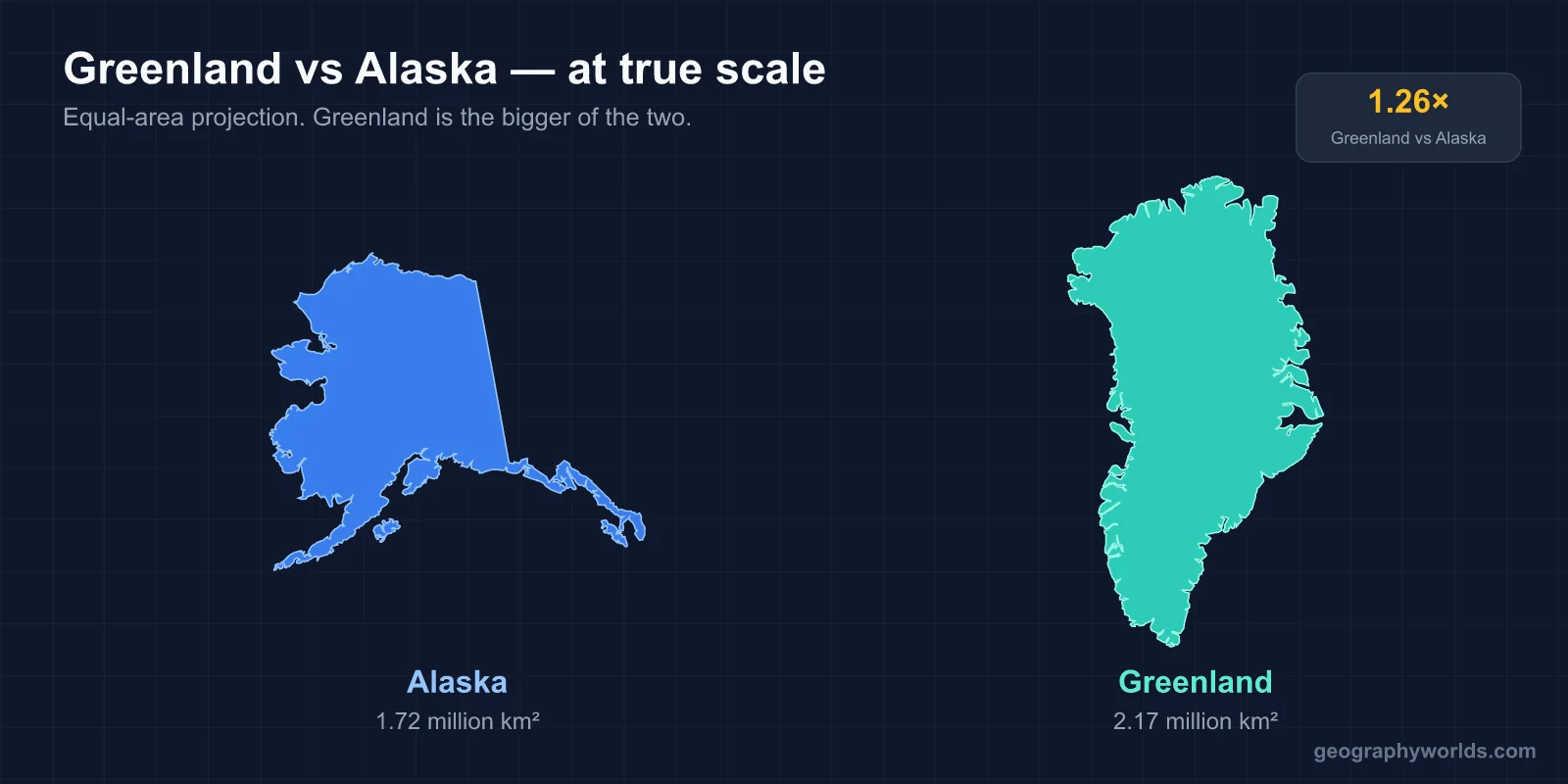
Yes. Greenland is larger than Alaska, but only by about 25%. Greenland covers 2,166,086 km² (836,330 sq mi), while Alaska covers 1,723,337 km² (665,400 sq mi). Greenland is about 1.26 times the size of Alaska, making them surprisingly close in area for two of the largest semi-empty places on Earth.
The Short Answer
Greenland and Alaska are sometimes lumped together in conversation because they're both vast, mostly frozen, and at the top of the world. But Greenland is meaningfully larger — by roughly 442,000 km², which is about the size of Iraq or California. If you laid Alaska on top of Greenland, you'd still need to add Sweden's land area to cover the rest of Greenland.
Both are also among the least densely populated places on Earth. Both are surrounded mostly by Arctic water. Both are governed from far-away capitals (Copenhagen for Greenland; Juneau and ultimately Washington DC for Alaska). The similarities are real, but Greenland is the bigger of the two.

The Real Numbers
- Greenland total area: 2,166,086 km² (836,330 sq mi)
- Alaska total area: 1,723,337 km² (665,400 sq mi)
- Difference: 442,749 km² — roughly the size of Iraq or California
- Ratio: Greenland is about 1.26× the size of Alaska
Globally, Greenland ranks 12th among countries and territories by area. Alaska, if it were a country, would rank about 19th. Both are in the top 20 globally — meaning each is bigger than the vast majority of the world's 200+ countries.
Why They Feel Similar
Greenland and Alaska share enough characteristics that they get mentally grouped together:
- Both sit mostly above 60° latitude
- Both have huge ice features (Greenland has the ice sheet; Alaska has the Bering Glacier and others)
- Both are administered remotely (Greenland by Denmark; Alaska from the lower 48)
- Both have indigenous peoples with deep histories (Inuit/Greenlandic, Yupik/Inupiat/Athabaskan/Tlingit in Alaska)
- Both have small populations and very large unsettled wildernesses
- Both are strategically important Arctic positions
The visual size confusion is also boosted by Mercator. Both get inflated on Mercator maps because they sit at high latitudes. Alaska looks much bigger than the lower 48 states on a Mercator map (it isn't — Alaska is smaller than Texas + California + Montana combined). Greenland looks bigger than it is too.
Climate: Both Cold, Both Different
Greenland's interior is dominated by the Greenland Ice Sheet — a vast slab of ice up to 3,000 m thick, covering about 80% of the country. Average temperatures in the interior never exceed 0°C even in summer. The coastal margins, where almost everyone lives, are warmer — Nuuk reaches summer averages around 8°C.
Alaska's climate is more varied. Southeastern Alaska has a maritime climate similar to coastal British Columbia (rainy, mild). Interior Alaska (Fairbanks region) is subarctic continental with extreme seasonal swings — -40°C winters and +25°C summers. The Arctic North Slope is true Arctic tundra. Alaska's southern panhandle has temperate rainforest. Alaska's climate range is broader, but Greenland's is more uniformly cold.
Population
Both are sparsely populated, but Alaska has more than 10× the population of Greenland:
- Alaska population: ~733,000
- Greenland population: ~56,000
- Alaska density: ~0.43 people per km²
- Greenland density: ~0.03 people per km²
Greenland is genuinely one of the most empty places on Earth — only Mongolia and a few other places have lower population densities. Alaska is sparse by US standards, but its main city (Anchorage, 290,000) is bigger than the entire population of Greenland five times over.
Wilderness and Land Coverage
About 80% of Greenland is covered by the Greenland Ice Sheet — a permanent feature that has been there for at least 110,000 years. The only ice-free zone is a narrow coastal strip. By contrast, Alaska is mostly land — extensive boreal forests (taiga), tundra in the north, and glaciers in the south, but only about 5% of Alaska is permanently ice-covered.
This makes the habitable land comparison interesting. Alaska has about 1,640,000 km² of ice-free terrain, while Greenland has only about 410,000 km². So even though Greenland is 26% larger overall, Alaska has roughly 4× more land that could theoretically be inhabited or used for forestry, agriculture, or development.
Norse and Indigenous History
Both have parallel histories of indigenous habitation followed by Norse and European arrivals. Greenland was inhabited by various Paleo-Inuit groups starting roughly 4,500 years ago, with the modern Inuit (Thule culture) arriving around 1,200 AD. The Norse Vikings, led by Erik the Red, settled southern Greenland around 985 AD and maintained settlements there for nearly 500 years before they mysteriously vanished in the 1400s. Modern Greenland was re-colonized by Danish missionaries and traders starting in 1721, and it remains a self-governing part of the Kingdom of Denmark.
Alaska was inhabited by multiple distinct indigenous peoples for at least 12,000 years — Inupiat, Yupik, Aleut, Athabaskan, Tlingit, Haida, and Tsimshian. Russians arrived in the 1700s and established Russian America, which the United States purchased in 1867 for $7.2 million. Alaska became a US state in 1959.
Greenland's Independence Question
Greenland is an autonomous territory within the Kingdom of Denmark. It has its own parliament, prime minister, and most domestic policies, but Denmark still handles foreign affairs and defense. There's been a growing independence movement in Greenland, particularly since the 2009 Self-Government Act gave Greenland more autonomy. A path to full independence exists in Danish law — Greenland could vote to leave Denmark and become its own country.
Alaska, by contrast, is fully integrated into the United States with no significant independence movement, though there are occasional discussions of greater autonomy. Both regions sit on important strategic Arctic real estate that great powers care about, but their political situations are completely different.
Economy
Alaska's economy is roughly 20× larger than Greenland's:
- Alaska GDP: ~$60 billion
- Greenland GDP: ~$3 billion
Alaska's economy is built on oil and gas (Trans-Alaska Pipeline), fishing (the largest commercial salmon fishery in the world), tourism, and federal government spending. Greenland's economy depends on fishing (about 90% of exports), tourism, and substantial annual subsidies from Denmark (about $600 million per year, around 20% of Greenland's GDP).
Strategic Importance
Both regions have outsized strategic importance because they sit on key Arctic geography. Greenland hosts Thule Air Base (now Pituffik Space Base), the US military's northernmost installation. It's a key node in early-warning radar systems for ballistic missiles and a critical link in NATO's Arctic defense posture. The 2019 Trump proposal to buy Greenland — bizarre as it sounded — was rooted in this strategic value. As Arctic shipping lanes open due to melting ice, control of Greenland's ports and coastline becomes more valuable.
Alaska's strategic importance is similar. It hosts major military bases (Joint Base Elmendorf-Richardson, Eielson Air Force Base, Fort Wainwright), and its westernmost islands sit just kilometers from Russian territory. The US bought Alaska from Russia in 1867 partly for strategic reasons (preventing British expansion from Canada). During the Cold War, Alaska was the front line between the US and the Soviet Union. Today it remains crucial for North American Arctic defense and for monitoring Russian military activity.
Key Facts
- Greenland is about 1.26× the size of Alaska.
- Alaska has more than 10× Greenland's population.
- About 80% of Greenland is permanent ice; only ~5% of Alaska is.
- Alaska has 4× more habitable land than Greenland despite being 26% smaller overall.
- Both rank in the top 20 territories globally by area.
Fun Facts
- Greenland is part of the Kingdom of Denmark but geographically part of North America.
- You can drive from Anchorage to Fairbanks (Alaska) in about 6 hours; there are zero roads connecting any two Greenlandic towns.
- Alaska has a famously long state name: only 6 letters, the shortest of any US state.
- Both Greenland and Alaska were once considered for US purchase — the US bought Alaska from Russia in 1867 and President Trump publicly floated buying Greenland from Denmark in 2019.
- If you stand at the very westernmost point of Alaska, you can see Russia. From the easternmost point of Greenland, you can't see anything — just open ocean.
The Bottom Line
Greenland is larger than Alaska, but not by a huge margin. The 26% difference is significant in absolute terms (an area the size of Iraq), but it doesn't feel as dramatic as some of the other comparisons (Africa vs North America, Australia vs Greenland) because the two places have so much in common.
If you're looking for the world's biggest non-continental landmass, it's Greenland — but Alaska is right behind it, and the two are more alike than different in everything except governance and ice coverage.