
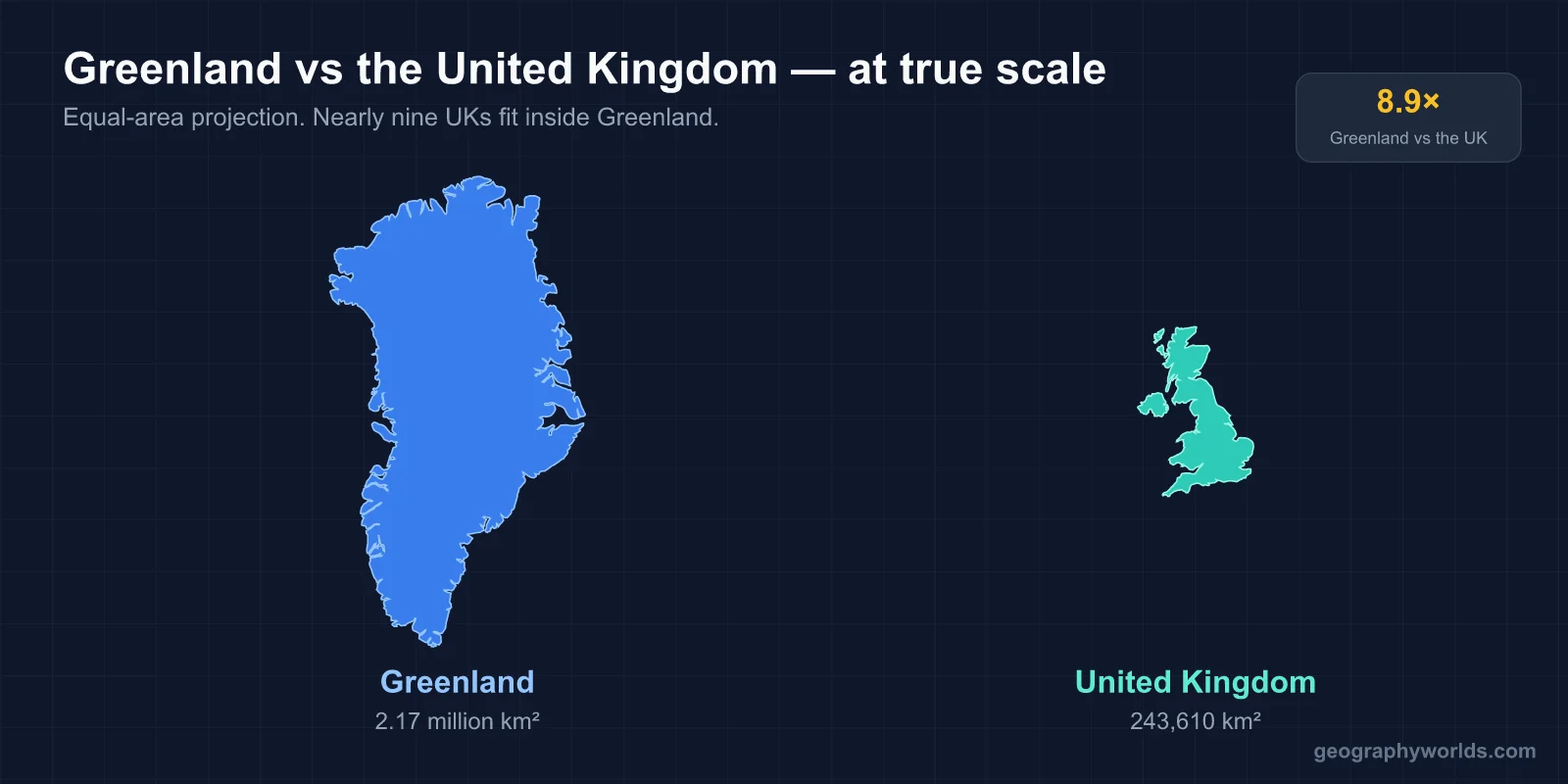
Greenland and the UK are both significant land masses on the European side of the Atlantic — Greenland a vast Arctic island, the UK a much smaller but vastly more populous archipelago. So which is bigger?
The Short Answer
Yes, Greenland is much bigger than the UK. Greenland covers 2,166,086 km². The UK covers 243,610 km². Greenland is approximately 8.89 times the size of the UK — about 9 times larger.
Side-by-Side Numbers
- Greenland area: 2,166,086 km² (836,330 sq mi)
- UK area: 243,610 km² (94,058 sq mi)
- Difference: Greenland is ~1,922,000 km² larger
- Ratio: Greenland is ~8.89× the size of the UK
- Greenland population: ~56,000
- UK population: ~67 million
Greenland
Greenland is the world's largest island, an autonomous territory of the Kingdom of Denmark located in the North Atlantic and Arctic Oceans between Iceland and Canada. About 80% of Greenland is covered by an ice sheet — the second-largest body of ice on Earth — up to 3 km thick. The ice-free coastal regions support about 56,000 people, almost all of whom are Inuit or of mixed Inuit-Danish ancestry.
Greenland is highly autonomous within the Kingdom of Denmark, with its own government, parliament (the Inatsisartut), and significant control over its own affairs. Denmark retains responsibility for foreign affairs and defense. Nuuk, the capital, has about 19,000 residents. The territory is strategically important due to its Arctic position, mineral wealth (rare earth elements, gold, uranium), and proximity to North America.
The United Kingdom
The United Kingdom of Great Britain and Northern Ireland comprises four constituent countries: England (the largest and most populous), Scotland, Wales, and Northern Ireland. England, Scotland, and Wales share the island of Great Britain; Northern Ireland sits on the island of Ireland alongside the Republic of Ireland. The UK has about 12,500 km of coastline and includes numerous smaller islands.
The UK has about 67 million people, with London (about 9 million in the city, 14 million in the metro area) as the dominant city. The country is one of the world's six largest economies and a permanent UN Security Council member. It left the European Union in 2020.
Population Density Gap
The contrast is dramatic. The UK has about 281 people per km² — high for Europe. Greenland has about 0.026 per km² — one of the lowest of any inhabited territory on Earth. The UK has 1,200 times more people than Greenland packed into 11% of the area. Each square kilometer of the UK supports roughly 10,800 times more people than each square kilometer of Greenland.
Climate Contrast
Greenland's climate is Arctic to subarctic. The far north has true polar conditions with permanent ice and minimal summer warming. The southern tip has a subarctic climate with relatively mild summers. The ice-free coastal regions support some vegetation, traditional Inuit communities, fishing, and limited agriculture. The UK has a temperate maritime climate moderated by the Gulf Stream. Summers are mild, winters are cool but rarely severe. Snow is occasional except in the Scottish Highlands and the Pennines.
Economy
The UK has the world's 6th largest economy at roughly $3.3 trillion. Major industries include financial services (London is one of the world's leading financial centers), professional services, aerospace, pharmaceuticals, the creative industries, and education. Greenland has a much smaller economy at about $3.2 billion — about 0.1% the size of the UK's. Fishing accounts for about 90% of Greenland's exports, with growing interest in mining and tourism. Denmark provides an annual block grant of about $500 million to support Greenland's budget.
History
Greenland was first settled by Indigenous peoples (the Saqqaq, Dorset, and ultimately Thule, ancestors of modern Inuit) starting around 4,500 years ago. Norse Vikings under Erik the Red established settlements around 985 CE, with up to several thousand Norse Greenlanders at peak; these settlements mysteriously vanished by the 15th century. Denmark colonized Greenland in 1721. The territory gained home rule in 1979 and full self-government in 2009.
The UK has shaped global history more than nearly any nation. The British Empire became the largest in history at its 1922 peak, covering nearly a quarter of the world's land and population. Most of the empire was dismantled in the 20th century. In 2020, the UK formally left the European Union ("Brexit").
Geographic Features
Greenland is overwhelmingly defined by its ice sheet. The Greenland Ice Sheet covers about 80% of the island and contains an estimated 2.85 million km³ of ice — enough to raise global sea levels by 7.2 m if it all melted. The ice-free coastal strip is mountainous, with fjords, glaciers, and dramatic landscapes. Greenland's highest point is Gunnbjørn Fjeld (3,694 m). The UK is generally low to gently rolling. Ben Nevis in Scotland is the highest peak at 1,345 m. England has the most varied terrain among the constituent countries, with the Lake District, the Pennines, the Cotswolds, and the South Downs. Scotland has the Highlands and the Cairngorms; Wales has Snowdonia.
Strategic Importance
Both have strategic geography. Greenland sits at the crossroads of the Arctic, with key military and surveillance value. The US Pituffik Space Base has operated there since 1951. As Arctic ice retreats, new shipping lanes and resource extraction opportunities open up — making Greenland increasingly contested. The UK is a permanent UN Security Council member, a nuclear power, a major NATO member, and one of the most influential nations globally. London is a global financial center alongside New York.
Tourism
Both are growing tourism destinations. Greenland welcomes about 100,000 international visitors per year, drawn by glaciers, fjords, the Northern Lights, dog sledding, kayaking, and Inuit cultural experiences. The UK welcomes about 38 million international visitors per year — about 380 times more than Greenland, making the UK one of the most-visited countries in the world. Top UK attractions include London, Edinburgh, Stonehenge, Bath, Oxford, Cambridge, and the Lake District.
Cultural Influence
The UK has had enormous global cultural influence — through the English language, literature (Shakespeare, Austen, Dickens, Tolkien, Rowling), music (the Beatles, Queen, the Rolling Stones), film and television, and the legacy of the British Empire. Greenland's cultural influence is smaller but distinctive — Inuit traditions, contemporary art, and increasing media presence give the territory a global identity beyond its small population.
Climate Change Frontline
Greenland is at the front line of climate change. The ice sheet is losing approximately 270 gigatons of ice per year on average, and the rate is accelerating. Major events like the 2019 surface melt that covered 56% of the ice sheet, and the 2022 collapse of huge ice shelves in northwestern Greenland, illustrate the speed of change. The UK faces climate change pressures too — rising sea levels threatening eastern and southeastern coasts, more frequent flooding, hotter and drier summers, and changes in agriculture. The UK has set ambitious climate targets (net-zero by 2050) and has made significant progress, particularly through offshore wind and grid decarbonization.
Key Facts
- Greenland is about 9× larger than the UK by area.
- The UK has 1,200× more people than Greenland.
- Greenland is the world's largest island.
- The UK is the world's 6th largest economy.
- About 80% of Greenland is ice-covered.
Fun Facts
- Greenland's population is about 56,000 — fewer than most UK small towns.
- The UK's longest river (the Severn) is shorter than Greenland's longest fjord (the Scoresby Sound).
- Greenland's ice sheet contains enough water to flood every UK coastal city.
- The UK has more castles than any country its size.
- Greenland left the EU in 1985 — the only territory to do so before the UK's 2020 Brexit.
- The UK has nuclear weapons; Greenland is a US ally with no military of its own.
- Greenland gained home rule in 1979 and full self-government in 2009.
- The UK leaves the EU in 2020 — Brexit — making it the only major member to ever leave.
- Greenland's capital Nuuk has fewer people than most English market towns.
- The UK has more universities than Greenland has towns.
- Greenland's ice retreat is opening new shipping routes and resource access.
- The UK is a permanent UN Security Council member; Greenland has no UN seat.
- Both Greenland and the UK are surrounded by the Atlantic but in radically different climate zones.
The Bottom Line
Greenland is much larger than the UK — about 9 times larger by area. But the UK has 1,200 times more people, dramatically more economic activity, and far greater global influence. The comparison shows how much human civilization depends on more than just land area: the UK has built a global cultural and economic legacy on an area that would fit 9 times into Greenland's mostly empty ice.
Quiz Atlantic Geography!
Test your knowledge of Greenland, the UK, and Atlantic geography.
Play Geography Games →