
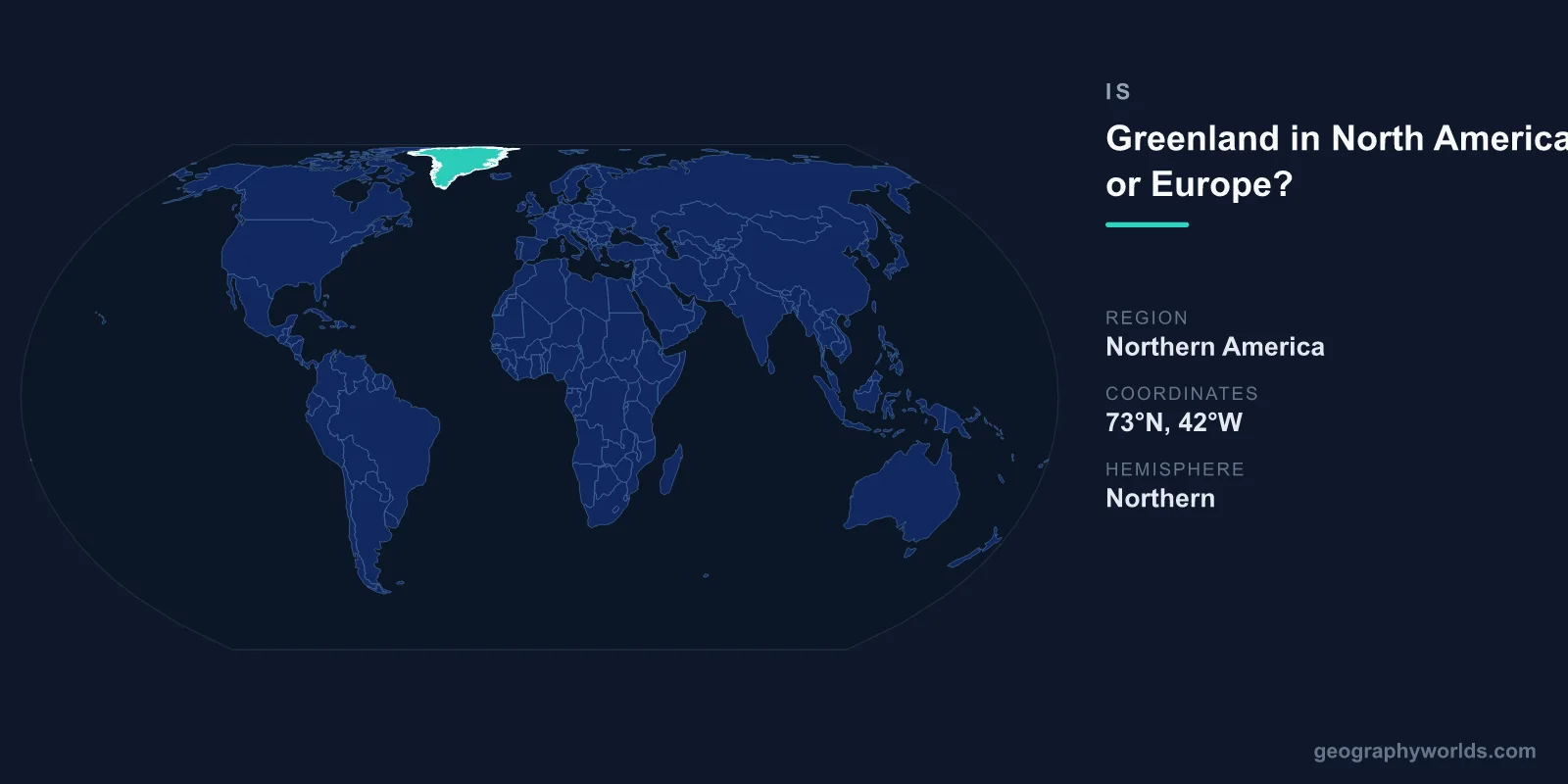
Greenland is part of the North American continent, even though it is politically an autonomous territory of the European kingdom of Denmark. In other words, the answer depends on whether you mean geography or politics: geographically Greenland belongs to North America, but its government, currency, and history tie it firmly to Europe. That split is exactly why the question comes up so often.
The Short Answer: Geographically North America, Politically European
Greenland sits on the North American tectonic plate and lies just northeast of Canada's Arctic islands, so physical geographers place it within North America. Yet it has been governed from Copenhagen for centuries and remains a self-governing part of the Kingdom of Denmark. This is the heart of the confusion: a piece of North American land that is administered by, and culturally linked to, a Scandinavian European nation. Both statements are correct, just in different senses.
Why Greenland Belongs to North America
The case for North America is geological and geographical. Greenland rests on the same continental shelf as Canada, separated from Ellesmere Island by the Nares Strait, which narrows to only about 26 kilometres at its tightest point. You could almost see one landmass from the other on a clear day. The island lies between the Arctic and Atlantic Oceans and is the world's largest island, covering roughly 2,166,086 square kilometres.
Human geography reinforces the link. Greenland's Indigenous Inuit majority shares ancestry, language roots, and cultural traditions with the Inuit of Arctic Canada and Alaska. Their forebears crossed from North America, not from Europe, making the population part of a circumpolar North American Indigenous world. By contrast, mainland Europe lies far to the east across the open North Atlantic.
Why People Think Greenland Is European
The European association is real, just not geographic. Norse settlers led by Erik the Red arrived from Iceland and Scandinavia around 985 AD, and the island later came under the Danish-Norwegian crown. Today Greenland remains an autonomous territory of Denmark, a member of the European Union's wider neighbourhood. Greenlanders are Danish nationals, the official currency is the Danish krone, and Danish is widely spoken alongside the Indigenous Greenlandic language.
Maps add to the impression. On political world maps Greenland is often shaded the same colour as Denmark, grouping it visually with Europe. It was even part of the European Community from 1973 until it withdrew in 1985, the only territory ever to leave. All of this means that institutionally Greenland looks European, while physically it does not.
An Island of Ice and Ocean
Greenland's landscape underlines its Arctic, North American setting. About 80 percent of the island is buried beneath the Greenland Ice Sheet, the second-largest body of ice on Earth after Antarctica. This ice holds enough frozen water to raise global sea levels by roughly seven metres if it ever fully melted, which is why the island features so prominently in climate science.
Because the interior is locked in ice, almost everyone lives along the milder coasts, especially the southwest. The capital, Nuuk, sits on that southwestern shore and is home to a large share of the territory's population of around 56,000 people. With so few residents spread across such a vast area, Greenland is among the least densely populated places on the planet, a striking contrast to crowded European nations.
Continent Versus Country: Clearing Up the Confusion
It helps to separate two questions. "What continent is Greenland on?" is a geographic question, and the answer is North America. "What country does Greenland belong to?" is a political question, and the answer is the Kingdom of Denmark. Greenland is not itself an independent country, though it has steadily gained self-rule, taking control of most domestic affairs while Denmark handles defence and foreign policy. Movements toward fuller independence continue to grow.
If you want to explore more about the Nordic nation that governs the island, see our denmark country guide for background on the wider kingdom.
Frequently Asked Questions
Is Greenland in North America or Europe?
Geographically, Greenland is in North America, as it sits on the North American plate next to Canada. Politically, it is an autonomous territory of Denmark, a European country, which is why people often associate it with Europe.
Is Greenland a country?
No, Greenland is not a fully independent country. It is a self-governing autonomous territory within the Kingdom of Denmark, with its own parliament and prime minister but still constitutionally part of Denmark.
How close is Greenland to Canada?
Very close. At the Nares Strait, Greenland lies only about 26 kilometres from Canada's Ellesmere Island, making Canada its nearest continental neighbour and reinforcing its North American geography.
Why is Greenland mostly ice if it is called "Greenland"?
Around 80 percent of the island is covered by the Greenland Ice Sheet. The "green" name is often attributed to Erik the Red, who reportedly chose an appealing name to attract Norse settlers to the harsh Arctic island.
