
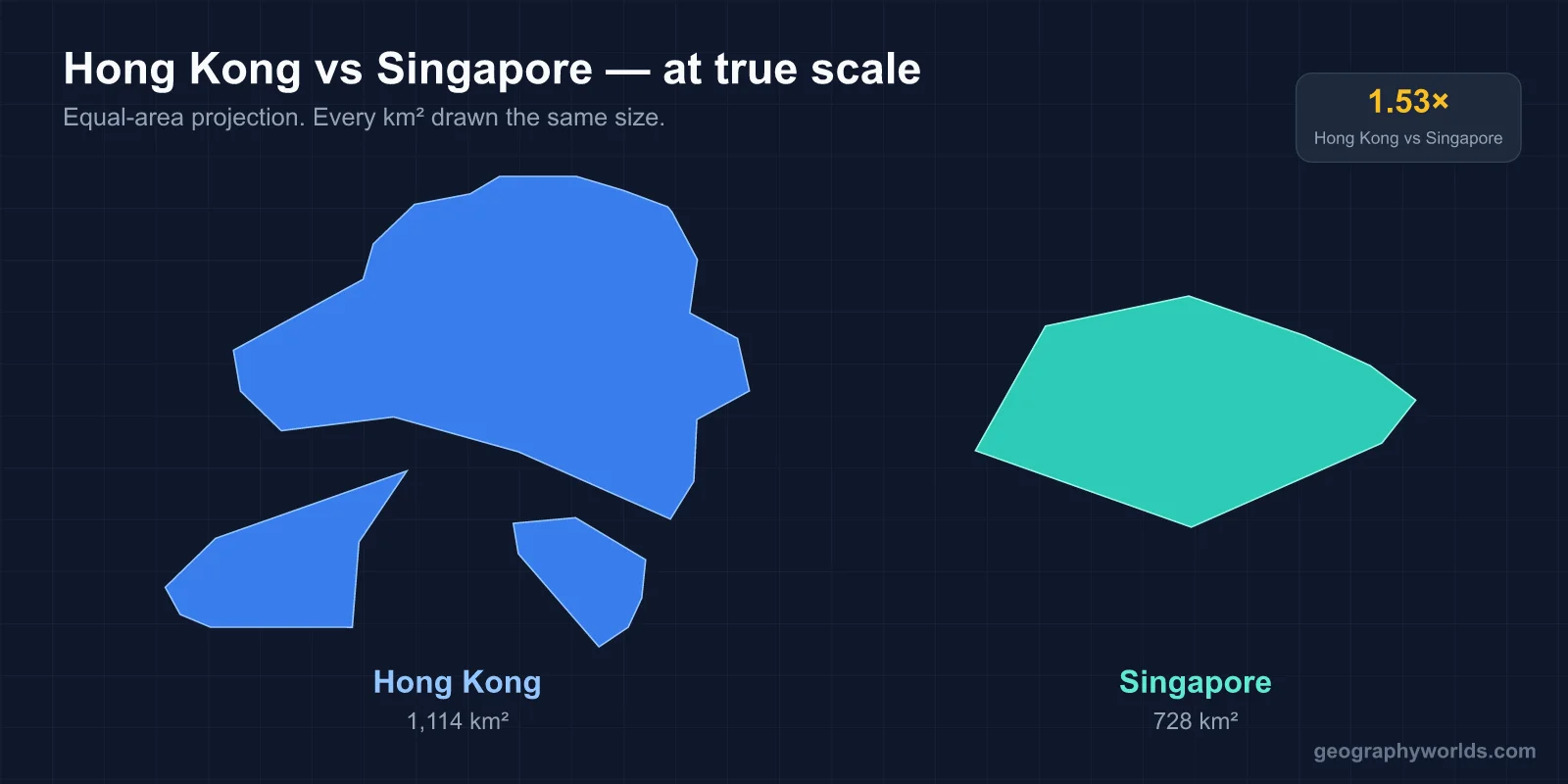
Yes. Hong Kong is larger than Singapore. Hong Kong covers 1,114 km², while Singapore covers 728 km². Hong Kong is about 1.53 times the size of Singapore — larger by 386 km², which is about the size of Andorra or Mauritius. Both are highly developed Asian city-states with similar populations and major global financial centers.
The Short Answer
Hong Kong and Singapore are two of the most globally influential city-states in Asia. They're both former British colonies turned global financial hubs, both with developed economies, both with significant Chinese populations, and both famous for their urban density and skyscrapers. Hong Kong is technically a Special Administrative Region of China rather than an independent country, while Singapore is a fully sovereign nation-state.
Hong Kong is bigger by area, but a lot of that extra land is mountainous and undeveloped — only about 25% of Hong Kong is built up. Singapore is smaller but uses more of its land for urbanization. Both have very high population densities and rank among the most expensive cities in the world.
The Real Numbers
- Hong Kong total area: 1,114 km² (430 sq mi)
- Singapore total area: 728 km² (281 sq mi)
- Difference: 386 km² — about the size of Andorra or Mauritius
- Ratio: Hong Kong is about 1.53× the size of Singapore
For global comparison: Hong Kong is roughly the size of Los Angeles county subdivisions or Greater Sydney. Singapore is about the same size as the City of Phoenix in Arizona, or twice the size of NYC's Manhattan plus Brooklyn combined.
Population
Both have similar populations, with Hong Kong slightly ahead:
- Hong Kong population: ~7,500,000
- Singapore population: ~5,900,000
- Hong Kong density: ~6,733 people per km²
- Singapore density: ~8,105 people per km²
Hong Kong has about 27% more people than Singapore. But Singapore is denser on average because it uses more of its small land area for residential development. Hong Kong's real density (in built-up areas like Kowloon) is among the highest in the world — Mong Kok has neighborhoods with over 130,000 people per km².
Land Use
Hong Kong's 1,114 km² is highly varied:
- Built-up areas: ~25%
- Country parks and protected areas: ~40%
- Other green spaces: ~35%
- Highest point: Tai Mo Shan (957 m)
About 75% of Hong Kong is undeveloped — mostly because the terrain is too mountainous for easy construction. The territory includes Hong Kong Island, Kowloon, the New Territories, and over 200 outlying islands. Hong Kong is famous for the contrast between its dense urban core and the relatively wild country parks just minutes from downtown.
Singapore's 728 km² is more thoroughly developed:
- Built-up areas: ~50%
- Industrial: ~10%
- Green spaces and parks: ~20%
- Water reservoirs: ~5%
- Highest point: Bukit Timah Hill (164 m)
Singapore has expanded its land area through reclamation — about 25% of Singapore's current land is reclaimed from the sea. The country has aggressive plans to continue land reclamation.
Economy
Both have major economies:
- Singapore GDP: ~$525 billion
- Hong Kong GDP: ~$405 billion
- Singapore per capita GDP: ~$89,000
- Hong Kong per capita GDP: ~$54,000
Singapore has a bigger economy in absolute terms and significantly higher per-capita GDP. Singapore is one of the wealthiest places in the world by GDP per capita — typically in the top 5 globally. Hong Kong is wealthy but less so than Singapore, and its economy has been affected by political tensions with China since 2019.
Both economies are heavily focused on financial services, shipping/logistics, and high-value services. Singapore is the world's 4th-largest financial center and home to the Singapore Exchange. Hong Kong is the world's 3rd-largest financial center and home to the Hong Kong Stock Exchange.
Political Status
Hong Kong is a Special Administrative Region (SAR) of the People's Republic of China. It was a British colony from 1842 (after the First Opium War) until 1997, when it was returned to Chinese sovereignty under the "one country, two systems" framework. Under this arrangement, Hong Kong was supposed to maintain its own legal system, capitalist economy, and "high degree of autonomy" for 50 years. Since 2020 (national security law) and 2021 (electoral reforms), Beijing has tightened control significantly, eroding many of the autonomies.
Singapore is a fully sovereign island nation. It was a British colony from 1819 (founded by Stamford Raffles) until 1959, when it gained self-government. Singapore briefly joined Malaysia in 1963 but separated in 1965 to become an independent country. Today Singapore is a parliamentary republic, dominant party (People's Action Party) has been in continuous government since 1959.
Transportation
Both cities are famous for excellent public transport. Hong Kong's MTR (Mass Transit Railway) is one of the world's most efficient subway systems — it covers about 220 km with 99 stations, carries 5 million riders daily, and reportedly runs at a 99.9% on-time rate. The MTR even operates profitably (unusual for a metro).
Singapore's MRT (Mass Rapid Transit) covers about 230 km with 134 stations, carrying about 3 million riders daily. Both systems are clean, fast, and integrated with bus networks. Singapore is famous for its electronic road pricing (ERP) system, which charges drivers to enter downtown during peak hours — pioneering modern urban congestion pricing.
Climate
Both cities have similar tropical/subtropical climates but with key differences. Singapore sits just 137 km north of the equator and has a true equatorial climate — hot and humid year-round, with no real seasons. Temperatures stay between 25-32°C virtually every day, and rain falls about 170 days per year. Singapore's climate is famously consistent and famously sticky.
Hong Kong, further north at 22°N, has a humid subtropical climate. It has more pronounced seasons: hot humid summers (28-32°C, June-September) and cool dry winters (10-20°C, December-February). Hong Kong's typhoon season runs from May to November, with major storms occasionally hitting the city. Singapore is south of the typhoon belt and rarely experiences cyclones.
Demographics and Languages
Hong Kong is about 92% ethnic Chinese, with significant Filipino, Indonesian, and South Asian minorities (mostly migrant workers). Cantonese is the dominant local language; Mandarin and English are also official and widely spoken in business.
Singapore is more diverse — about 74% ethnic Chinese, 13% Malay, 9% Indian, 4% other. Four official languages: English (main working language), Mandarin Chinese, Malay (national language for ceremonial purposes), and Tamil. Most Singaporeans are multilingual.
Tourism and Culture
Hong Kong is known for its skyline, dim sum and Cantonese cuisine, Disneyland, Ocean Park, the Peak (Victoria Peak), Lan Kwai Fong nightlife, the Star Ferry across Victoria Harbour, and shopping. Hong Kong receives about 50-60 million tourists annually (pre-2019; numbers dropped during political tensions and the pandemic).
Singapore is known for Marina Bay Sands (with its iconic infinity pool on the roof), Gardens by the Bay (with the supertree grove), the Universal Studios theme park, Sentosa island, Chinatown and Little India, hawker food, and shopping along Orchard Road. Singapore receives about 19 million tourists annually.
Key Facts
- Hong Kong is about 1.53× the size of Singapore.
- Hong Kong has 27% more people than Singapore.
- Both are major global financial centers (Hong Kong 3rd, Singapore 4th).
- Singapore is wealthier per capita than Hong Kong (~$89K vs ~$54K).
- Hong Kong is part of China; Singapore is fully independent.
Fun Facts
- Singapore has more golf courses per square kilometer than any other country.
- Hong Kong has more skyscrapers (above 150m) than any other city in the world — over 350.
- Both cities are nearly entirely smoke-free in public places, with strict anti-littering laws.
- Singapore famously banned chewing gum imports in 1992 (you can buy it for medical use only).
- Hong Kong's name comes from "Heung Gong" meaning "fragrant harbor" in Cantonese.
- Singapore is so small that you could drive across it in less than an hour on a clear day.
- Both cities have famous nighttime light shows — Hong Kong's "Symphony of Lights" runs nightly along Victoria Harbour, and Singapore's Marina Bay area has the "Spectra" light and water show.
The Bottom Line
Hong Kong is bigger than Singapore by area — 53% larger — but Singapore is wealthier per capita and has a more efficient land use pattern. Both are top-tier Asian city-states, global financial centers, and remarkable examples of high-density urban development. Hong Kong has more population and more land; Singapore has more wealth per person and more carefully managed urbanization.
The comparison highlights how similar these two places are despite their different political situations. Both started as British colonial trading ports, both grew into financial giants, and both today represent the cutting edge of urban Asian development.