

Yes. K2 is slightly taller than Kangchenjunga. K2's summit reaches 8,611 m (28,251 ft), while Kangchenjunga reaches 8,586 m (28,169 ft). K2 is only 25 m (82 ft) taller — about the height of a 7-story building. K2 ranks as the 2nd-highest mountain in the world; Kangchenjunga is 3rd.
The Short Answer
The world's three highest mountains — Everest, K2, and Kangchenjunga — are all over 8,500 m and concentrated in the Himalaya-Karakoram region of Asia. The gap between Everest (8,849 m) and K2 (8,611 m) is 238 m. The gap between K2 and Kangchenjunga is just 25 m. After Kangchenjunga, the next-highest mountain (Lhotse at 8,516 m) is 70 m shorter. So K2 and Kangchenjunga sit in a very close 2nd-3rd cluster, far from both the runaway leader (Everest) and the 4th-place peak.
K2 sits in the Karakoram range on the China-Pakistan border. Kangchenjunga sits in the eastern Himalayas on the India-Nepal border. They're about 1,300 km apart and were once each considered the "world's highest mountain" before Everest was properly surveyed in 1856.
The Real Numbers
- K2: 8,611 m (28,251 ft)
- Kangchenjunga: 8,586 m (28,169 ft)
- Difference: 25 m (82 ft)
- Ratio: K2 is about 1.003× the height of Kangchenjunga
For perspective, 25 m is the height of a typical 7-8 story apartment building. The two mountains are essentially tied in height at any practical scale, but the world's mountain rankings care about every meter.
K2
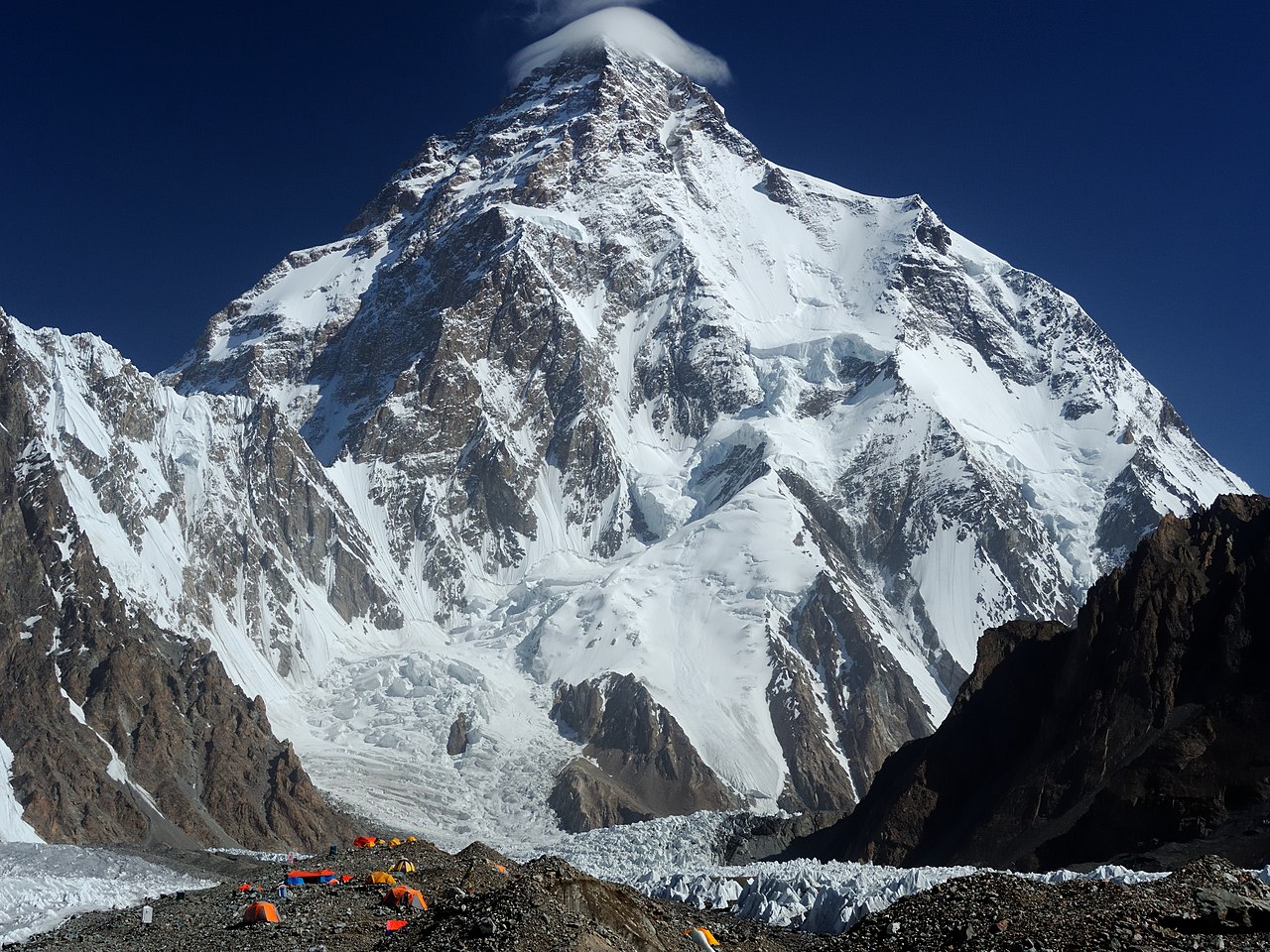
K2 (also called Mount Godwin-Austen and Chhogori in Balti language) sits on the China-Pakistan border in the Karakoram range. It rises from the Baltoro Glacier and is part of a cluster of 8,000-m peaks including Broad Peak, Gasherbrum I, and Gasherbrum II.
K2 has a reputation as the most dangerous and technically difficult 8,000-m peak. Its nickname "the Savage Mountain" comes from its steep, sustained technical climbing, severe storms, and history of disasters. As of 2024, about 600 people have summited K2 — fewer than any other 8,000-m peak. The historical death rate is around 25% (1 climber dies for every 4 who summit), making it one of the deadliest mountains in the world.
K2 was first summited on July 31, 1954, by Italians Achille Compagnoni and Lino Lacedelli. The mountain was first climbed in winter only in January 2021, when a Nepali team made the historic ascent — making K2 the last 8,000-m peak to be climbed in winter.
Kangchenjunga
Kangchenjunga ("Five Treasures of the Snow" in Tibetan) sits on the India-Nepal border in the eastern Himalayas. The mountain has five peaks, the highest of which is the main summit at 8,586 m. The other peaks (West, South, Yalung Kang, Kangbachen) all exceed 8,400 m.
From 1838 to 1856, Kangchenjunga was thought to be the world's highest mountain. Surveys in 1849-1850 challenged this and identified what would later be named Mount Everest as higher. By 1856, official surveys had established Everest as #1, K2 as #2, and Kangchenjunga as #3.
Kangchenjunga was first summited on May 25, 1955, by British climbers Joe Brown and George Band. Following the wishes of the local Sikkimese people, the first climbers stopped just below the actual summit out of respect for the mountain's sacred status. This tradition continues — most climbers stop about 1.5 m below the actual summit. About 280 people have summited Kangchenjunga as of 2024.
Climbing Difficulty
Both mountains are extremely difficult — they're both in the top 5 deadliest 8,000-m peaks. But their challenges differ:
K2 Climbing
- Difficulty: Highest technical difficulty of any 8,000-m peak
- Standard route: Abruzzi Spur (Pakistan side)
- Bottleneck: A famous narrow couloir below the summit, prone to ice avalanches
- Weather: Karakoram storms can arrive with little warning
- Summit count: ~600
- Historical death rate: ~25%
Kangchenjunga Climbing
- Difficulty: Very high — comparable to K2 in technical demands
- Standard route: Southwest face from Nepal
- Avalanche risk: Very high — Kangchenjunga has steep snow slopes prone to slides
- Weather: Monsoon-influenced, with severe storms
- Summit count: ~280
- Historical death rate: ~20%
K2 has more summits but is generally considered slightly harder due to sustained technical climbing on its standard routes. Kangchenjunga has fewer summits but a similarly high death rate.
Cultural Significance
Both mountains are sacred to local peoples. K2's local Balti name is Chhogori ("Big Mountain"). The mountain doesn't have the centuries of cultural significance that Kangchenjunga does — partly because K2 is in a remote, sparsely populated region.
Kangchenjunga is far more culturally significant. It's the highest mountain in Sikkim (an Indian state) and a sacred mountain in Sikkimese, Tibetan, and Hindu traditions. The mountain's name refers to five treasures (gold, silver, jewels, sacred scriptures, weapons) said to be hidden in its peaks. The Sikkimese have traditionally requested that climbers stop just below the summit to respect the mountain's sanctity — a practice still followed.
Geography and Access
K2 is in one of the most remote and difficult-to-access regions in the world. Reaching K2 base camp requires a 7-10 day trek from Askole, Pakistan, through the Baltoro Glacier. There are no roads near the mountain. The Pakistani route from the south is most commonly used; the Chinese route from the north is much more difficult and less developed.
Kangchenjunga is also remote but somewhat more accessible. Climbers approach from Nepal's northeastern border, with trekking routes from the towns of Taplejung or Lukla. The Indian (Sikkim) side has been closed to mountaineers since 2000 to preserve the mountain's sacred status, so all climbing now happens from Nepal.
The 8,000-Meter Peaks
There are exactly 14 mountains in the world over 8,000 m — all in the Himalaya-Karakoram region. K2 and Kangchenjunga are 2nd and 3rd in this elite club. Here's the list:
- Everest (8,849 m) — Nepal/China
- K2 (8,611 m) — Pakistan/China
- Kangchenjunga (8,586 m) — Nepal/India
- Lhotse (8,516 m) — Nepal/China
- Makalu (8,485 m) — Nepal/China
- Cho Oyu (8,188 m) — Nepal/China
- Dhaulagiri I (8,167 m) — Nepal
- Manaslu (8,163 m) — Nepal
- Nanga Parbat (8,126 m) — Pakistan
- Annapurna I (8,091 m) — Nepal
- Gasherbrum I (8,080 m) — Pakistan/China
- Broad Peak (8,051 m) — Pakistan/China
- Gasherbrum II (8,035 m) — Pakistan/China
- Shishapangma (8,027 m) — China
K2 and Kangchenjunga are separated by 25 m. The next gap (Kangchenjunga to Lhotse) is 70 m. After that the gaps shrink to 30 m or less for several peaks.
Key Facts
- K2 is 25 m taller than Kangchenjunga.
- K2 is the 2nd-highest mountain in the world; Kangchenjunga is 3rd.
- About 600 people have summited K2; about 280 have summited Kangchenjunga.
- Both have death rates of 20-25% historically.
- K2 was first climbed in 1954; Kangchenjunga in 1955.
Fun Facts
- Kangchenjunga was once considered the world's highest mountain (1838-1856) before Everest was properly surveyed.
- K2 takes its name from "Karakoram-2" — the second peak surveyed in the Karakoram range by 19th-century British mappers.
- Most Kangchenjunga summiteers stop 1.5 m below the actual summit out of respect for local religious traditions.
- K2 has been climbed in winter only once (January 2021); Kangchenjunga has been climbed in winter only twice.
- Both mountains have alternate "geographic prominence" measurements that put them in different rankings than absolute height.
Climate and Weather Patterns
The two mountains experience different weather patterns despite both being in the high Himalayas. K2 sits in the Karakoram, which has a more continental climate with less monsoon influence than the Himalayas proper. K2's climbing season is concentrated in June-August, when storms are slightly less frequent. But the Karakoram's isolation creates locally severe weather — storms can form quickly without much warning.
Kangchenjunga, further east in the Himalayas, is heavily influenced by the South Asian monsoon. Heavy snowfall from monsoon-driven storms (June-September) makes summer climbing dangerous; most attempts are pre-monsoon (April-May) or post-monsoon (October-November). Avalanches are a primary cause of fatalities on Kangchenjunga, more so than on K2 where falls and altitude sickness dominate the death statistics.
The Bottom Line
K2 is taller than Kangchenjunga by just 25 meters — a tiny margin in absolute terms but enough to give K2 the #2 spot in world mountain rankings. K2 is widely considered the more technically demanding climb. Kangchenjunga has greater cultural significance to the local peoples and a longer history as a "world's highest" candidate. Both are top-tier mountaineering objectives, with histories of brutal accidents and elite achievements.
For mountaineers, the small height difference doesn't matter much — both are deadly high-altitude technical climbs. For trivia and rankings, K2 holds the #2 spot, and Kangchenjunga the #3.