
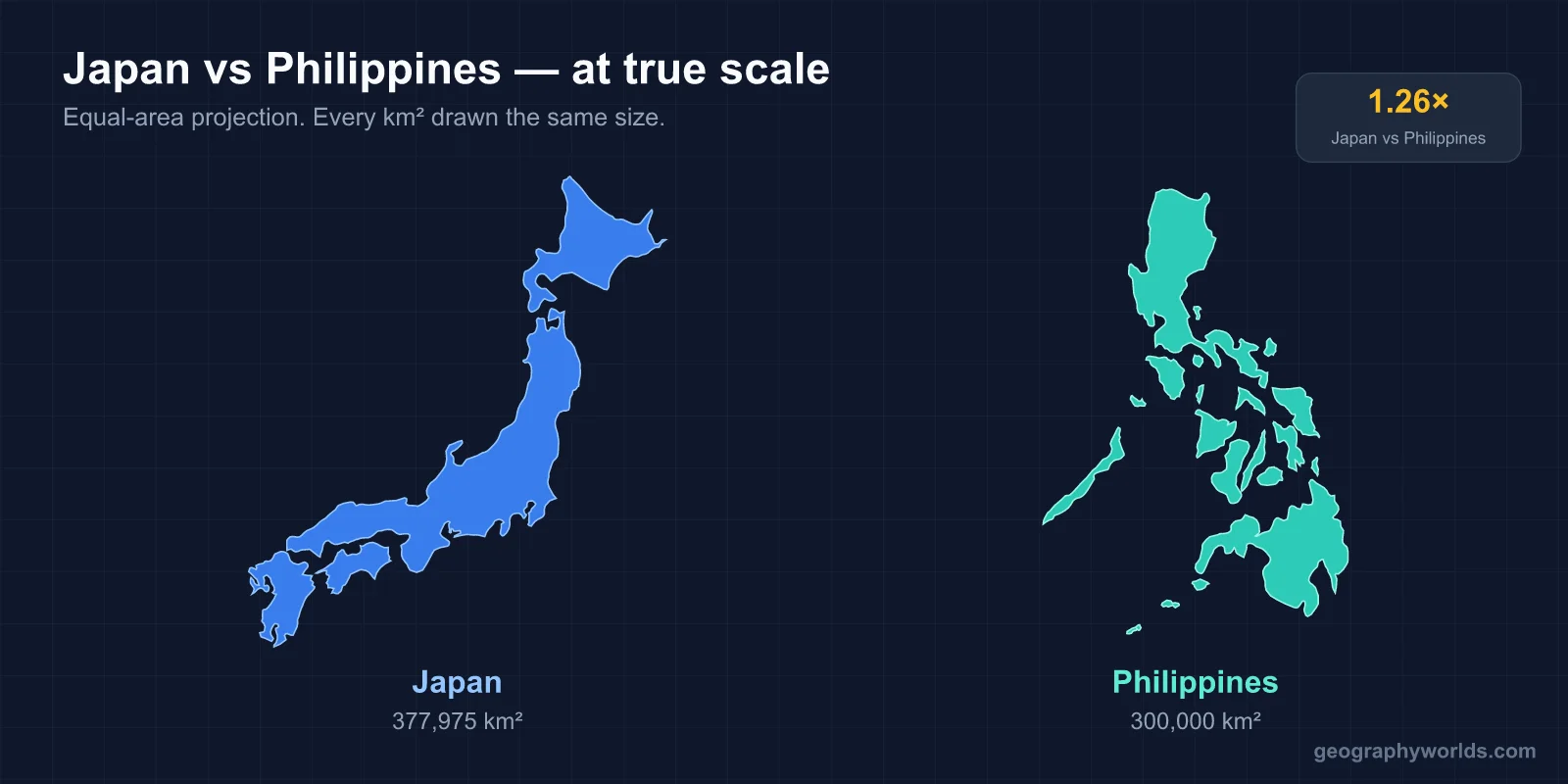
Japan and the Philippines are two of East Asia's most distinctive island nations. Both are archipelagos with thousands of islands, both sit on the Pacific Ring of Fire, and both have major cultural and economic influence in the region. So which one is bigger?
The Short Answer
Yes, Japan is bigger than the Philippines. Japan covers 377,975 km². The Philippines covers 300,000 km². Japan is approximately 26% larger than the Philippines.
Side-by-Side Numbers
- Japan area: 377,975 km² (145,937 sq mi)
- Philippines area: 300,000 km² (115,831 sq mi)
- Difference: Japan is ~78,000 km² larger
- Ratio: Japan is ~1.26× the size of the Philippines
- Japan population: ~123 million
- Philippines population: ~115 million
Japan
Japan is an East Asian island nation in the Pacific Ocean, off the coasts of China, Korea, and Russia. It consists of about 14,125 islands, with the four main ones — Honshu, Hokkaido, Kyushu, and Shikoku — accounting for the vast majority of the land area. Japan stretches about 3,000 km from Hokkaido in the north to Okinawa in the south.
Japan sits on the convergence of four tectonic plates, making it one of the most seismically and volcanically active places on Earth. About 73% of the country is mountainous, with most of the population concentrated in narrow coastal plains. Tokyo's metro area, with 37+ million people, is the largest urban area in the world. Other major cities include Yokohama, Osaka, Nagoya, Sapporo, and Fukuoka.
The Philippines
The Philippines is a Southeast Asian archipelago consisting of about 7,641 islands (the official count varies). The country is located between the Philippine Sea (east), the South China Sea (west), the Celebes Sea (south), and the Luzon Strait (north, separating it from Taiwan). The Philippines is divided into three major island groups: Luzon in the north (the largest island, containing Manila), Visayas in the central region, and Mindanao in the south.
Manila, the capital, has about 13 million in its metro area, making it one of the most densely populated cities in the world. Other major cities include Cebu, Davao, Quezon City (technically the largest city by population in the country), and Baguio. The Philippines has a population of about 115 million people, making it the 12th most populous country in the world. The country gained independence from the United States in 1946, after Spanish colonial rule (1565–1898) and American rule (1898–1946).
Population Density
Both countries are densely populated, but the Philippines is denser per square kilometer. Japan has about 325 per km²; the Philippines has about 383 per km². However, Japan's population is concentrated in narrow coastal plains (about 73% of the country is mountainous), so the inhabited areas are even denser than the average suggests. The Philippines' population is spread across many islands, with major concentrations in Luzon (especially Metro Manila) and Cebu.
Climate
Japan spans subarctic in Hokkaido to subtropical in Okinawa. Most of Honshu has a humid subtropical climate with four distinct seasons. The Sea of Japan coast gets heavy winter snow due to cold Siberian air picking up moisture over the relatively warm sea. Typhoons strike Japan from late summer through early fall.
The Philippines has a tropical climate. The country experiences three seasons: hot dry (March–May), rainy (June–October), and cool dry (November–February). The Philippines is one of the most typhoon-prone countries on Earth, with an average of 20 typhoons making landfall each year, many causing significant damage. Climate change is making typhoons stronger and increasing rainfall extremes.
Economy
Japan has the world's 4th largest economy at about $4.2 trillion GDP, dominated by manufacturing, robotics, automobiles, electronics, and increasingly services. Japan has been a global economic powerhouse since the 1960s. The Philippines has the 36th largest economy at about $440 billion GDP. The economy is growing rapidly and is dominated by services (especially business process outsourcing, the second-largest BPO industry in the world), agriculture (rice, sugar, coconut, banana), manufacturing (electronics, automotive parts), and remittances from the about 10 million Filipinos working overseas.
Volcanoes and Earthquakes
Both countries are extremely seismically and volcanically active. Japan has about 110 active volcanoes, including Mount Fuji (3,776 m, dormant since 1707), Sakurajima in Kyushu (which erupts almost daily), and Asama. Earthquakes are frequent — about 1,500 a year are felt — and devastating major events occur regularly (2011 Tōhoku M9.0 earthquake and tsunami killed 18,000+ people). The Philippines has about 24 active volcanoes, including Mayon (a near-perfect cone), Pinatubo (whose 1991 eruption was one of the largest of the 20th century), and Taal (which erupts unpredictably from a lake). Major earthquakes include the 2013 Bohol earthquake and the 1990 Luzon earthquake.
Cultural Influence
Both countries have outsized cultural influence relative to their size. Japan has shaped global pop culture through anime, manga, video games (Nintendo, Sony PlayStation, Sega), J-pop, traditional arts (tea ceremony, ikebana, calligraphy), cuisine (sushi, ramen, sake have spread globally), and martial arts. Japanese aesthetic principles have influenced design worldwide. The Philippines has shaped global culture through music (the Philippines is sometimes called the world capital of karaoke, and Filipino musicians dominate hotel and cruise ship entertainment globally), film, basketball culture (the Philippines is one of the most basketball-obsessed countries on Earth), and an enormous diaspora that has spread Filipino culture across the world.
Religion
Japan is a complex mixture of Shinto, Buddhism, and secular life. Most Japanese practice elements of both Shinto and Buddhism but do not strongly identify with either as their primary religion. The Philippines is overwhelmingly Roman Catholic (about 80% of the population), making it the only Catholic-majority country in Asia along with East Timor. The country also has significant Muslim minorities, especially in Mindanao and the southwest, where Islam has been present for centuries (preceding Spanish colonization).
Diaspora
Both countries have significant diasporas, but the Philippines has a much larger one relative to its population. About 10 million Filipinos work or live abroad — about 9% of the country's population — sending home approximately $36 billion in remittances annually (about 9% of GDP). Filipino communities exist in essentially every country with major economies, with the largest groups in the United States, Saudi Arabia, the UAE, Canada, Japan, and Australia. Japan's diaspora is smaller but historically significant, especially in Brazil (the largest Japanese community outside Japan), the United States, and Peru.
Languages
Japanese is the only official language of Japan, spoken by virtually all 123 million residents. The language is unrelated to Chinese (despite sharing the kanji writing system) and is sometimes classified as a language isolate, though it may be related to Korean. The Philippines has two official languages: Filipino (a standardized version of Tagalog) and English. The country also has about 120–175 living languages, including major regional languages like Cebuano (Visayan), Ilocano, Hiligaynon, Bikol, and Waray. The widespread use of English (a legacy of US colonial rule from 1898 to 1946) makes the Philippines one of the largest English-speaking countries in the world by total speakers.
Tourism
Japan welcomes about 32 million international visitors per year (peak before the pandemic, recovering quickly). Top draws include Tokyo, Kyoto, Mount Fuji, Hiroshima, the bullet train experience, cherry blossom season, and pop culture districts like Akihabara. The Philippines welcomes about 6 million international visitors per year — far less than Japan but growing. Top destinations include Boracay, Palawan (consistently ranked among the world's best islands), Cebu and Bohol, El Nido, the Banaue Rice Terraces, and Manila's historic Intramuros district.
Key Facts
- Japan is about 26% larger than the Philippines by area.
- Both are East Asian archipelagos with thousands of islands.
- Both sit on the Pacific Ring of Fire.
- Japan has 123 million people; the Philippines has 115 million.
- The Philippines is the only majority-Catholic Asian country (along with East Timor).
Fun Facts
- Japan has about 14,125 islands; the Philippines has about 7,641.
- The Philippines is the world's top karaoke market.
- Both countries drive on different sides — Japan on the left, the Philippines on the right.
- About 10 million Filipinos work abroad.
- Japan's coast is one of the most disaster-prone in the world.
- The Philippines was named after Spanish King Philip II in 1543.
- Japan is the only country with a reigning emperor as head of state.
- Both nations are major manufacturers of electronics components.
The Bottom Line
Japan is larger than the Philippines — by about 26%. Both are densely populated, volcanically active, and disaster-prone island nations with major cultural influence. Japan is wealthier and older as a unified state; the Philippines is more religiously distinct and has a larger global diaspora. Both will continue to be central to East Asian and Pacific affairs.
Quiz Pacific Islands!
Test your knowledge of Japan, the Philippines, and great Pacific nations.
Play Geography Games →