
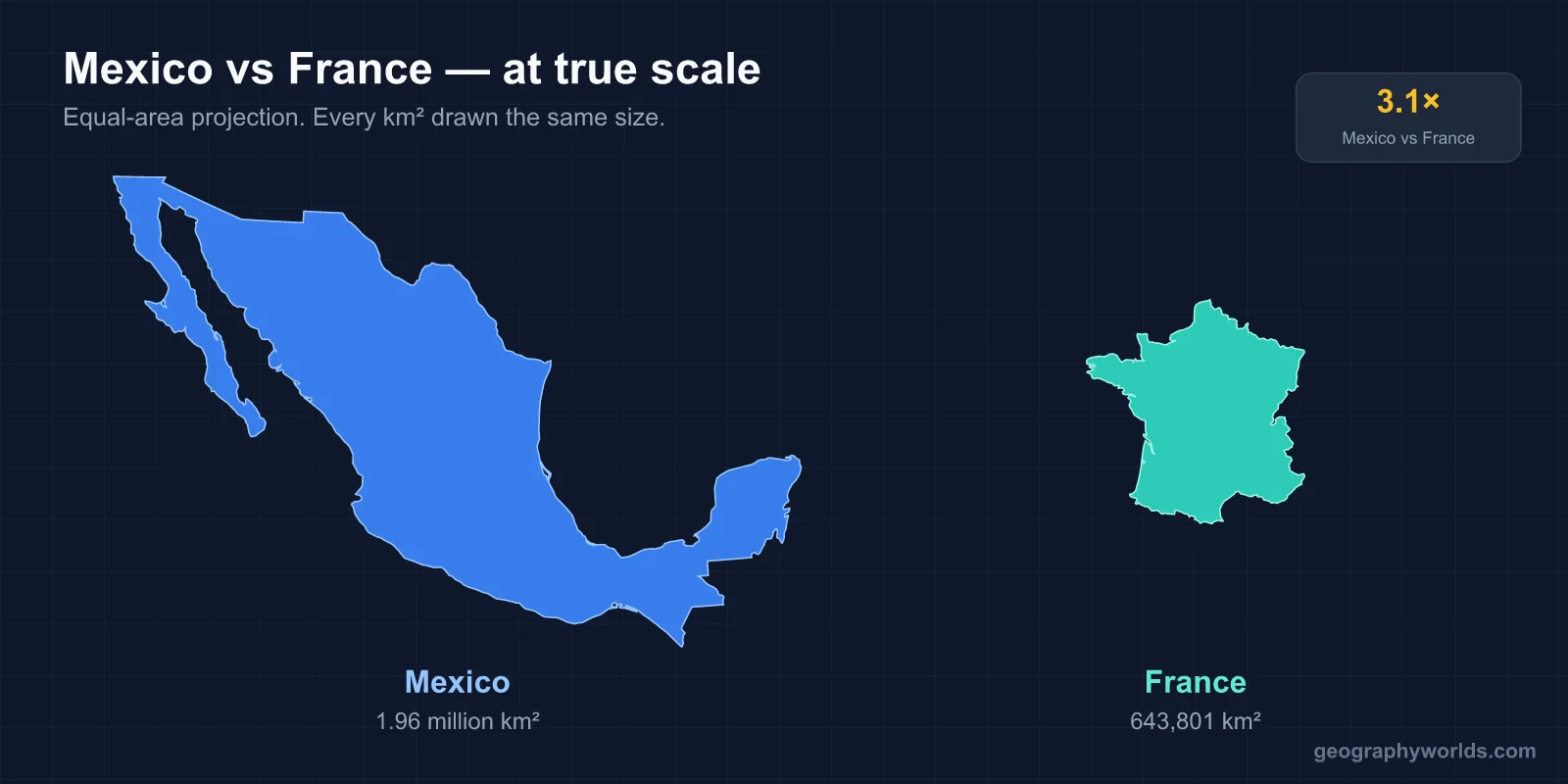
Yes. Mexico is significantly larger than France. Mexico covers 1,964,375 km², while metropolitan France covers 643,801 km². Mexico is about 3.05 times the size of France — large enough to fit three Frances inside its borders. But France has nearly the same population (68 million vs 130 million Mexicans), making France much more densely populated.
The Short Answer
Mexico is the 13th-largest country in the world; France is the 42nd by metropolitan area. The two countries are major regional cultural and economic powers — Mexico dominates Spanish-speaking North/Central America, France dominates Western Europe. Both have global influence well beyond their immediate neighbors.
Mexico is bigger by area, but France is much wealthier per capita and has a larger economy in absolute terms. Both countries have rich cultural heritages stretching back thousands of years and produce major exports in food, art, fashion, and ideas.

The Real Numbers
- Mexico total area: 1,964,375 km² (758,449 sq mi)
- France (metropolitan) area: 643,801 km² (248,573 sq mi)
- Difference: 1,320,574 km² — about the size of South Africa
- Ratio: Mexico is about 3.05× the size of France
Mexico is one of the 15 largest countries in the world. France is mid-sized globally — comparable to Spain, Sweden, or Iraq in size. The gap between them (about 1.3 million km²) is significant — larger than most countries in Europe or the Americas.
Population
Mexico has more people, but France has much higher density:
- Mexico population: ~130,000,000
- France population: ~68,000,000
- Mexico density: ~66 people per km²
- France density: ~106 people per km²
Mexico has about 91% more people than France. But France is about 60% more densely populated. France has its 68 million people spread relatively evenly across its territory; Mexico's 130 million people are concentrated in the central highlands (Mexico City and surrounding areas) and along the borders.
Geography
Mexico has diverse geography:
- Sierra Madre mountain ranges: Western, Eastern, and Southern — running parallel to the country's coasts
- Mexican Plateau: Central highlands at 1,200-2,400 m elevation, home to Mexico City
- Yucatán Peninsula: Tropical flat region with the famous Mayan archaeological sites
- Baja California: Long peninsula (1,247 km) along Mexico's western Pacific coast
- Sonoran and Chihuahuan deserts: Northern Mexican deserts
- Pacific and Atlantic coastlines: Plus Caribbean coast on Yucatán
- Volcanoes: Including Pico de Orizaba (5,636 m), Mexico's highest peak
France has its own geographic variety:
- The Alps: Including Mont Blanc (4,808 m)
- Pyrenees: Border with Spain
- Massif Central: Plateau in the south-central region
- Loire Valley: The "Garden of France" with castles
- Mediterranean and Atlantic coasts: Plus English Channel coast in the north
- Major rivers: Seine, Rhône, Loire, Garonne
Climate
Mexico has varied climate due to its geography. The north is mostly arid/desert. Central Mexico is temperate due to elevation. Southern Mexico is tropical. Coastal areas are hot and humid. The Yucatán has a wet tropical climate. Hurricane season hits the Atlantic and Caribbean coasts.
France has temperate climate dominant — oceanic in the west, continental in the east, Mediterranean in the south, alpine in the mountains. The country has all four seasons distinctly across most of its territory.
Economy
France has the larger economy:
- France GDP: ~$3.1 trillion
- Mexico GDP: ~$1.79 trillion
- France per capita GDP: ~$46,000
- Mexico per capita GDP: ~$13,800
France's economy is about 73% larger than Mexico's in absolute terms. Per capita, France is about 3.3× richer on average. France is the 7th-largest economy in the world; Mexico is the 15th. France has a highly developed, diversified economy. Mexico has been growing rapidly and is now a major manufacturing hub for North America, especially in automotive (about 25% of all cars sold in the US are made in Mexico).
History
Mexico has a complex history blending Mesoamerican (Aztec, Maya, Olmec, Toltec), Spanish colonial, and modern Mexican identities. The country gained independence from Spain in 1821 after a long war. Mexico lost about half its territory (including California, Arizona, New Mexico, Texas, Nevada, Utah, and parts of Colorado) to the United States through the Mexican-American War (1846-1848) and Gadsden Purchase (1853).
France has been a major European power for over 1,200 years. The country has been a kingdom, an empire, a republic — through dramatic changes including the French Revolution (1789), Napoleonic era, World Wars, and modern integration into the European Union. France has shaped Western philosophy, science, art, cuisine, and politics in fundamental ways.
Cultural Influence
Both countries are global cultural powerhouses. Mexico exports its food (tacos, mole, mezcal), music (mariachi, ranchera), film, art (Frida Kahlo, Diego Rivera), and literature (Octavio Paz, Carlos Fuentes). Spanish is one of the world's most-spoken languages — about 500 million speakers globally.
France's cultural influence is enormous and historical — from Voltaire and Rousseau to Camus and Foucault, from Monet to Matisse, from Hugo to Proust, from coq au vin to croissants. French is one of the world's most prestigious cultural languages — spoken by about 300 million people worldwide due to French colonial history.
Key Facts
- Mexico is about 3.05× the size of France.
- Mexico has 91% more people than France.
- France's economy is 73% larger than Mexico's in absolute terms.
- France is 3.3× richer per capita than Mexico.
- Both countries have major culinary, artistic, and intellectual traditions.
Fun Facts
- Mexico City sits at 2,240 m elevation — among the highest large cities in the world.
- France has more time zones than any country in the world (12 total) when including overseas territories.
- Mexico is the 6th most-visited country in the world (about 45 million tourists annually).
- France is the most-visited country in the world (about 90 million tourists annually).
- Both have major film industries — Mexican cinema produces hits like Roma and Pan's Labyrinth; French cinema is one of Europe's oldest and most respected.
- Mexico produces about 80% of the world's avocados.
Migration Between the Two
Mexican migration to France is modest, but French migration to Mexico has a long history. French intervention in Mexico in the 1860s (creating the short-lived Second Mexican Empire under Maximilian I) ended in disaster. Today, French expatriates in Mexico number about 25,000, mostly in Mexico City and tourist areas. Mexican migration is mainly directed to the US (Mexico's northern neighbor), with about 38 million people of Mexican origin living in the US.
Sports and Entertainment
Mexico has world-class football (soccer) — Mexican football is among the most popular in Latin America. Mexico has hosted the FIFA World Cup twice (1970 and 1986) and will host again in 2026 alongside the US and Canada. France has won the FIFA World Cup twice (1998 and 2018) and is consistently one of the world's top football powers. Both countries also have major film industries — Mexican cinema producing Oscar-winning works (Y Tu Mamá También, Roma, Pan's Labyrinth) and French cinema being one of the world's oldest and most respected art-film traditions.
The Bottom Line
Mexico is bigger than France by area (3× larger), but France has a larger economy, higher per-capita wealth, and a longer continuous political history as a unified state. Mexico has more people, more biodiversity, and a younger demographic profile. Both countries are major regional and global cultural powers with influence far exceeding their geographic footprints. The size difference is significant but doesn't determine the relative weight of these two civilizations in world history and culture. Both have shaped global affairs in ways that go beyond what their relative populations and economies would suggest.
Trade Relations
France is one of Mexico's top European trading partners, with bilateral trade worth over $5 billion annually. French companies invest in Mexico's automotive sector, finance, and tourism. Mexico exports food products, automotive parts, and beverages to France. Cultural connections — including French influence on Mexican architecture and academia — continue to bind the two countries.
Wine Production
France is the world's largest wine producer, generating about 51 million hectoliters annually. French wine regions — Bordeaux, Burgundy, Champagne, Loire Valley, Rhône — produce some of the world's most prestigious wines and define global standards for wine production.
Mexico has a smaller but growing wine industry, primarily in Baja California's Valle de Guadalupe region. Mexican wine production is about 2 million hectoliters annually — a fraction of France's — but quality has been improving rapidly and Mexican wines are increasingly recognized internationally. Mexico is more famous for tequila and mezcal (made from agave), which originated and remain centered in specific Mexican regions like Jalisco and Oaxaca. The contrast between French wine culture and Mexican agave culture reflects deeper differences in agricultural heritage and tradition.