
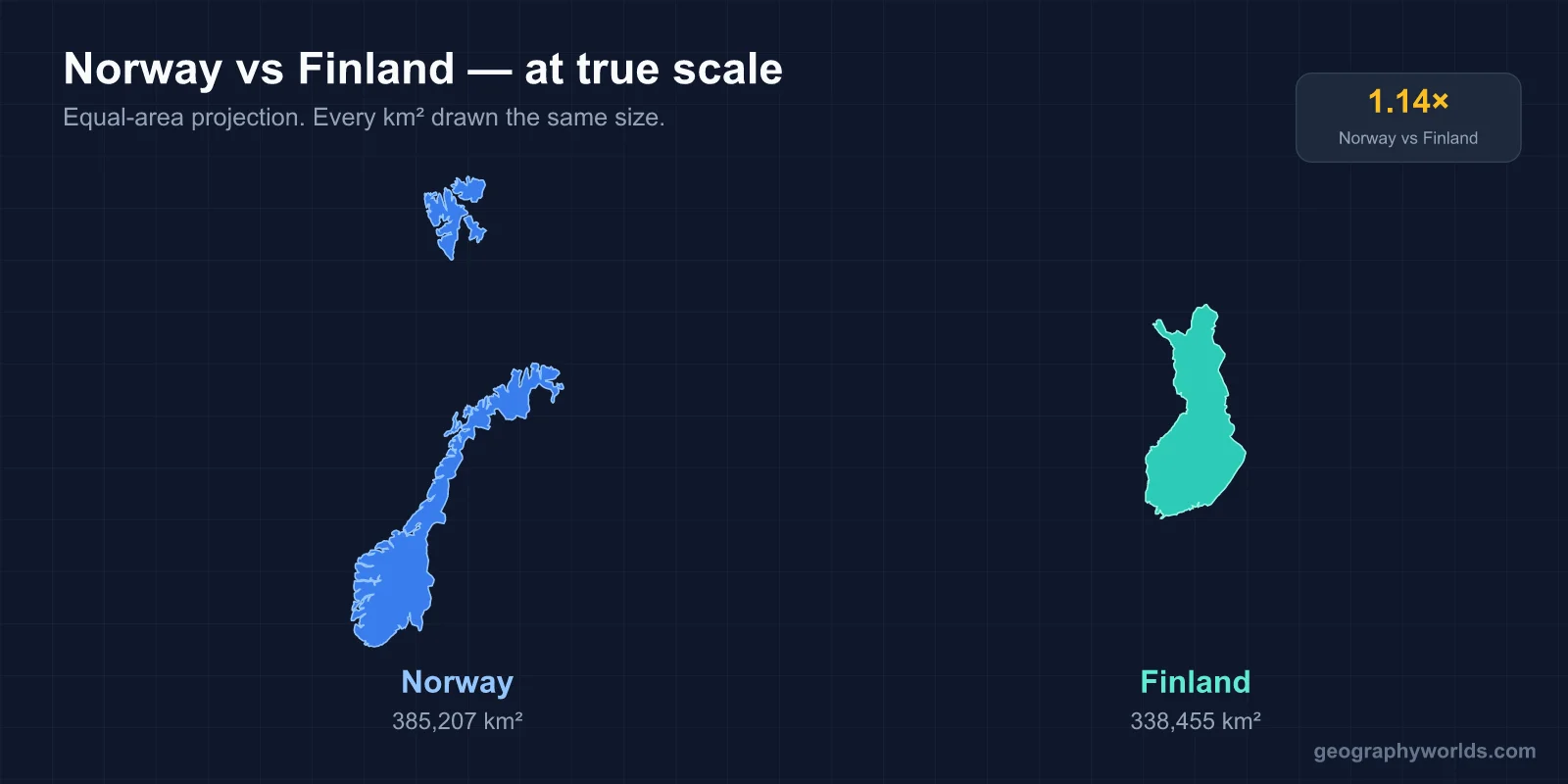
Yes. Norway is larger than Finland. Norway covers 385,207 km², while Finland covers 338,455 km². Norway is about 1.14 times the size of Finland — larger by 46,752 km², roughly the size of Denmark. Both have similar populations (~5.5 million each), making Norway slightly less densely populated.
The Short Answer
Norway and Finland are two of the five Nordic countries (along with Sweden, Denmark, and Iceland). The two countries share a 736-km border and similar Nordic cultural traditions, but they're also quite distinct — Norway is largely mountainous and fjord-rich, while Finland is mostly forest and lakes. Norway is famously connected to its 25,000+ km of coastline; Finland is famously connected to its 188,000 lakes.
Both are wealthy, developed democracies with strong social welfare systems, high quality of life, and Nordic models of governance. Both are NATO members (Finland joined in 2023, Norway is a founding member). Both have small populations relative to their territories.

The Real Numbers
- Norway total area: 385,207 km² (148,729 sq mi)
- Finland total area: 338,455 km² (130,678 sq mi)
- Difference: 46,752 km² — about the size of Denmark
- Ratio: Norway is about 1.14× the size of Finland
Population
Both have similar populations:
- Norway population: ~5,500,000
- Finland population: ~5,600,000
- Norway density: ~14 people per km²
- Finland density: ~17 people per km²
Finland has slightly more people than Norway. Both are among the most sparsely populated developed countries — about half the density of the United States, and much less dense than most European countries.
Geography
Norway is dominated by:
- The Scandinavian Mountains: Running the length of the country
- Fjords: Cut deeply into the western coast, including famous ones like Sognefjord (205 km long)
- Coastline: About 25,148 km counting all fjords and islands — among the longest in the world
- Hardangervidda: Europe's largest mountain plateau
- Lofoten Islands: Dramatic coastal archipelago
- Svalbard: Arctic archipelago (61,022 km²)
Finland is dominated by:
- Lakes: About 188,000 lakes, more than any country in Europe — Finland is sometimes called the "Land of a Thousand Lakes" (a vast understatement)
- Forests: About 75% of Finland is forested — one of the most forested countries in Europe
- Lakeland: Central region with thousands of lakes and waterways
- Lapland: Northern Finland, home to the Sami people and ski resorts
- Archipelago Sea: Southwestern coast with about 40,000 islands
- Highest peak: Halti (1,324 m), much lower than Norway's peaks
Climate
Norway has a varied climate. The western coast has a maritime climate, mild for its latitude due to the Gulf Stream (Bergen has winters similar to London). The interior and north are colder with significant snow. Arctic regions (above 70°N) have polar climate.
Finland has a continental and subarctic climate. Summers are short but can be warm (15-25°C). Winters are long and cold — northern Finland regularly drops below -30°C. Finland has more extreme seasonal swings than coastal Norway.
Economy
Norway has the larger economy and is richer per capita:
- Norway GDP: ~$485 billion
- Finland GDP: ~$300 billion
- Norway per capita GDP: ~$88,000
- Finland per capita GDP: ~$54,000
Norway's economy is about 60% larger than Finland's in absolute terms, and about 63% richer per capita. Norway has accumulated extraordinary wealth from North Sea oil and gas — the Norwegian Government Pension Fund is the world's largest sovereign wealth fund at about $1.5 trillion.
Finland's economy is heavily based on forestry, technology (Nokia originated here), shipping, and manufacturing. Finland has been moving toward services and innovation-based economy. The country is consistently ranked among the world's most innovative.
History
Norway was under Danish rule from 1380 to 1814, then under Swedish rule from 1814 to 1905, before becoming fully independent. Modern Norway has been a constitutional monarchy with a parliamentary democracy since 1905.
Finland was under Swedish rule from the 12th century until 1809, then a Grand Duchy of Russia until 1917 when it declared independence. Modern Finland is a parliamentary republic. Both countries have stayed out of the European Union currency (Norway is not in the EU; Finland uses the Euro).
Languages
Norwegian and Swedish are mutually intelligible, but Finnish is completely different — Finnish is a Finno-Ugric language, related to Estonian and Hungarian, not to Norwegian or Swedish. Finland has two official languages — Finnish and Swedish (about 5% of Finns speak Swedish as a first language). Norway has Bokmål and Nynorsk as two written forms of Norwegian, plus Sami languages in the north.
Quality of Life
Both rank consistently high on global quality-of-life rankings. Finland has often topped the World Happiness Report; Norway is also typically in the top 10. Both have excellent healthcare, education, low corruption, gender equality, and political stability. Both Nordic countries are widely studied as models of social democracy and welfare-state design.
Key Facts
- Norway is about 1.14× the size of Finland.
- Both have similar populations (~5.5 million each).
- Norway's economy is 60% larger; Norway is 63% richer per capita.
- Norway has the world's largest sovereign wealth fund.
- Finland has about 188,000 lakes — more than any other country in Europe.
Fun Facts
- Norway has the longest coastline in Europe by some measurements when including all fjords.
- Finland has the most saunas per capita in the world — about 2 million saunas for 5.6 million people.
- Both countries celebrate Midsummer with bonfires and outdoor festivities.
- Norway invented modern skiing — the word "ski" is from Old Norse.
- Finland gave the world Nokia, Angry Birds, and the modern educational system that consistently ranks at the top of international comparisons.
- Both countries have substantial Sami populations in their northern regions, with distinct indigenous cultures.
Education and Healthcare
Both have excellent public education and healthcare systems. Finland's education system is consistently among the world's best, regularly ranking at the top of PISA international student assessments. The Finnish approach emphasizes equality, teacher autonomy, and reduced standardized testing. Finland also has universal healthcare with excellent outcomes.
Norway has similar high-quality public education and a comprehensive welfare state. Norwegian universities are tuition-free for all students (including international students until recent changes). Both countries demonstrate that high taxation can fund excellent public services and high quality of life — a "Nordic model" that has influenced policy debates worldwide.
Environment and Climate
Both countries are leaders in environmental policy. Norway has used its oil wealth to fund renewable energy and conservation. The country has the world's highest electric vehicle penetration — over 80% of new car sales are electric. Norway aims to be a "low-emission society" by 2050.
Finland has been a leader in forest management and renewable energy. About 75% of Finland is forested, and the country has strong policies on sustainable forestry. Finland generates a significant portion of electricity from wood and other biomass, plus nuclear and hydroelectric. The country aims to be carbon-neutral by 2035 — among the most ambitious goals globally.
The Bottom Line
Norway is bigger than Finland by area (14%), but both are similarly populated Nordic countries with high quality of life. Norway is richer per capita due to oil wealth; Finland has its own strong economy based on forestry, tech, and innovation. Both share the Nordic model of social democracy, both prize quality of life, and both have strong national identities. Their geographic neighborhood and shared Nordic traditions make them natural partners despite distinct cultures, languages, and economic structures. As fellow members of NATO (Finland joined in 2023), the Nordic Council, and other regional bodies, Norway and Finland represent the success of small-population Nordic countries on the world stage. They will continue to influence global discussions of social democracy, environmental policy, and innovation for decades to come. The Norwegian-Finnish relationship has also been strengthened by their shared border and complementary economies. While Norway focuses heavily on oil, gas, and shipping, Finland's economy is more diversified into technology and forestry. Together with Sweden and Denmark, they form the core Nordic bloc — a small but globally influential group of countries that consistently ranks at the top of global indices for prosperity, equality, and quality of life. Norway and Finland exemplify how Nordic geography, history, and policy choices have produced exceptional outcomes. Both face common challenges related to aging populations, climate change, and the changing geopolitical landscape of northern Europe — issues they will navigate alongside other Nordic countries and the broader European community. Their success offers lessons for other small nations seeking to balance prosperity, equality, and sustainability. The Norway-Finland comparison reminds us that geographic neighbors can develop very differently while still sharing core values, and that smart policy choices can compound over generations into truly exceptional outcomes.
Quiz Nordic Countries!
Test your knowledge of Norway, Finland, and Scandinavia.
Play Geography Games →